Integration of Allure Report with Robot Framework

Last Updated on

HOME

In this tutorial, we will discuss the integration of Allure Report with the Robot Framework.

Table of Contents:

  1. What is Allure Report?
  2. Prerequisite
  3. Implementation Steps
    1. Create a new project
    2. Install allure-robotframework plugin
    3. Add allure-robotframework package to the PyCharms
    4. Create 3 new directories in the new project
    5. Create the test code
    6. Execute the tests
    7. View Report and Log
    8. Generate the Allure Report
    9. Allure Report Dashboard
    10. Categories in Allure Report
    11. Suites in Allure Report
    12. Graphs in Allure Report
    13. Timeline in Allure Report
    14. Behaviours of Allure Report
    15. Packages in Allure Report

What is Allure Report?

Allure Framework is a flexible lightweight multi-language test report tool that not only shows a very concise representation of what has been tested in a neat web report form but allows everyone participating in the development process to extract maximum useful information from everyday execution of tests.

From the dev/qa perspective, Allure reports shorten common defect lifecycle: test failures can be divided into bugs and broken tests, also logs, steps, fixtures, attachments, timings, history, and integrations with TMS and bug-tracking systems can be configured, so the responsible developers and testers will have all information at hand.

Prerequisite:

  1. Install Python
  2. Install PIP
  3. Install Robot Framework
  4. Install Robot framework Selenium Library
  5. Install PyCharm IDE

Please refer to this tutorial to install Robot Framework – How to install and setup Robot Framework for Python.

Implementation Steps:

Step 1 – Create a new project

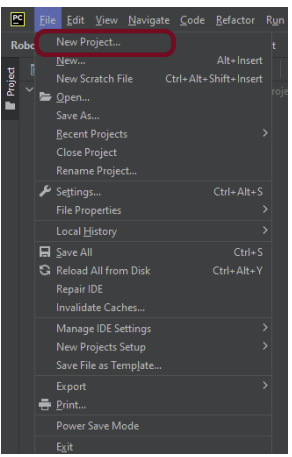
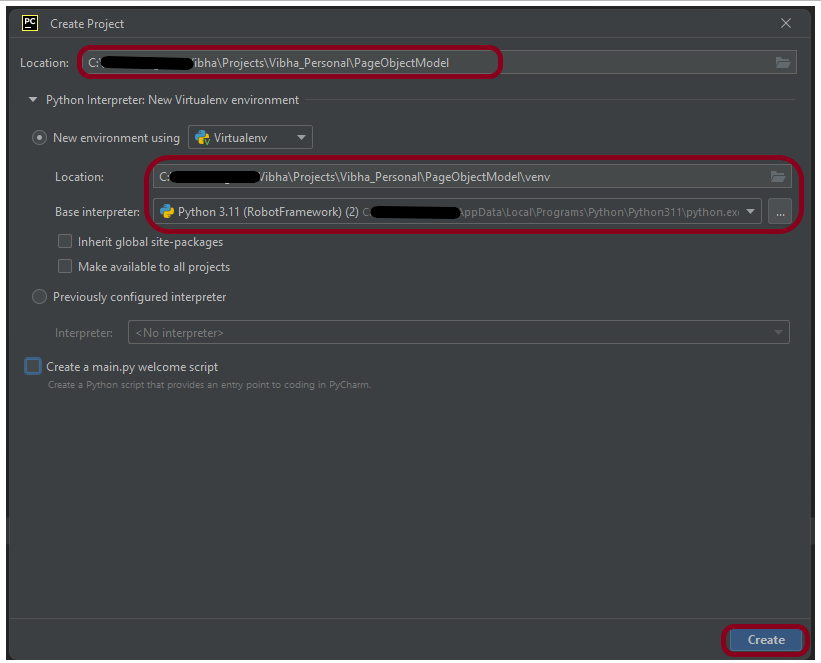
Step 1.1 – Open PyCharm and create a new project. Go to File and select New Project from the main menu.
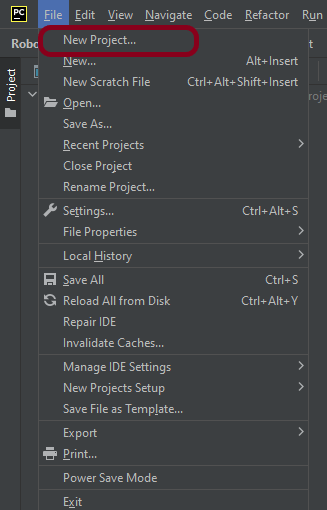
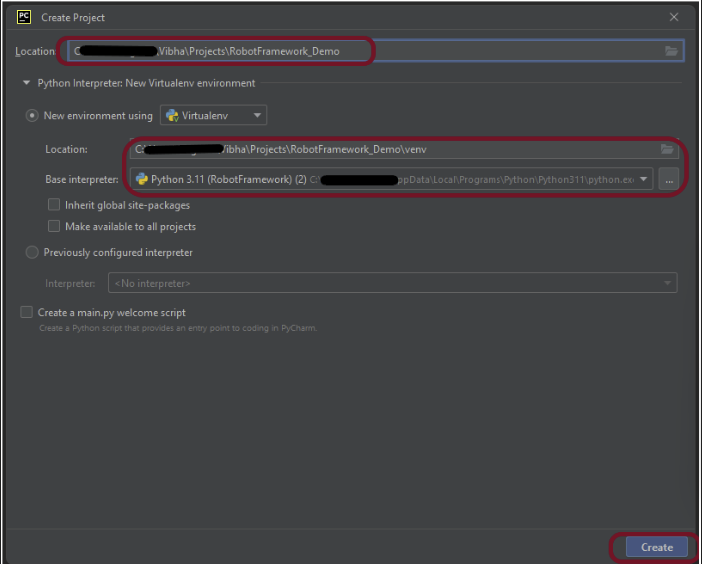
Step 1.2 – Choose the project location. Click the “Browse” button next to the Location field and specify the directory for your project.

Deselect the Create a main.py welcome script checkbox because you will create a new Python file for this tutorial.
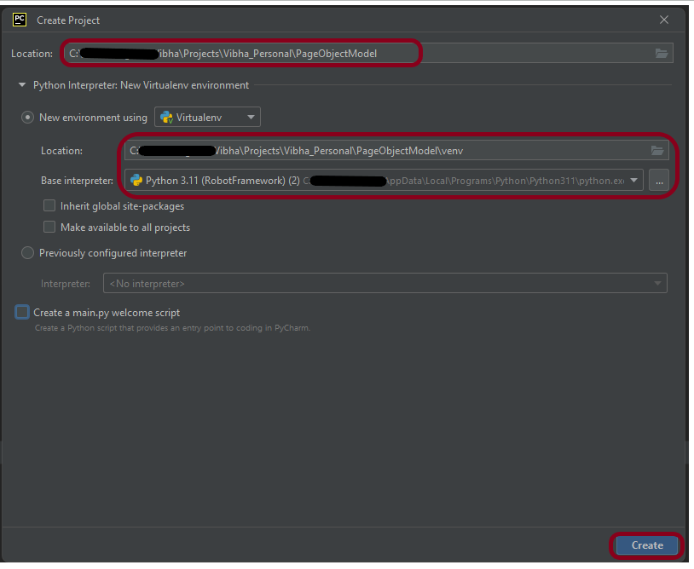
Click on the “Create” Button.

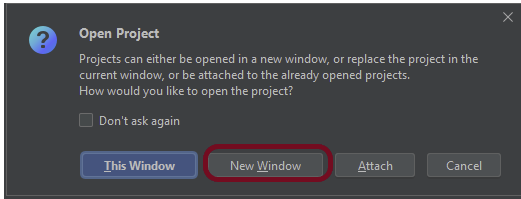
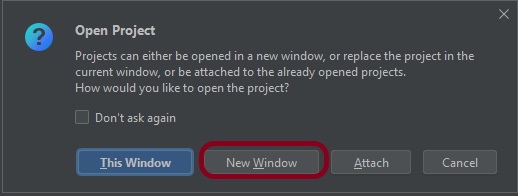
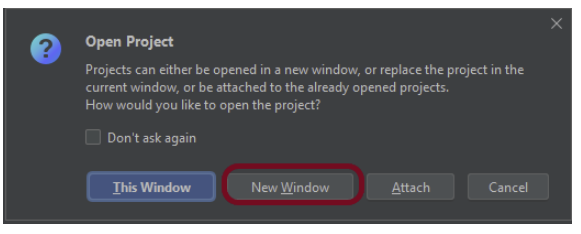
Step 1.3 – A new dialog appears asking to open the project using any one of the given options. I have selected New Window as I like to have separate windows for each project.
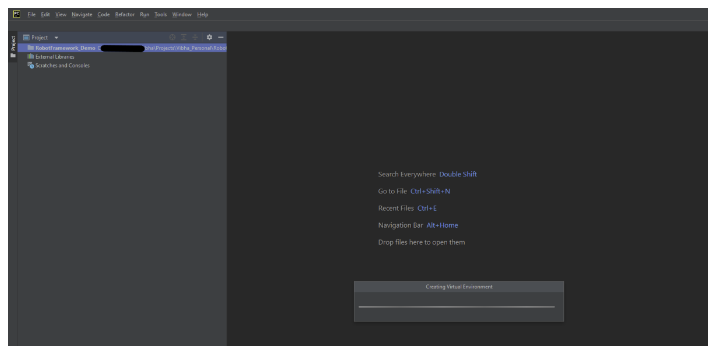
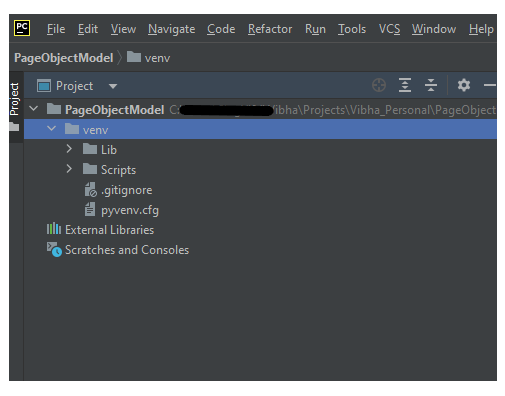
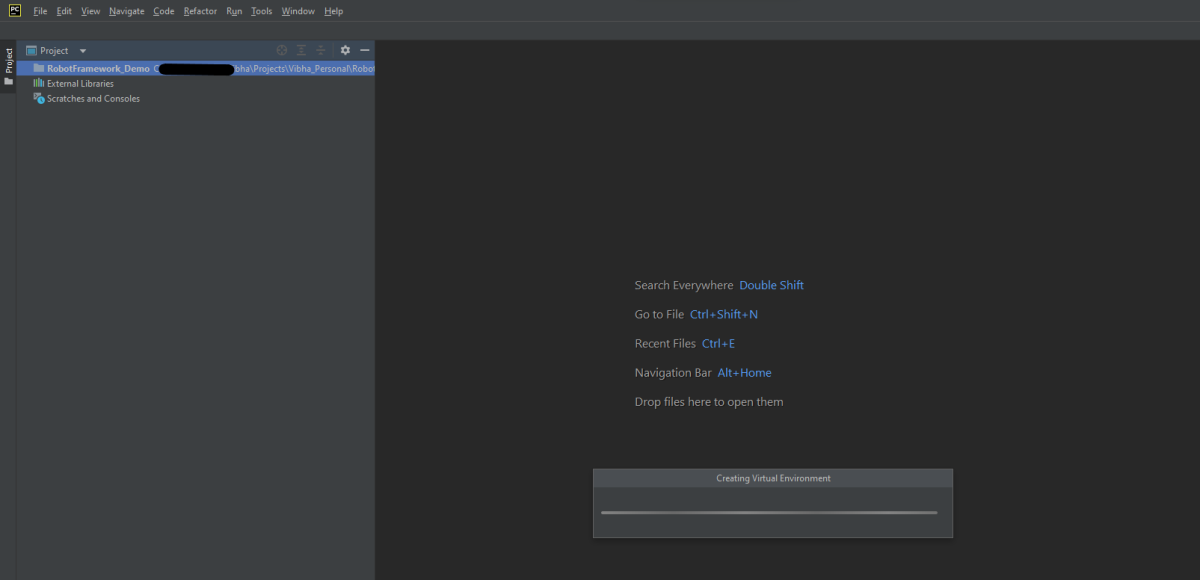
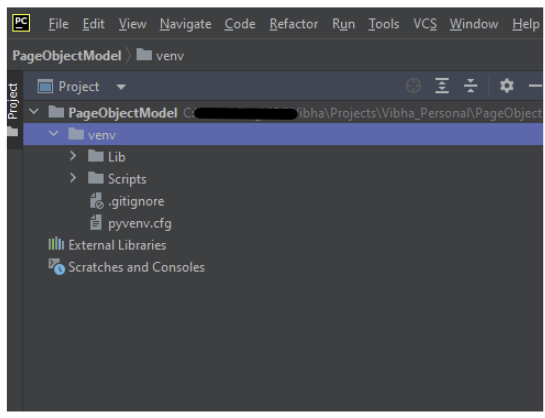
Below is the image of the new project created in PyCharms.

Step 2 – Install allure-robotframework plugin

Go to the command prompt and run the below-mentioned command to download the plugin:

pip install allure-robotframework

The below image shows that the plugin is installed successfully.

Step 3 – Add allure-robotframework package to the PyCharms

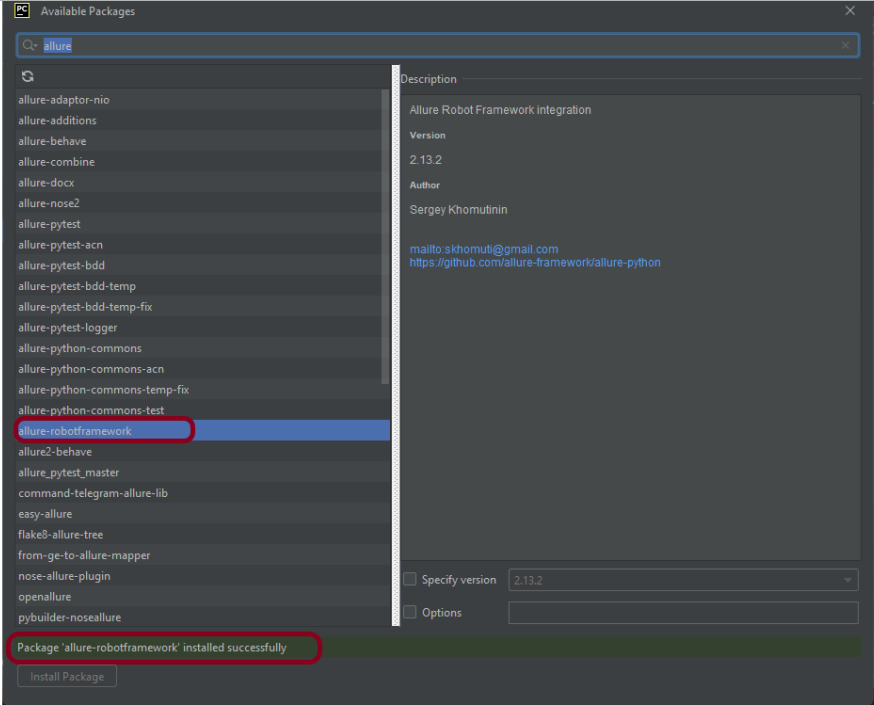
Go to File->Settings ->Project:RobotFramework_Demo ->Python Interpreter.

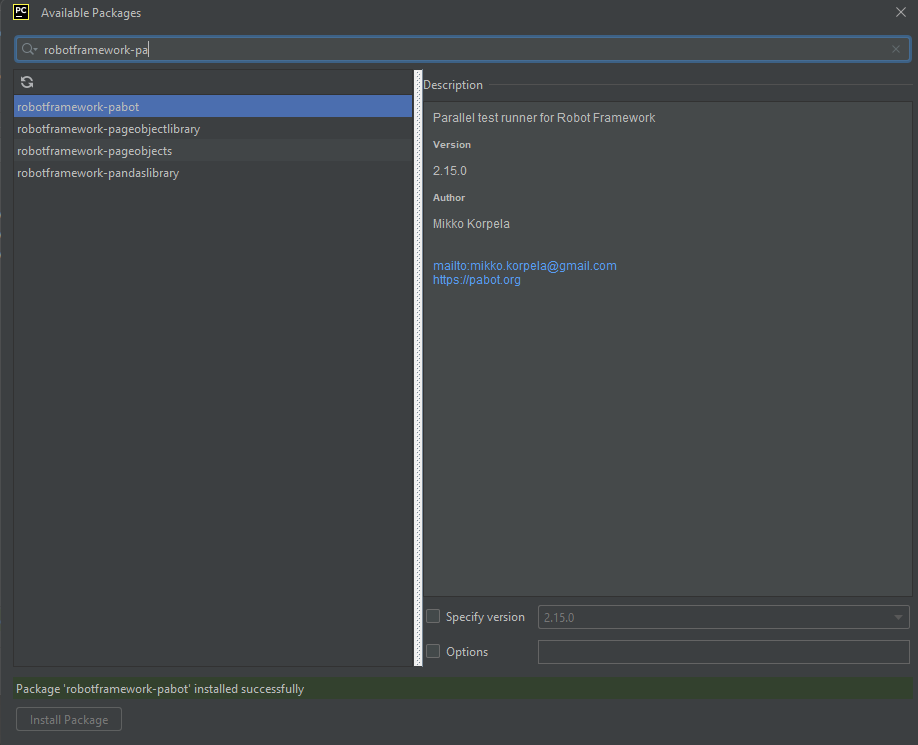
Click on the “+” sign and enter allure-r in the search bar. It will show a list of packages. Select the “allure-robotframework” package and click on the “Install Package”.

Once the package is installed, we will see the message that the package is installed successfully.
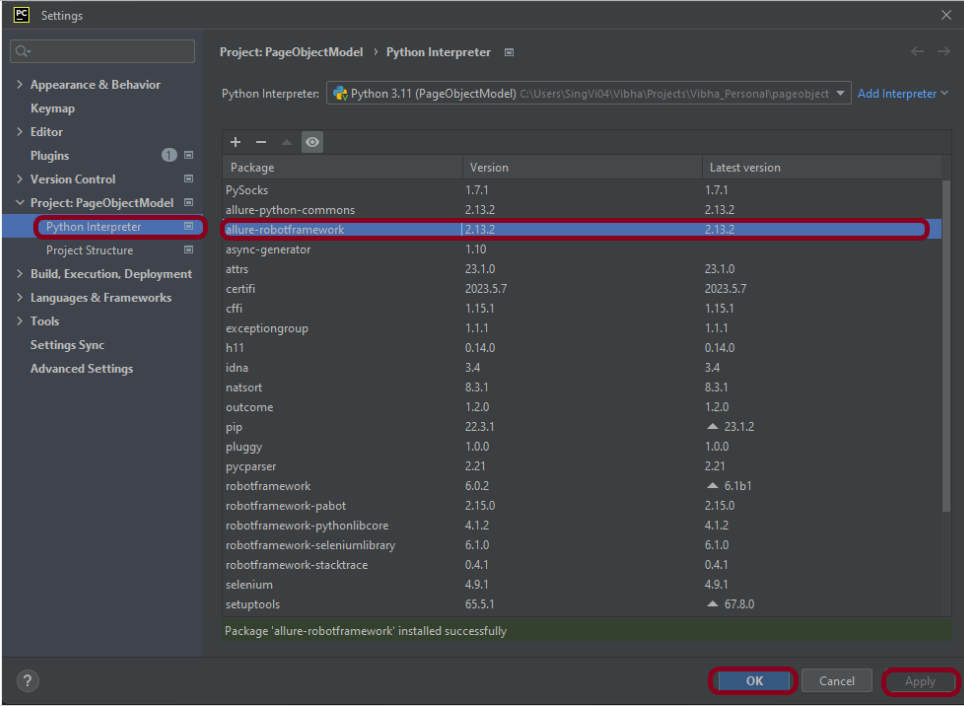
Once the package is installed, it can be seen under the package list as shown below:
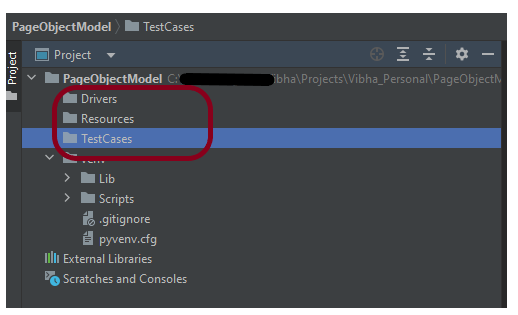
Step 4 – Create 3 new directories in the new project

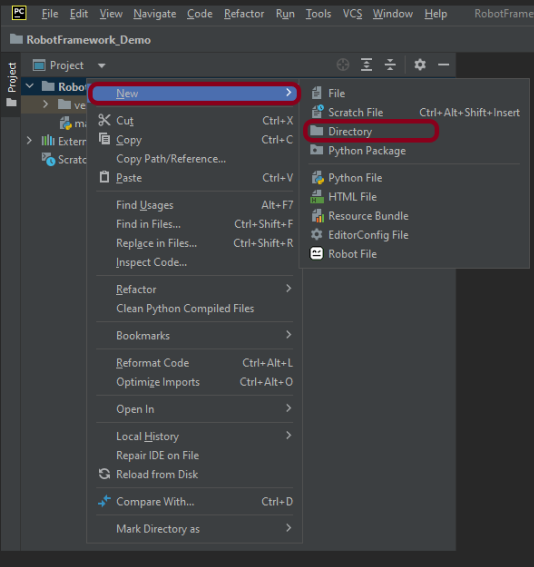
Right-Click on the project, select New->Directory and provide the name as TestCases, Drivers, and Resources
Step 5 – Create the test code

To know the framework, tests, and corresponding keywords can be referred from here – Page Object Model in the Robot Framework.

Step 6 – Execute the tests

We need the below command to run the Robot Framework script using Allure listener.

 robot --listener allure_robotframework --outputdir ./output/robot ./TestCases

The output of the above program is

Step 7 – View Report and Log

We have the test case passed. The Robot Framework generates log.html, output.xml, and report.html by default.

These reports are generated in the output/robot folder as I have provided –outputdir ./output/robot in the command line.

Let us now see the report and log details.

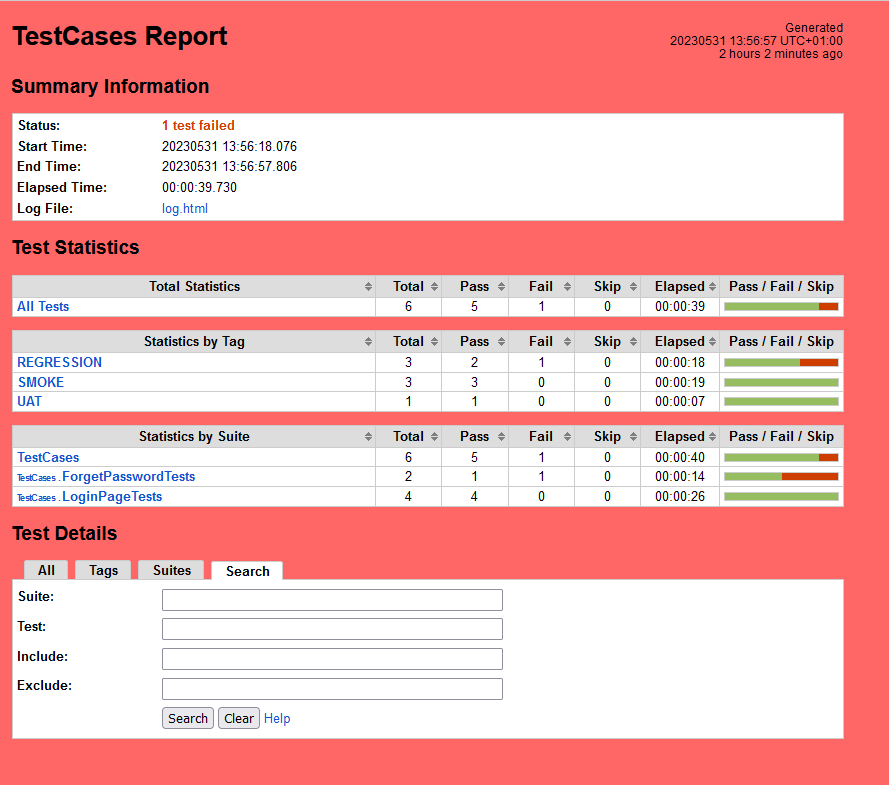
Report

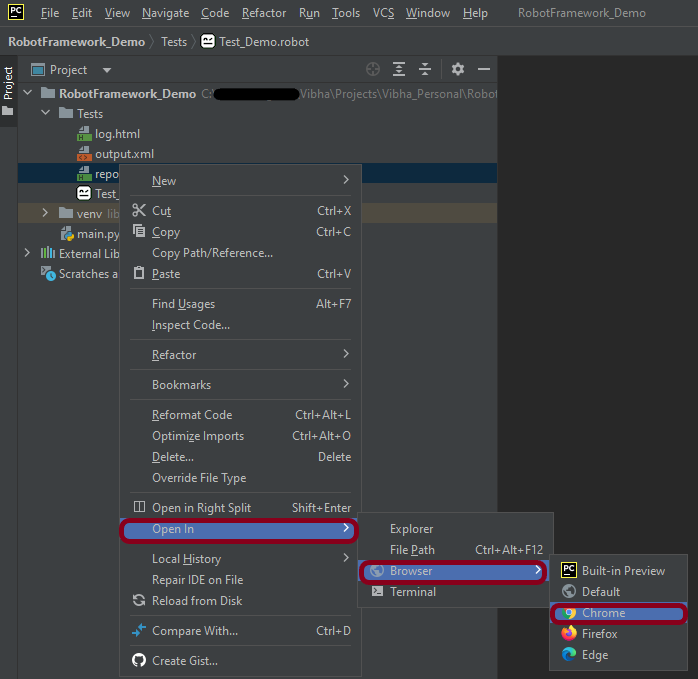
Right-click on report.html. Select Open In->Browser->Chrome(any browser of your wish).

As one of the tests purposefully failed to demonstrate how the report would look in the event of a failure, we can see that it is now a Red report. The framework generated the following report:
Log

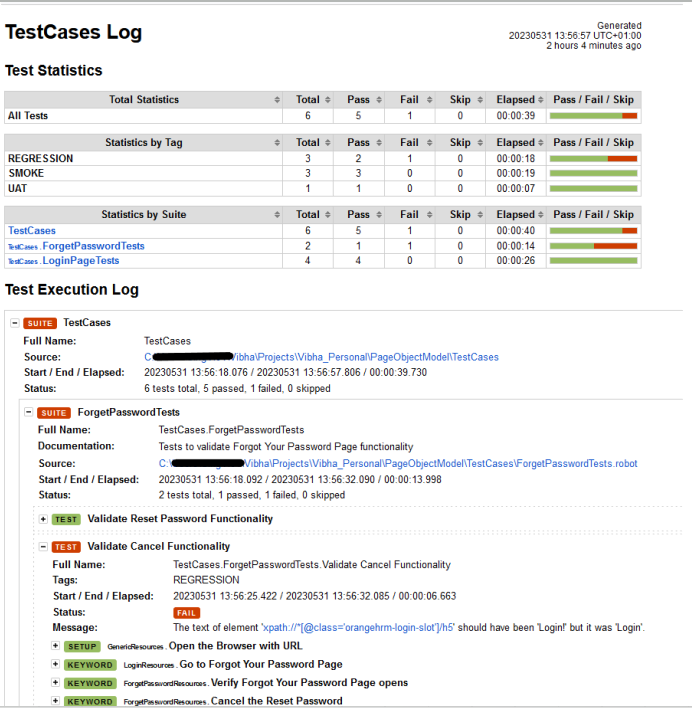
Robot Framework has multiple log levels that control what is shown in the automatically generated log file. The default Robot Framework log level is INFO.

Right-click on log.html. Select Open In->Browser->Chrome(any browser of your wish).
Step 8 – Generate the Allure Report

To create Allure Report, use the below command

 allure serve ./output/allure

This will generate the beautiful Allure Test Report as shown below.

Step 9 – Allure Report Dashboard

The overview page hosts several default widgets representing the basic characteristics of your project and test environment.

  1. Statistics – overall report statistics.
  2. Launches – if this report represents several test launches, statistics per launch will be shown here.
  3. Behaviours – information on results aggregated according to stories and features.
  4. Executors – information on test executors that were used to run the tests.
  5. History Trend – if tests accumulated some historical data, it’s trend will be calculated and shown on the graph.
  6. Environment – information on the test environment.

Categories in Allure Report

The categories tab gives you a way to create custom defect classifications to apply for test results. There are two categories of defects – Product Defects (failed tests) and Test Defects (broken tests).

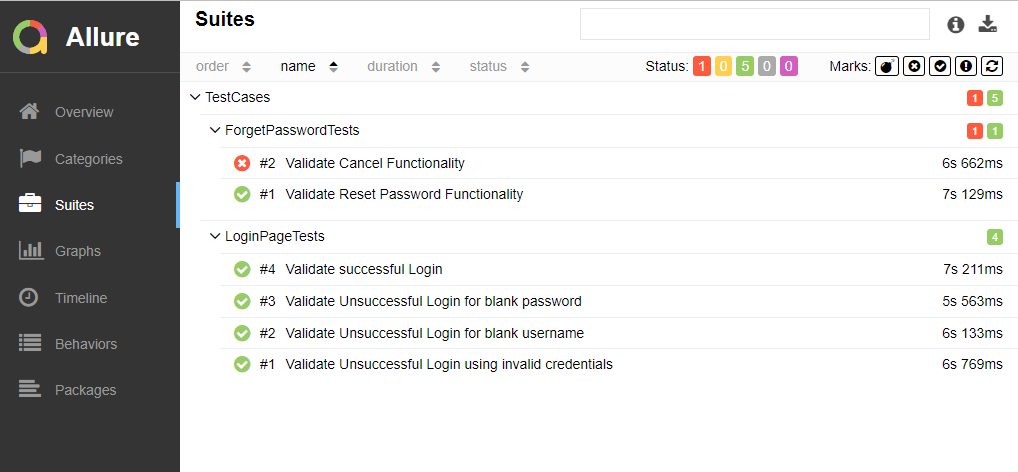
Suites in Allure Report

On the Suites tab a standard structural representation of executed tests, grouped by suites and classes can be found.
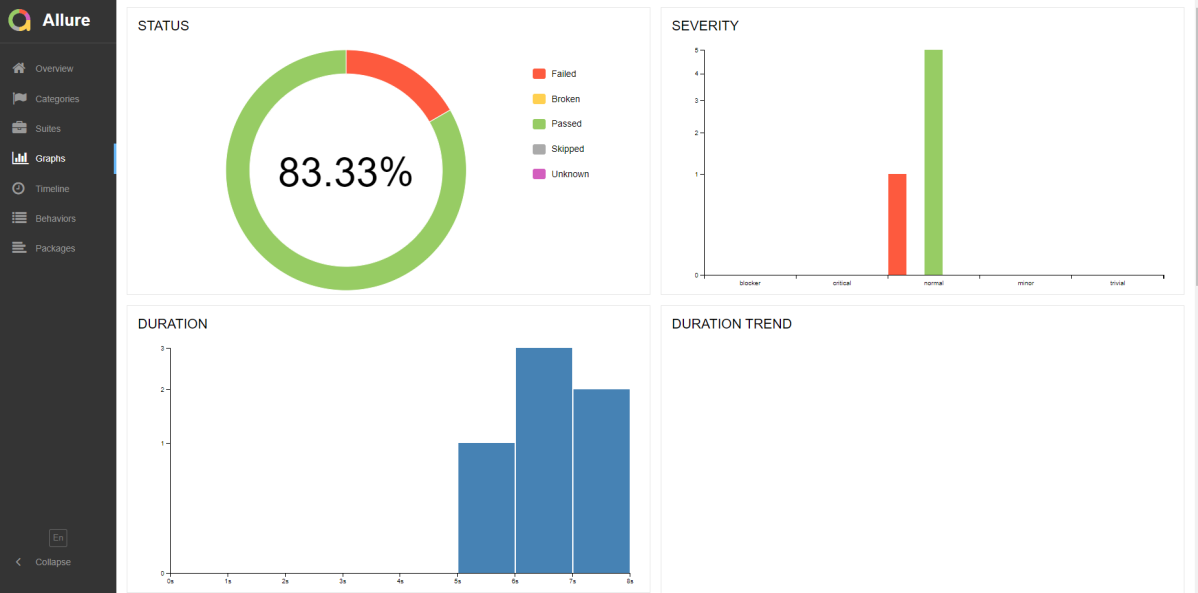
Graphs in Allure Report

Graphs allow you to see different statistics collected from the test data: statuses breakdown or severity and duration diagrams.
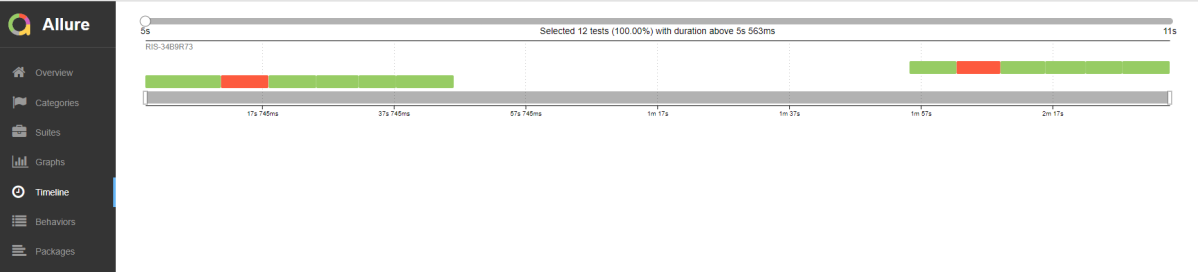
Timeline in Allure Report

The timeline tab visualizes retrospective of tests execution, allure adaptors collect precise timings of tests, and here on this tab, they are arranged accordingly to their sequential or parallel timing structure.
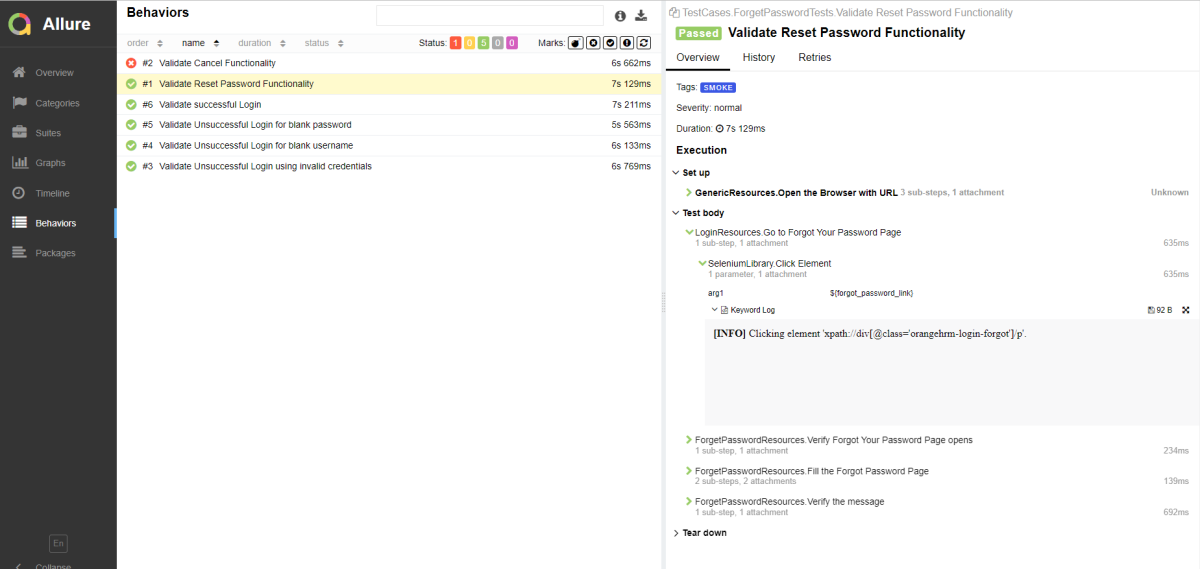
Behaviours of Allure Report

This tab groups test results according to Epic, Feature, and Story tags.
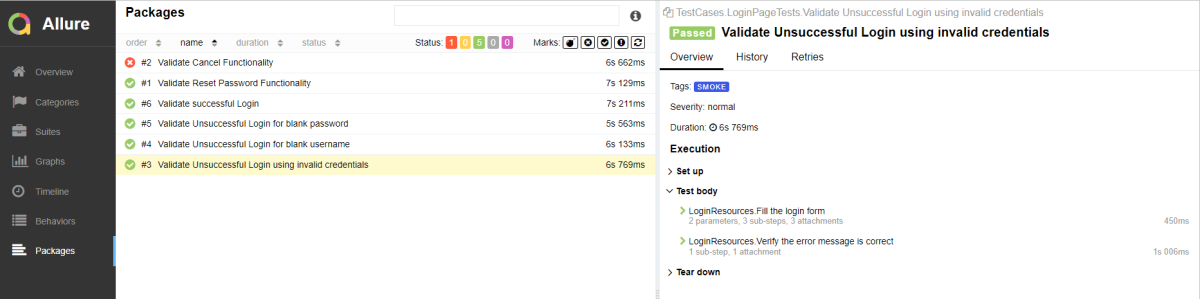
Packages in Allure Report

The packages tab represents a tree-like layout of test results, grouped by different packages.
That’s it! Congratulations on making it through this tutorial and hope you found it useful! Happy Learning!!

Run Robot Framework Tests in GitLab CI/CD

Last Updated On

HOME

This tutorial walks you through the process of running Robot Framework tests in GitLab pipelines. This is a very important step in achieving CI/CD. Ideally, tests should be run after each change (minor/major) before the latest change is merged into the master branch. Let’s assume that 100 changes are merged into the master branch a day and tests are run every time before deployment. In this case, there is no QA manually starting 100 tests a day. Now, what should be done to overcome this problem. Now add a test to your GitLab pipeline. Adding a test stage to your pipeline automatically runs the tests when you run the pipeline. 

Table of Contents

  1. What is GitLab CI/CD Workflow?
  2. What is a headless browser?
  3. Prerequisite
  4. Implementation Steps:
    1. Create a new Project
    2. Create 2 new directories in the new project
    3. Create Test Files
    4. Create Resources file for each page
    5. Execute the tests
  5. GitLab Section
    1. Create a blank project in GitLab
    2. Push the project from local repository to Gitlab Repository
    3. Create a .gitlab-ci.yml file in the project in GitLab
    4. Run the tests in the GitLab pipeline
    5. Check the status of the pipeline
    6. Download the report

What is GitLab CI/CD Workflow?

Once the proposed changes are built, then push the commits to a feature branch in a remote repository that’s hosted in GitLab. The push triggers the CI/CD pipeline for your project. Then, GitLab CI/CD runs automated scripts (sequentially or in parallel) to build as well as to test the application. After a successful run of the test scripts, GitLab CI/CD deploys your changes automatically to any environment (DEV/QA/UAT/PROD). But if the test stage is failed in the pipeline, then the deployment is stopped.

To use GitLab CI/CD, we need to keep 2 things in mind:

a) Make sure a runner is available in GitLab to run the jobs. If there is no runner, install GitLab Runner and register a runner for your instance, project, or group.

b) Create a .gitlab-ci.yml file at the root of the repository. This file is where CI/CD jobs are defined.

The Selenium tests run on a headless browser in the pipeline.

What is a headless browser?

A headless browser is like any other browser but without a Head/GUI (Graphical User Interface).  A headless browser is used to automate the browser without launching the browser. While the tests are running, we could not see the browser, but we can see the test results coming on the console.

Prerequisite

  1. Install Python
  2. Install PIP
  3. Install Robot Framework
  4. Install Robot framework Selenium Library
  5. Install PyCharm IDE
  6. GitLab Account

Implementation Steps:

Step 1 – Create a new Project

Step 1.1 – Open PyCharm and create a new project. Go to File and select New Project from the main menu.

Step 1.2 – Choose the project location. Click the Browse button next to the Location field and specify the directory for your project.

Deselect the Create a main.py welcome script checkbox because you will create a new Python file for this tutorial.

Click on the Create Button.

Step 1.3 – A new dialog will appear asking to Open the project using any one of the given options. I have selected New Window as I like to have separate windows for each project.

Below is the image of the new project created in PyCharms.

Step 2 – Create 2 new directories in the new project

Right-Click on the project, select New->Directory, and provide the name as TestCases and Resources

Step 3 – Create Test Files

This directory contains multiple test case files consisting of test steps. 

Right-click on the new directory select New File and provide the name LoginPageTests.robot and ForgetPasswordTests.robot as shown below:

Below is the code for LoginPageTests.robot

*** Settings ***
Documentation       Tests to login to Login Page
Library     SeleniumLibrary
Test Setup      Open the Browser with URL
Test Teardown   Close Browser Session
Resource       ../Resources/GenericResources.robot
Resource       ../Resources/LoginResources.robot
Resource      ../Resources/DashboardResources.robot

*** Test Cases ***

Validate Unsuccessful Login using invalid credentials

    LoginResources.Fill the login form     ${valid_username}       ${invalid_password}
    LoginResources.Verify the error message is correct


Validate Unsuccessful Login for blank username

     LoginResources.Fill the login form     ${blank_username}       ${valid_password}
     LoginResources.Verify the error message is displayed for username


Validate Unsuccessful Login for blank password

     LoginResources.Fill the login form     ${valid_username}       ${blank_password}
     LoginResources.Verify the error message is displayed for password


Validate successful Login

    LoginResources.Fill the login form     ${valid_username}       ${valid_password}
    DashboardResources.Verify Dashboard page opens

Below is the code for ForgetPasswordTests.robot

*** Settings ***
Documentation       Tests to validate Forgot Your Password Page functionality
Library     SeleniumLibrary
Test Setup      Open the Browser with URL
Test Teardown   Close Browser Session
Resource       ../Resources/GenericResources.robot
Resource       ../Resources/LoginResources.robot
Resource      ../Resources/ForgetPasswordResources.robot


*** Test Cases ***

Validate Reset Password Functionality

    LoginResources.Go to Forgot Your Password Page
    ForgetPasswordResources.Verify Forgot Your Password Page opens
    ForgetPasswordResources.Fill the Forgot Password Page
    ForgetPasswordResources.Verify the message

Validate Cancel Functionality

    LoginResources.Go to Forgot Your Password Page
    ForgetPasswordResources.Verify Forgot Your Password Page opens
    ForgetPasswordResources.Cancel the Reset Password
    ForgetPasswordResources.Verify that Login Page is displayed

Step 4 – Create a Resource file for each page

It maintains the files which contain page elements as well as corresponding keywords. 

Right-click on the new directory select New File and provide the name as LoginResources.robot, DashboardResources.robot, GenericResources.robot, and ForgetPasswordResources.robot as shown below:

GenericResources.robot contains the keywords that are common to all the tests, like opening of the browser or closing of the browser.

*** Settings ***
Documentation    A resource file with reusable keywords and variables.
Library     SeleniumLibrary

*** Variables ***
${valid_username}     Admin
${valid_password}       admin123
${invalid_username}     1234
${invalid_password}     45678
${blank_username}
${blank_password}
${url}      https://opensource-demo.orangehrmlive.com/web/index.php/auth/login
${browser_name}      Chrome

*** Keywords ***

Open the Browser with URL
    Open Browser   ${url}    headlesschrome
    Maximize Browser Window
    Set Selenium Implicit Wait    5

Close Browser Session
    Close Browser

Below is the code for LoginResources.robot

*** Settings ***
Documentation        All the page objects and keywords of landing page
Library     SeleniumLibrary

*** Variables ***
${login_error_message}      css:.oxd-alert-content--error
${dashboard_title}       css:.oxd-topbar-header-breadcrumb-module
${missing_username_error_message}    xpath://*[@class='oxd-form']/div[1]/div/span
${missing_password_error_message}   xpath://*[@class='oxd-form']/div[2]/div/span
${forgot_password_link}   xpath://div[@class='orangehrm-login-forgot']/p

*** Keywords ***

Fill the login form
    [Arguments]    ${username}      ${password}
   Input Text    css:input[name=username]   ${username}
   Input Password    css:input[name=password]   ${password}
   Click Button    css:.orangehrm-login-button


Verify the error message is correct
    Element Text Should Be    ${login_error_message}    Invalid credentials


Verify the error message is displayed for username
     Element Text Should Be    ${missing_username_error_message}      Required

Verify the error message is displayed for password
      Element Text Should Be    ${missing_password_error_message}      Required

Go to Forgot Your Password Page
    Click Element      ${forgot_password_link}

Below is the code for DashboardResources.robot

*** Settings ***
Documentation        All the page objects and keywords of Dashboard page
Library     SeleniumLibrary

*** Variables ***
${dashboard_title}       css:.oxd-topbar-header-breadcrumb-module

*** Keywords ***

Verify Dashboard page opens
    Element Text Should Be    ${dashboard_title}      Dashboard

Below is the code for ForgetPasswordResources.robot

*** Settings ***
Documentation       All the page objects and keywords of Forget Password page
Library     SeleniumLibrary

*** Variables ***
${forgot_page_title}       css:.orangehrm-forgot-password-title
${username}     css:.oxd-input--active
${reset_btn}     css:.orangehrm-forgot-password-button--reset
${cancel_btn}    css:.orangehrm-forgot-password-button--cancel
${reset_message}      xpath://div[@class='orangehrm-card-container']/h6
${login_page_title}   xpath://*[@class='orangehrm-login-slot']/h5

*** Keywords ***

Verify Forgot Your Password Page opens
    Element Text Should Be    ${forgot_page_title}      Reset Password

Fill the Forgot Password Page
   Input Text        ${username}     abc@gmail.com
   Click Button    ${reset_btn}

Verify the message
    Element Text Should Be    ${reset_message}      Reset Password link sent successfully

Cancel the Reset Password
    Click Button    ${cancel_btn}

Verify that Login Page is displayed
    Element Text Should Be    ${login_page_title}       Login

All the below-mentioned keywords are derived from SeleniumLibrary. The functionality of keywords mentioned above:

1. Create Webdriver − The keyword creates an instance of Selenium WebDriver.

2. Go To – This keyword navigates the current browser window to the provided url.

3. Maximize Browser Window – This keyword maximizes the current browser window.

4. Set Selenium Implicit Wait – This keyword sets the implicit wait value used by Selenium.

5. Input Text − This keyword is used to type the given text in the specified textbox identified by the locator name:username.

6. Input Password – This keyword is used to type the given text in the specified password identified by the locator name:password.

The difference compared to Input Text is that this keyword does not log the given password on the INFO level.

7. Click button – This keyword is used to click the button identified by the locator. In this case, it is “Login” button.

8. Element Text Should Be – This keyword is used to verify that the current page contains the exact text identified by the locator. Here, we are checking the exact text “Invalid Credentials”.

These keywords are present in SeleniumLibrary. To know more about these keywords, please refer to this document – https://robotframework.org/SeleniumLibrary/SeleniumLibrary.htm.

To run this script, go to the command line and go to directory tests.

Step 5 – Execute the tests

We need the below command to run the Robot Framework script.

robot .

The output of the above program is

GitLab Section

Step 6 – Create a blank project in GitLab

To know, how to create a blank new project in GitLab, please refer to this tutorial.

Step 7 – Push the project from the local repository to the Gitlab Repository

To know, how to push the changes in GitLab, please refer to this tutorial.

Step 8 – Create a .gitlab-ci.yml file in the project in GitLab

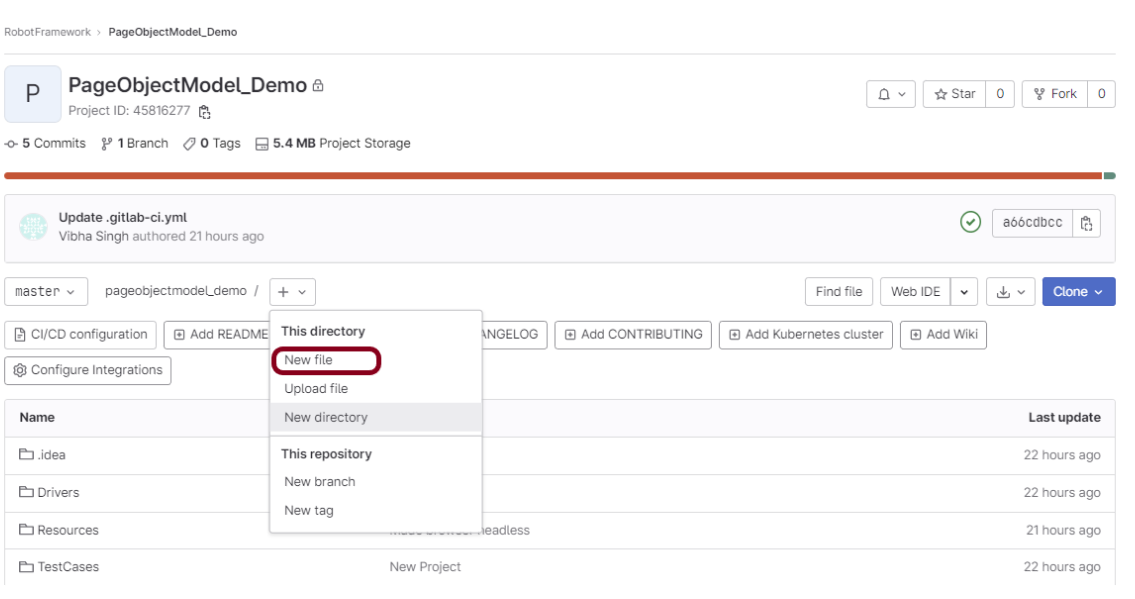
There are many ways to create a new file in GitLab. One of the ways is to create a file as shown in the below image.

It is a YAML file where you configure specific instructions for GitLab CI/CD. In the .gitlab-ci.yml, we can define:

  • The scripts you want to run.
  • Other configuration files and templates you want to include.
  • Dependencies and caches.
  • The commands you want to run in sequence and those you want to run in parallel.
  • The location to deploy your application to.
  • Whether you want to run the scripts automatically or trigger any of them manually.

Below is the sample pipeline.

stages:
  - test

image: ppandiyan/robotframework

run-tests:
  stage: test
  script:
    - robot --outputdir testOutput .
  artifacts:
    paths:
      - testOutput
    expire_in: 1 day

Image – ppandiyan/robotframework is used in this test. This docker file contains headlesschrome, headlessfirefox and Python2.7.

This gitlab-ci.yml has only 1 stage – a test that contains the command to run the tests as well as also create an artifact that contains all the surefire reports which can be saved as Test Evidence.

Step 9 – Run the tests in the GitLab pipeline

Now, when a new change is committed, a pipeline kicks off and it runs all the tests.

Step 10 – Check the status of the pipeline

Once the Status of the pipeline changes to either failed or passed that means the tests are already executed.

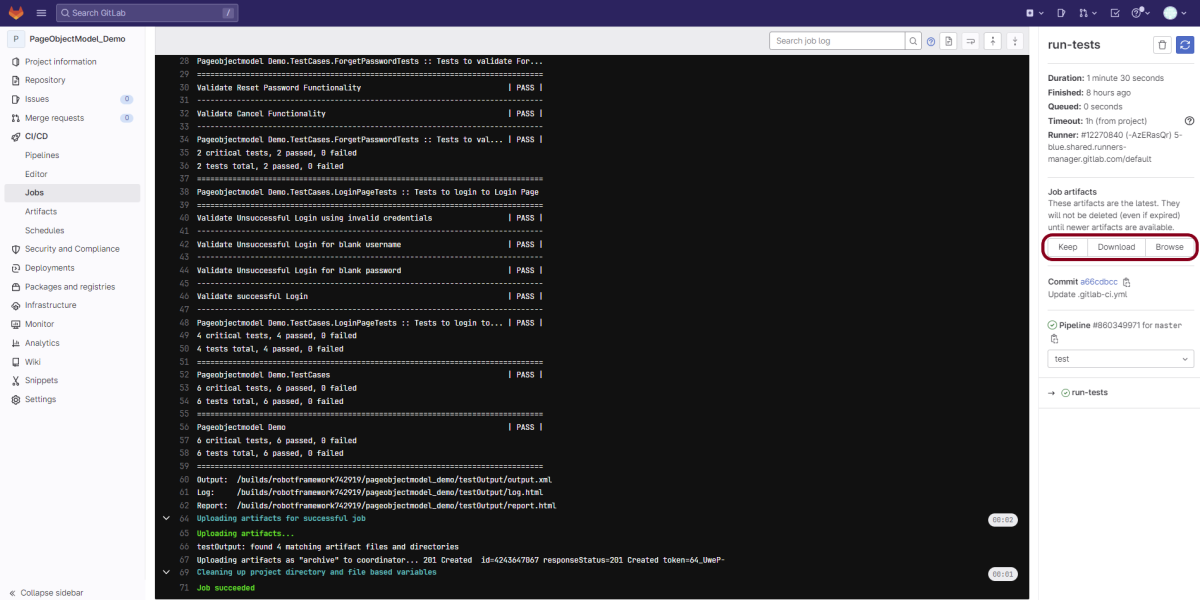
Let us see the logs of the execution it shows that all the tests are passed here.

As I have added an artifact also in the gitalb-ci.yml, which is highlighted in the image. This artifact creates a folder with the name “testOutput” and the folder contains reports, logs as well as output files. This artifact gives us the option to download the reports or browse the report. This report will be available for 1 day only as mentioned in the gitlab-ci.yml.

Step 11 – Download the report

Once, will click on the download button, it will download “report.zip”. Unzip the folder and it looks like something as shown below:

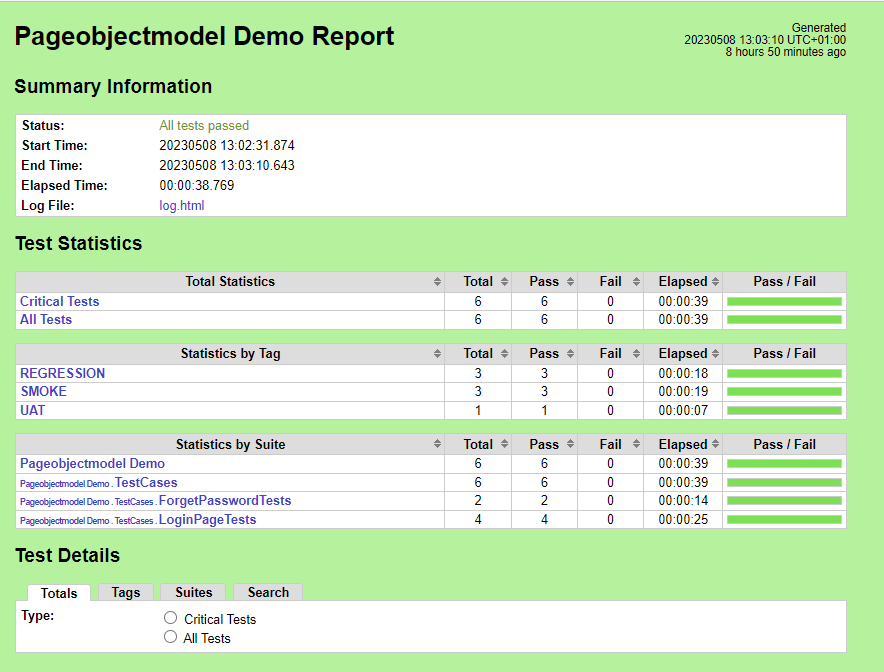
Example of Report.html

Example of Log.html

Congratulations. This tutorial has explained the steps to run Robot Framework tests in GitLab CI/CD. Happy Learning!!

How to perform API Testing in Robot Framework using RequestLibrary

HOME

In this article, we will discuss in detail how we can perform API testing in Robot Framework

Prerequisite:

  1. Install Python
  2. Install PIP
  3. Install Robot Framework
  4. Install Robot framework Selenium Library
  5. Install PyCharm IDE

Please refer to this tutorial to install Robot Framework – How to install and setup Robot Framework for Python.

RequestLibrary is a Robot Framework library aimed to provide HTTP API testing functionalities by wrapping the well-known Python Requests Library.

Implementation Steps:

Step 1.1 – Open PyCharm and create a new project. Go to File and select New Project from the main menu.

Step 1.2 – Choose the project location. Click the “Browse” button next to the Location field and specify the directory for your project.

Deselect the Create a main.py welcome script checkbox because you will create a new Python file for this tutorial.

Click on the “Create” Button.

Step 1.3 – A new dialog appears asking to open the project using any one of the given options. I have selected New Window as I like to have separate windows for each project.

Below is the image of the new project created in PyCharms.

Step 2 – Install RequestLibrary

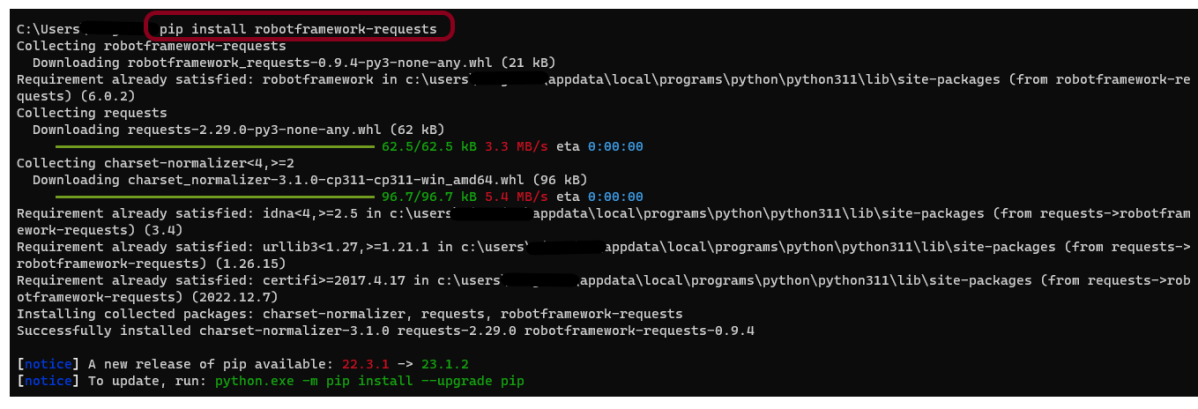
To install RequestLibrary, you need to use the below command:

pip install robotframework-requests

Step 3 – Add robotframework-requests package to the PyCharms

Go to File->Settings ->Project:RobotFramework_Demo ->Python Interpreter.

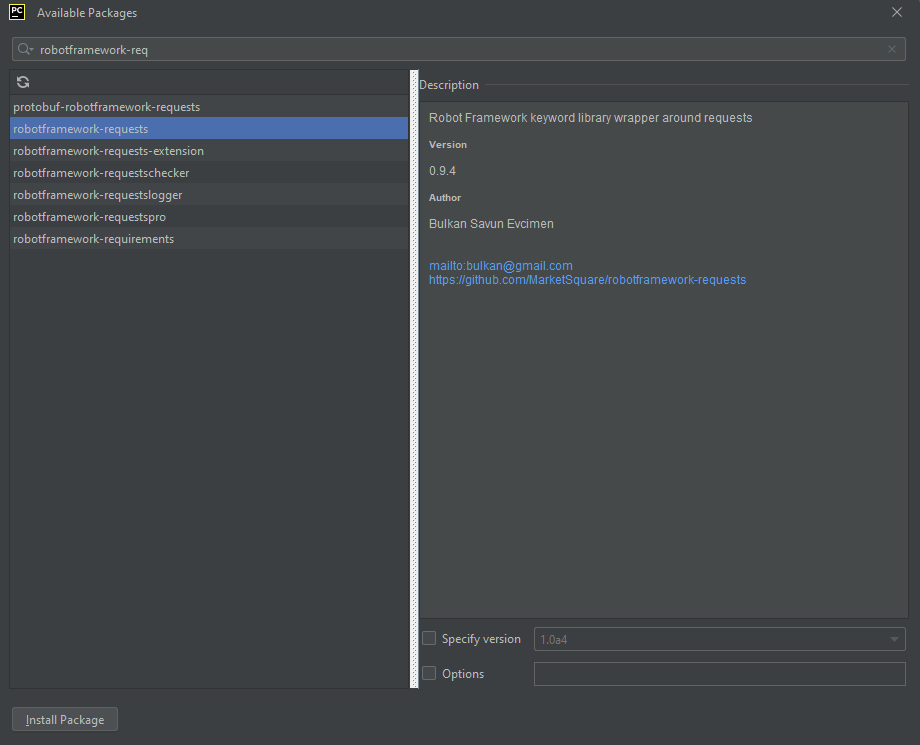
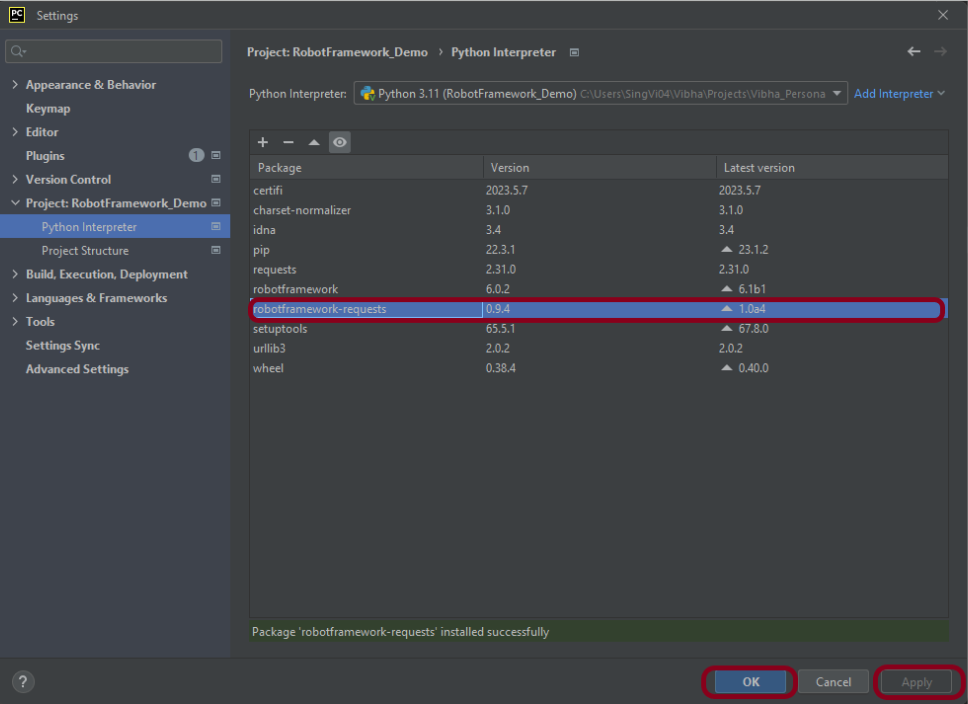
Click on the “+” sign and enter pabot in the search bar. It will show a list of packages. Select the “robotframework-requests” package and click on the “Install Package”.

Once the package is installed, we will see the message that the package is installed successfully.

Once the package is installed, it can be seen under the package list as shown below:

Step 4 – Create a new directory in the new project

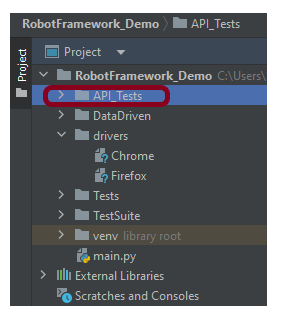
Right-Click on the project, select New->Directory, and provide the name as API_Tests

Below is the image of the new directory.

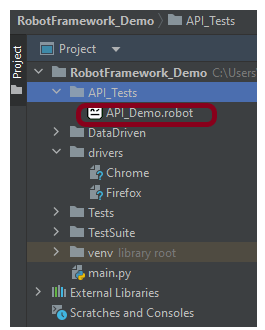
Right-click on the new directory and select New File and provide the name as API_Demo.robot as shown below:

Step 5 – Create API tests in Robot Framework

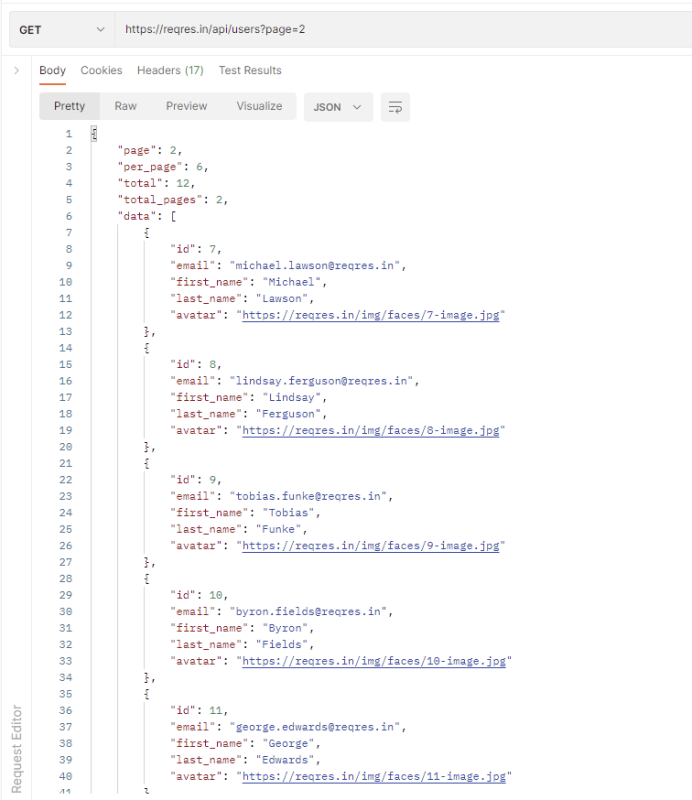
GET Request

The corresponding API Test in Robot Framework.

*** Settings ***
Library     RequestsLibrary
Library     Collections


*** Variables ***
${base_url}         https://reqres.in/api/users
${page_id}          2


*** Test Cases ***

Quick Get Request Test
    ${response}=    GET      ${base_url}     params=page=${page_id}   expected_status=200
    log    ${response.json()}
    Should Be Equal As Strings    6  ${response.json()}[per_page]
    Should Be Equal As Strings    12  ${response.json()}[total]
    Should Be Equal As Strings    7  ${response.json()}[data][0][id]

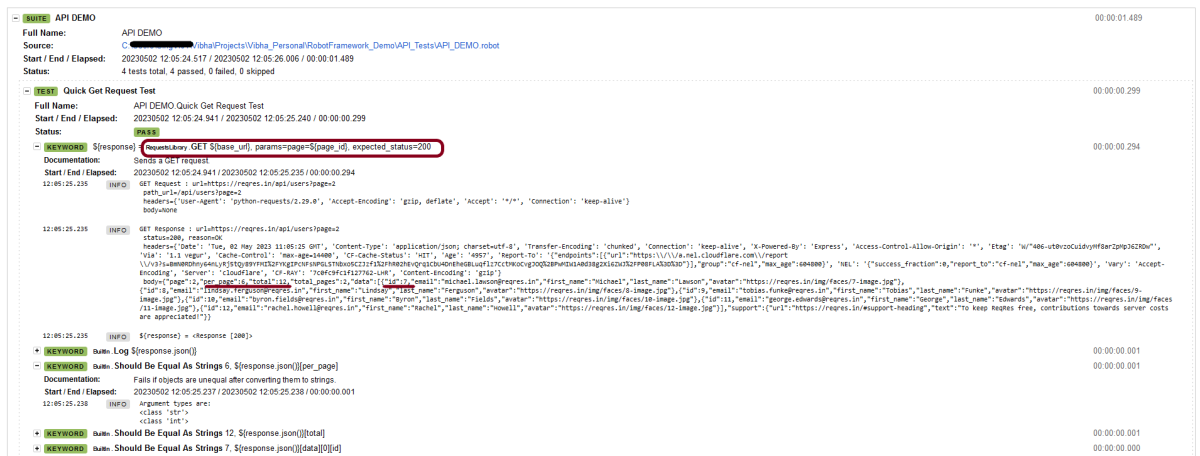
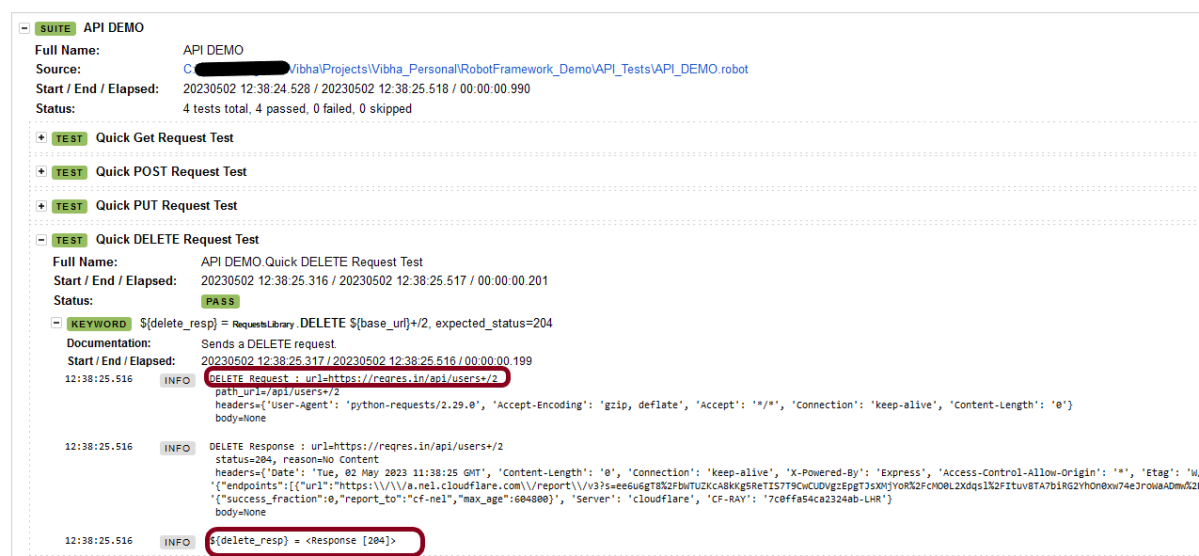
The corresponding log of this request is

${response}= We are saving the response of the GET operation in the ${response} variable.

The response is logged in the log by using the below command:

 log    ${response.json()}

POST Request

The corresponding API Test in Robot Framework.

*** Settings ***
Library     RequestsLibrary
Library     Collections


*** Variables ***
${base_url}         https://reqres.in/api/users
${page_id}          2
${expectedname}     test
${expectedjob}      team leader


*** Test Cases ***

Quick POST Request Test
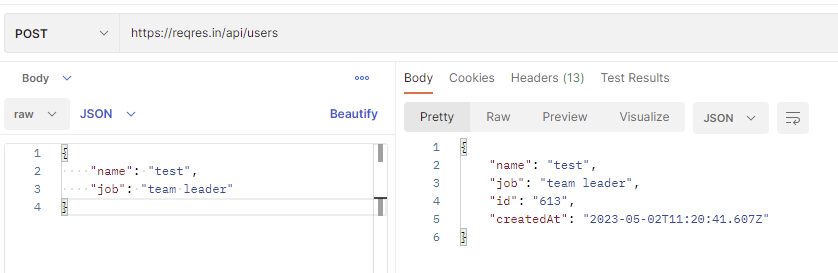
    &{req_body}=  Create Dictionary    name=test        job=team leader
    ${response}=     POST        ${base_url}     json=${req_body}    expected_status=201
    log      ${response.json()}
    Dictionary Should Contain Key     ${response.json()}     id
    ${name}=    Get From Dictionary     ${response.json()}    name
    Should Be Equal As Strings    ${expectedname}   ${name}

    ${job}=    Get From Dictionary     ${response.json()}    job
    Should Be Equal As Strings    ${expectedjob}    ${job}

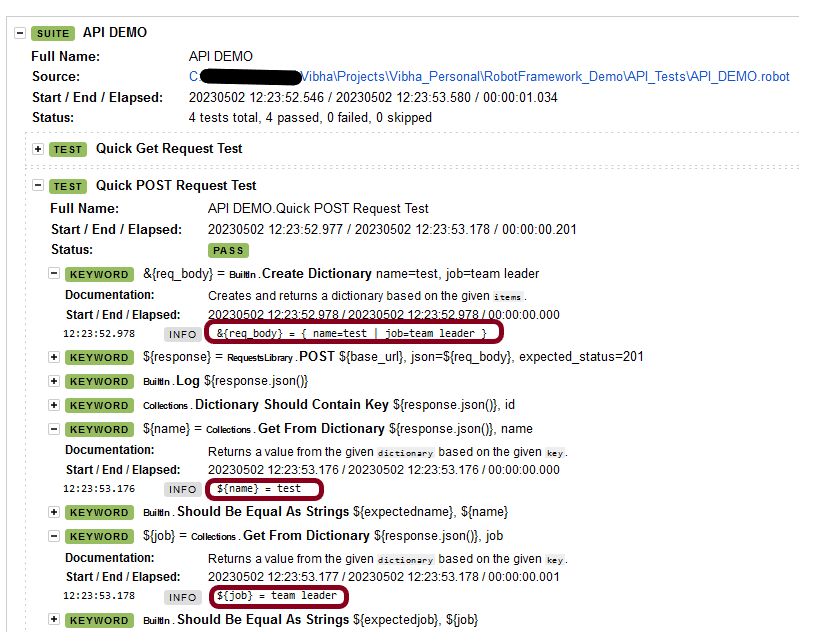
The corresponding log of this request is

1.Create Dictionary – This keyword is used from BuiltIn Library. It creates and returns a dictionary based on the given Items. Items are typically given using the key=value syntax.

2. Dictionary should contain key – This keyword is used from Collections library. It is used to verify if the specified key is present in the dictionary.

3. Get From Dictionary – This keyword is used from the Collections library. It is used to return a value from the given dictionary based on the given key. Here, it is used to check the values of the key name and job.

PUT Request

The corresponding API Test in Robot Framework.

*** Settings ***
Library     RequestsLibrary
Library     Collections


*** Variables ***
${base_url}         https://reqres.in/api/users
${updated_expectedname}     update_test
${updated_expectedjob}      resident


*** Test Cases ***

Quick PUT Request Test
    &{req_body}=  Create Dictionary    name=update_test        job=resident
    ${response}=     PUT        ${base_url}+/2     json=${req_body}    expected_status=200
    log      ${response.json()}

    Dictionary Should Contain Key     ${response.json()}     name
    ${name}=    Get From Dictionary     ${response.json()}    name
    Should Be Equal As Strings    ${updated_expectedname}    ${name}

    Dictionary Should Contain Key     ${response.json()}     job
    ${job}=    Get From Dictionary     ${response.json()}    job
    Should Be Equal As Strings    ${updated_expectedjob}    ${job}

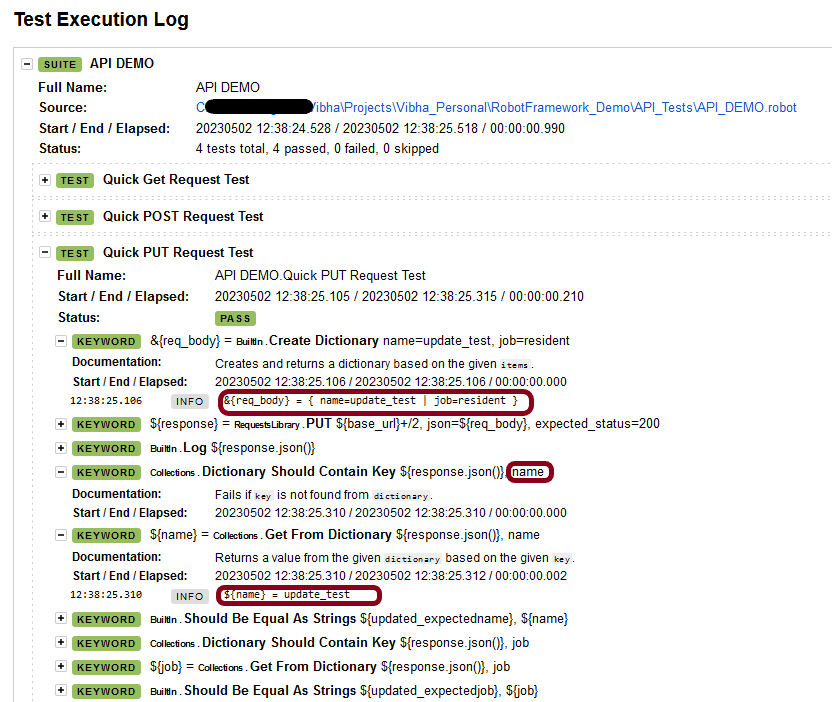
The corresponding log of this request is

DELETE Request

The corresponding API Test in Robot Framework.

*** Settings ***
Library     RequestsLibrary


*** Variables ***
${base_url}         https://reqres.in/api/users


*** Test Cases ***

Quick DELETE Request Test
     ${delete_resp}=   DELETE    ${base_url}+/2           expected_status=204

The corresponding log of this request is

The complete program looks like

Step 6 – Execute the tests

We need the below command to run the Robot Framework script.

robot API_DEMO.robot

The output of the above program is

Step 7 – View Report and Log

We have the test case passed. The Robot Framework generates log.html, output.xml, and report.html by default.

Let us now see the report and log details.

Report

Right-click on report.html. Select Open In->Browser->Chrome(any browser of your wish).

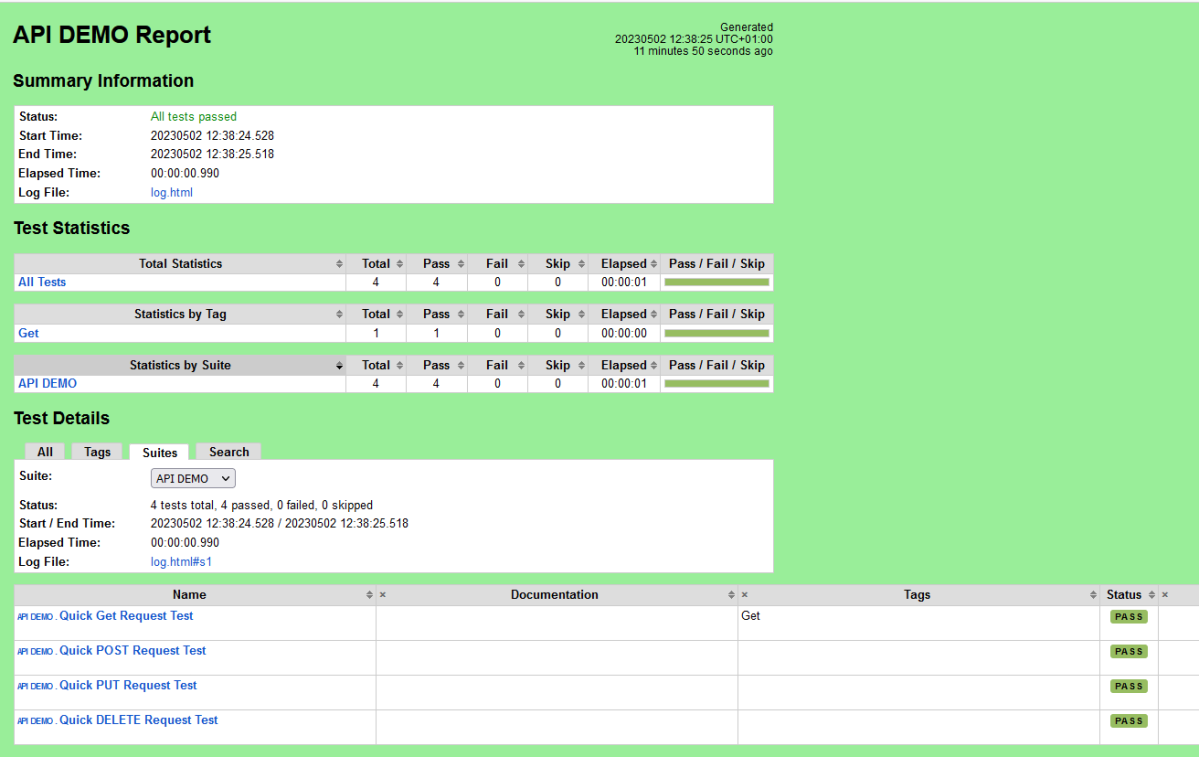
The Report generated by the framework is shown below:

Log

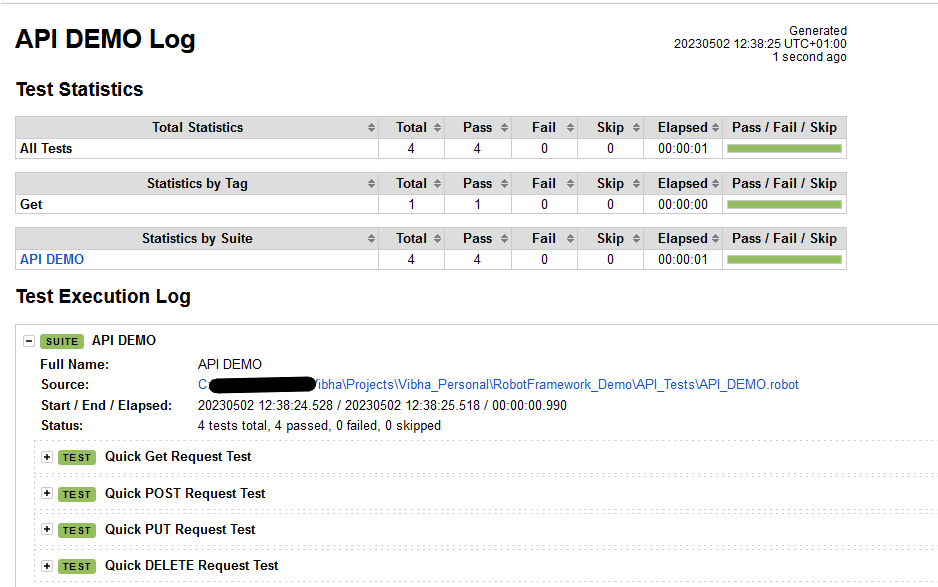
Robot Framework has multiple log levels that control what is shown in the automatically generated log file. The default Robot Framework log level is INFO.

Right-click on log.html. Select Open In->Browser->Chrome(any browser of your wish).

That’s it! Congratulations on making it through this tutorial and hope you found it useful! Happy Learning!!
Additional Tutorials

How to Install Python on Windows 11
How to install and setup Robot Framework for Python
How to rerun failed tests in Robot Framework
Page Object Model in the Robot Framework
Parallel Testing in Robot Framework
How to load data from CSV files in the Robot Framework?

How to run parameterized Robot Framework tests in Jenkins

HOME

When running your Jenkins automation jobs, you may need to pass some parameters to your scripts. These parameters can be a URL, a browser name, or even the test user’s credentials. This tutorial will walk you through the process of creating a parameterized Jenkins job for Robot Framework.

It is recommended to go through these tutorials, before creating a parameterized Jenkins job:-

Download and install Jenkins on Windows10

Configure JAVA_HOME and MAVEN_HOME

Types of parameters

Jenkins supports several parameter types. Below is a list of the most common ones, but keep in mind that different plugins may add new parameter types:

  • String: any combination of characters and numbers
  • Choice: a pre-defined set of strings from which a user can pick a value
  • Credentials: a pre-defined Jenkins credential
  • File: the full path to a file on the filesystem
  • Multi-line String: same as String, but allows newline characters
  • Password: similar to the Credentials type, but allows us to pass a plain text parameter specific to the job or pipeline
  • Run: an absolute URL to a single run of another job

Implementation Steps

Step 1: Create a new FreeStyle project

  1. Give the Name of the project – RobotFramework_Demo.
  2. Click on the FreeStyle project. 
  3. Click on the OK button.

Step 2: Description of the project

In the General section, enter the project description in the Description box.

Check the option – This project is parameterized.

Click on Add Parameter, and we can select any option as shown in the above image.

Step 3: Select the Choice Parameter

Choice Parameter

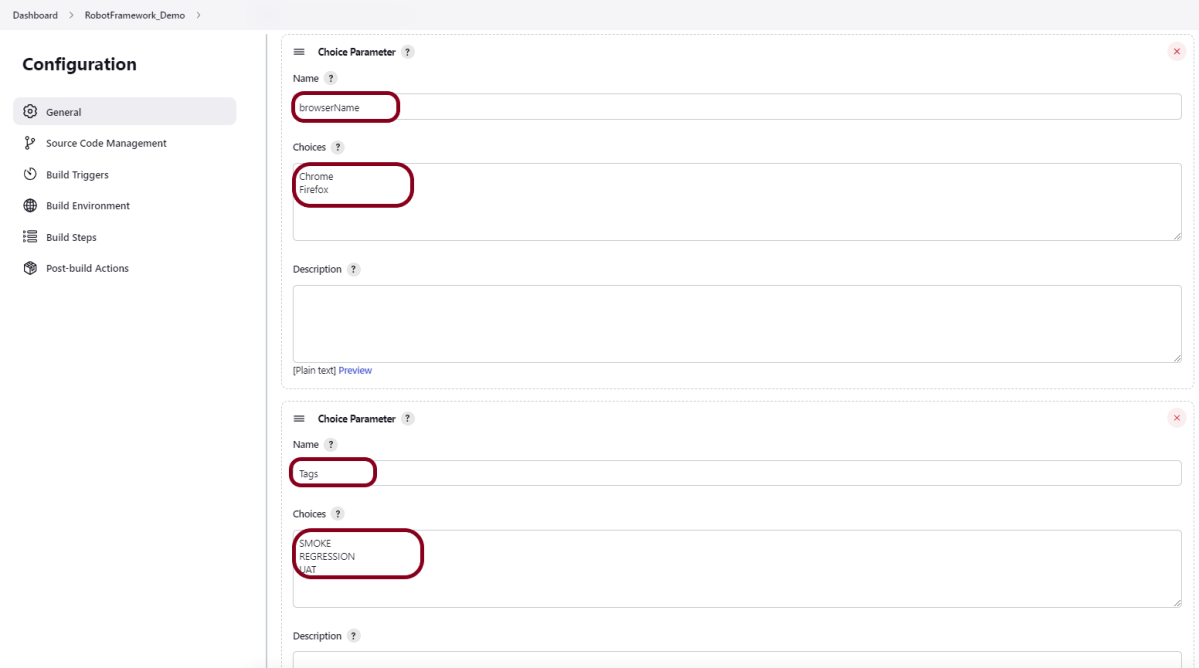
As I want to run my tests on different browsers, I have selected Choice Parameter.

  1. Give the Name of the Parameter.
  2. Give the Choices of the Parameter – Chrome, Firefox, IE
  3. Give the Description of the Parameter – Select any browser to run the tests (optional).

Step 4: Select a custom workspace

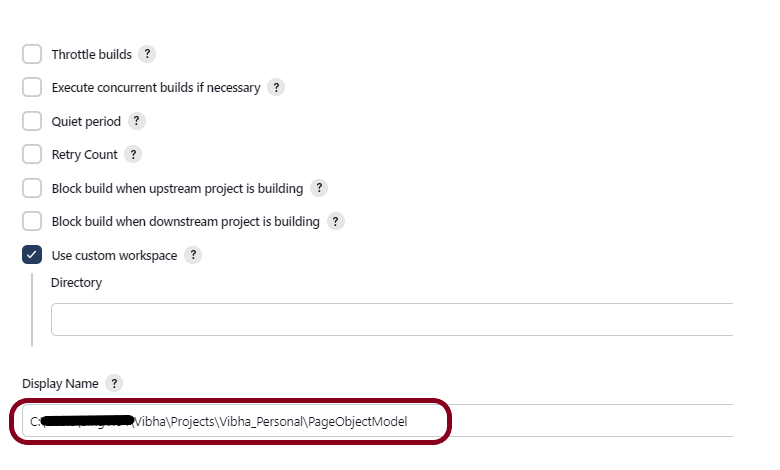
Mention the full path of the project in the Use custom workspace.

Step 5: Source Code Management

In the Source Code Management section, select None.

Step 6: Build Management

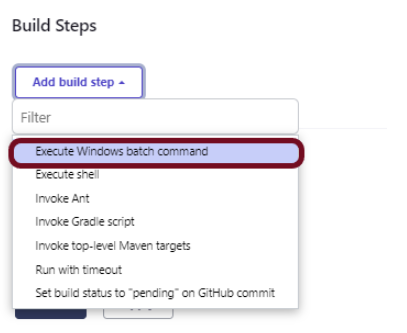
Go to the Build section of the new job. Select “Execute Windows batch command”.

Mention the command needed to execute the tests. In this case, I have to execute all the tests, so used the below command:

robot --variable browser_name:"%browserName%" --include "%Tags%" .

Step 7: Select “HTML Reports” from “Post Build Actions

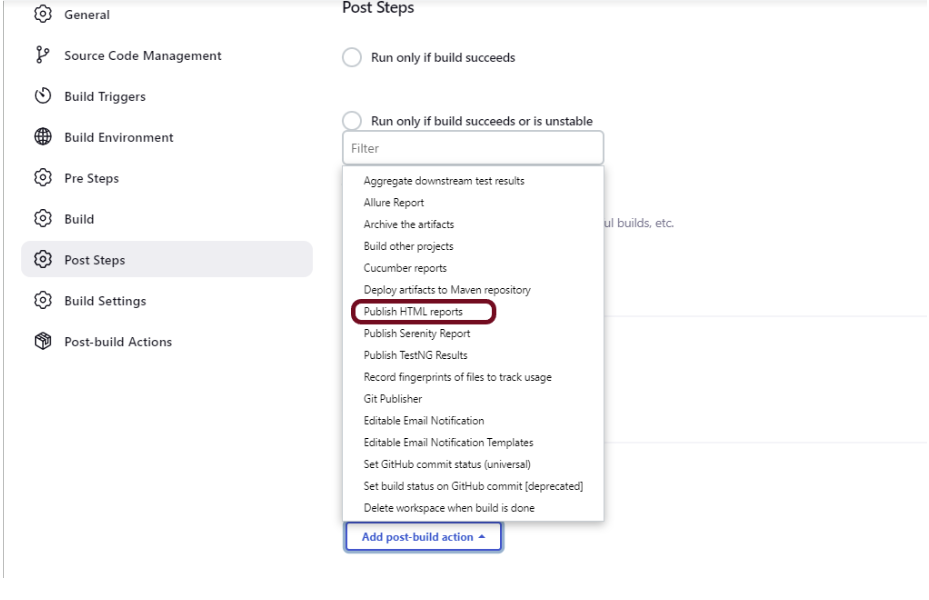
Scroll down to Post Build Actions” and click on the “Add Post Build Actions” drop-down list.

Select “Publish HTML Reports“. 

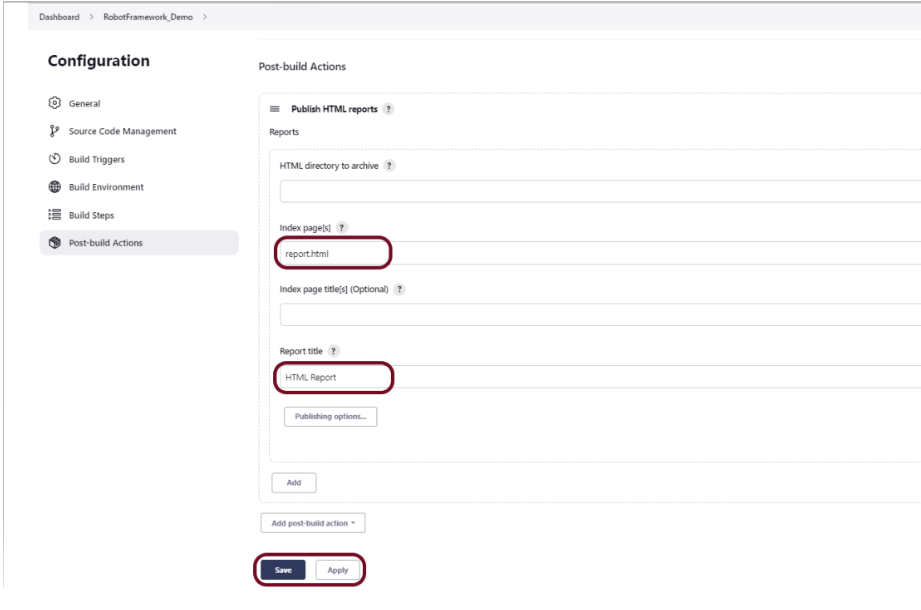
Enter the HTML directory to archive – Empty, Index page[s] – report.html, and Report title – HTML Report.

Click on the Apply and Save buttons.

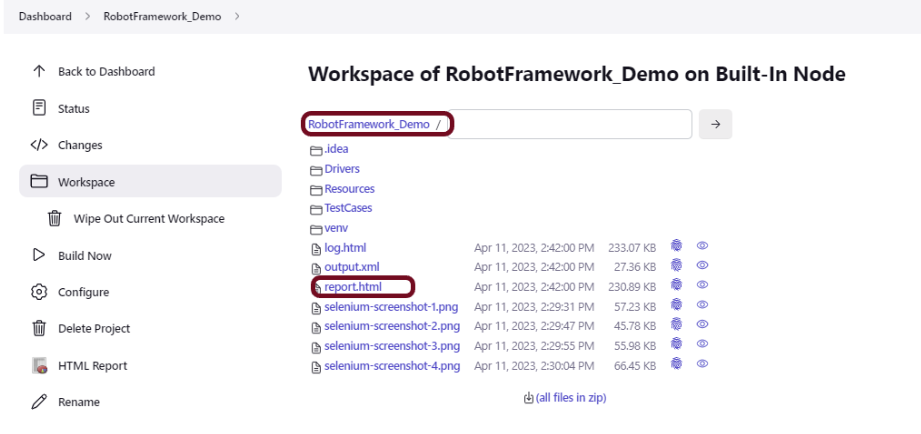
If you want to see where the report is saved in Jenkins, go to the Dashboard -> RobotFramework_Demo -> Workspace -> report.html.

We have created a new project “RobotFramework_Demo“.

Step 8: Execute the tests

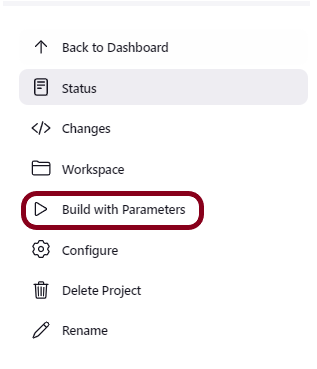
Let’s execute it now by clicking on the “Build with Parameters” button.

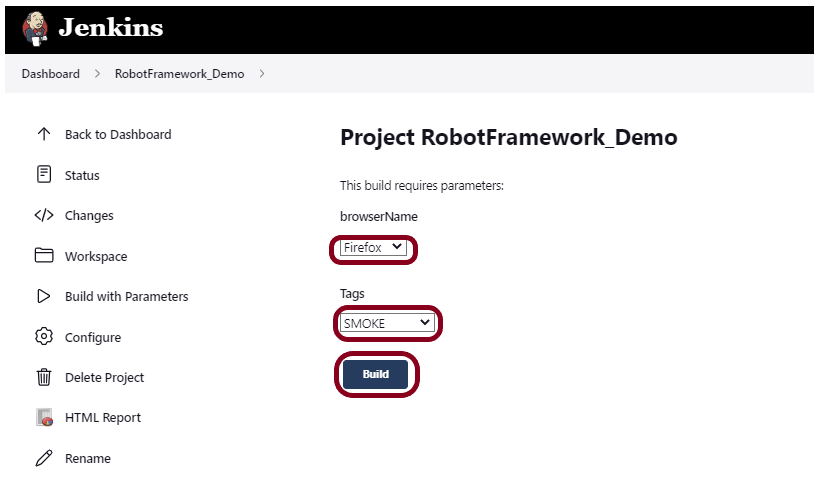
This screen contains the parameters which we have to select. The browser was a choice parameter and selecting a parameter from it and Tags was also a Choice parameter, so mention the tags in it and click on the “Build” button.

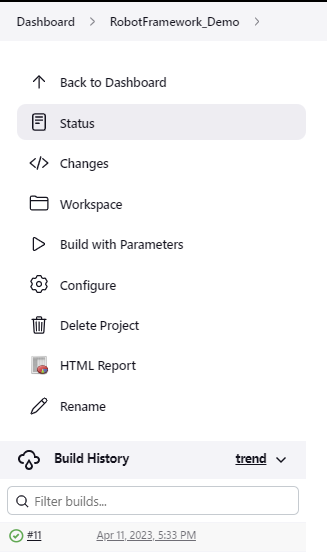
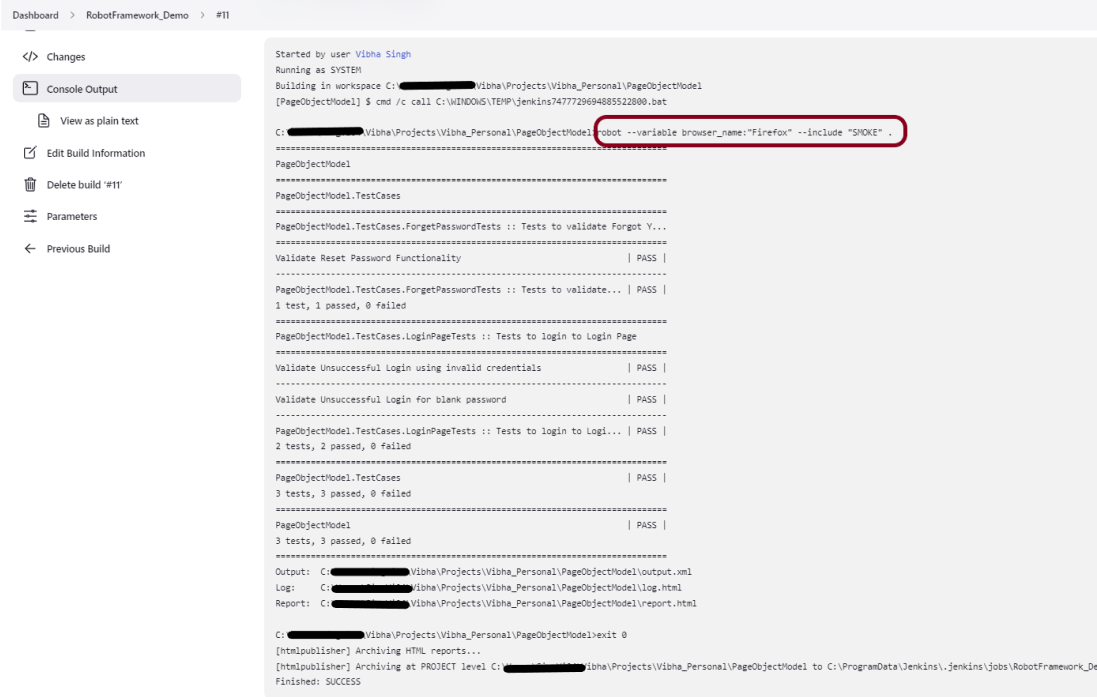
Right-click on Build Number (here in my case it is #11).

Click on Console Output to see the result.

Step 9: View the HTML Report

Once the execution is completed, click on go “Back to Project“, and we could see a link to view the “HTML Report“.

Click on the HTML Report. It displays the summary of the tests.

Congratulations on making it through this tutorial and hope you found it useful! Happy Learning!! Cheers!!
Additional Tutorials

How to Install Python on Windows 11
How to install and setup Robot Framework for Python
How to rerun failed tests in Robot Framework
Page Object Model in the Robot Framework
 How to set variable values from Runtime command in Robot Framework
How to load data from CSV files in the Robot Framework?

Parallel Testing in the Robot Framework

HOME

In this tutorial, we will discuss running the tests parallelly in the Robot Framework. To run the tests parallelly, we need to have pabot installed on the machine. Pabot is a parallel test runner for Robot Framework. It can be used to run tests in parallel on a single machine with multiple processes.

What is Parallel Testing?

Parallel testing is an automated testing process that allows developers and testers to run numerous tests against various real-world device combinations and browser setups at the same time. Parallel testing aims to solve time restrictions by distributing tests across available resources.

For example, if 20 test cases take 100 minutes to complete, 10 parallel execution might run 2 test cases each, reducing overall testing time to 10 minutes.

Prerequisite:

  1. Install Python
  2. Install PIP
  3. Install Robot Framework
  4. Install Robot framework Selenium Library
  5. Install PyCharm IDE

Please refer to this tutorial to install Robot Framework – How to install and setup Robot Framework for Python.

Implementation Steps:

Step 1.1 – Open PyCharm and create a new project. Go to File and select New Project from the main menu.

Step 1.2 – Choose the project location. Click the “Browse” button next to the Location field and specify the directory for your project.

Deselect the Create a main.py welcome script checkbox because you will create a new Python file for this tutorial.

Click on the “Create” Button.

Step 1.3 – A new dialog appears asking to open the project using any one of the given options. I have selected New Window as I like to have separate windows for each project.

Below is the image of the new project created in PyCharms.

Step 2 – Download pabot plugin

Go to command prompt and run the below mentioned command to download pabot:

 pip install -U robotframework-pabot

Step 3 – Add pabot package to the PyCharms

Go to File->Settings ->Project:RobotFramework_Demo ->Python Interpreter.

Click on the “+” sign and enter pabot in the search bar. It will show a list of packages. Select the “robotframework-pabot” package and click on the “Install Package”.

Once the package is installed, we will see the message that the package is installed successfully.

Once the package is installed, it can be seen under the package list as shown below:

Click the “Apply” and “OK” button.

Step 4 – Create 3 new directories in the new project

Right-Click on the project, select New->Directory, and provide the name as TestCases, Drivers, and Resources

Below is the image of the new directories.

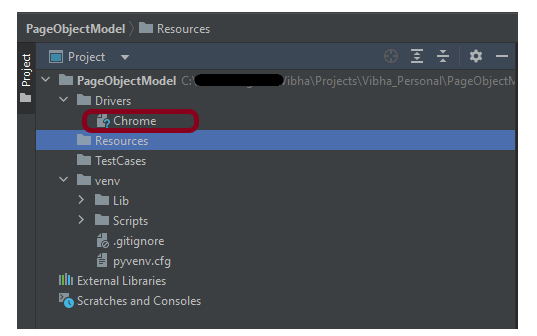
Step 5 – Download ChromeBinaries and place them in the Drivers directory

This directory contains the browser binary in it. As we are using Chrome, will keep chromedriver.exe here.

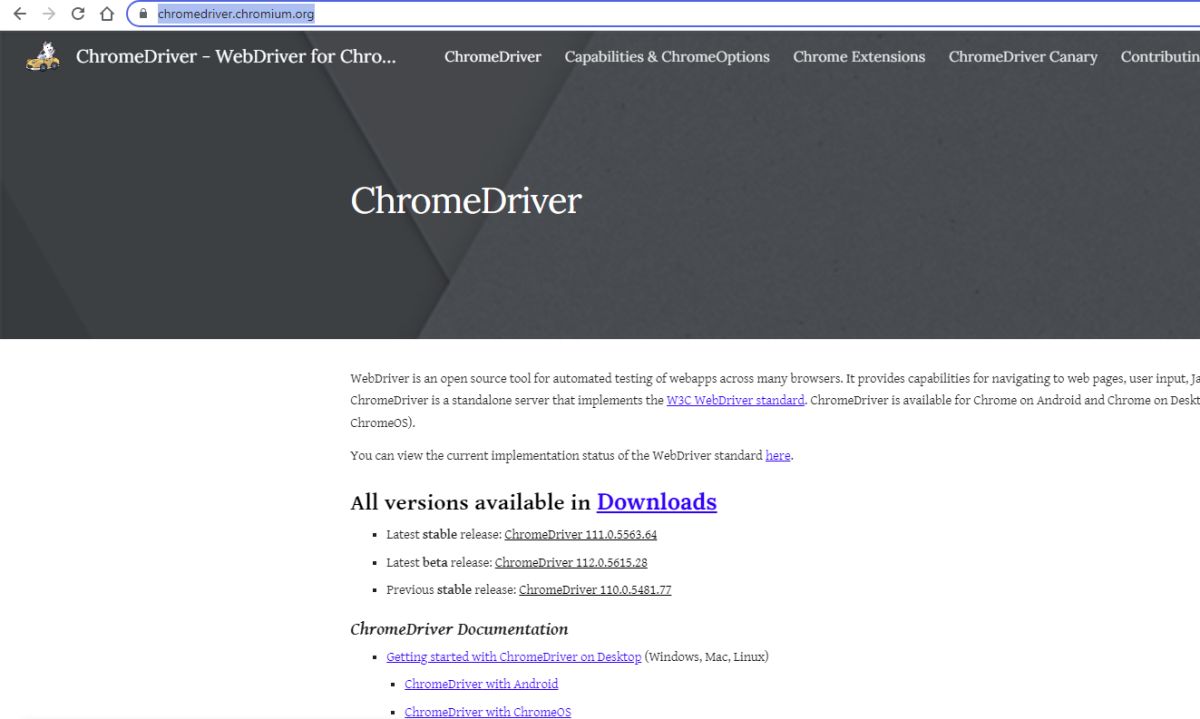
The tests are going to use the Chrome browser, so we need to download the ChromeBinaries to open a blank browser in Chrome.

https://chromedriver.chromium.org/

I will rename chromedriver.exe to Chrome.

Step 6 – Create Test Files

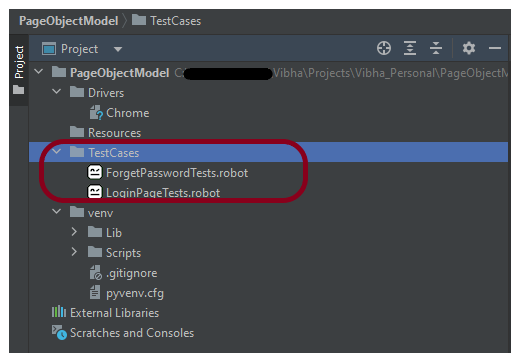
This directory contains multiple test case files consisting of test steps. 

Right-click on the new directory and select New File and provide the name as LoginPageTests.robot and ForgetPasswordTests.robot as shown below:

Below is the code for LoginPageTests.robot

*** Settings ***
Documentation       Tests to login to Login Page
Library     SeleniumLibrary
Test Setup      Open the Browser with URL
Test Teardown   Close Browser Session
Resource       ../Resources/GenericResources.robot
Resource       ../Resources/LoginResources.robot
Resource      ../Resources/DashboardResources.robot

*** Test Cases ***

Validate Unsuccessful Login using invalid credentials

    LoginResources.Fill the login form     ${valid_username}       ${invalid_password}
    LoginResources.Verify the error message is correct


Validate Unsuccessful Login for blank username

     LoginResources.Fill the login form     ${blank_username}       ${valid_password}
     LoginResources.Verify the error message is displayed for username


Validate Unsuccessful Login for blank password

     LoginResources.Fill the login form     ${valid_username}       ${blank_password}
     LoginResources.Verify the error message is displayed for password


Validate successful Login


    LoginResources.Fill the login form     ${valid_username}       ${valid_password}
    DashboardResources.Verify Dashboard page opens

Below is the code for ForgetPasswordTests.robot

*** Settings ***
Documentation       Tests to validate Forgot Your Password Page functionality
Library     SeleniumLibrary
Test Setup      Open the Browser with URL
Test Teardown   Close Browser Session
Resource       ../Resources/GenericResources.robot
Resource       ../Resources/LoginResources.robot
Resource      ../Resources/ForgetPasswordResources.robot


*** Test Cases ***

Validate Reset Password Functionality

    LoginResources.Go to Forgot Your Password Page
    ForgetPasswordResources.Verify Forgot Your Password Page opens
    ForgetPasswordResources.Fill the Forgot Password Page
    ForgetPasswordResources.Verify the message

Validate Cancel Functionality

    LoginResources.Go to Forgot Your Password Page
    ForgetPasswordResources.Verify Forgot Your Password Page opens
    ForgetPasswordResources.Cancel the Reset Password
    ForgetPasswordResources.Verify that Login Page is displayed


Step 7 – Create Resources file for each page

It maintains the files which contain page elements as well as corresponding keywords. 

Right-click on the new directory and select New File and provide the name as LoginResources.robot, DashboardResources.robot, GenericResources.robot, and ForgetPasswordResources.robot as shown below:

GenericResources.robot contains the keywords that are common to all the tests, like the opening of the browser or closing of the browser.

*** Settings ***
Documentation    A resource file with reusable keywords and variables.
Library     SeleniumLibrary

*** Variables ***
${valid_username}     Admin
${valid_password}       admin123
${invalid_username}     1234
${invalid_password}     45678
${blank_username}
${blank_password}
${url}      https://opensource-demo.orangehrmlive.com/web/index.php/auth/login
${browser_name}      Chrome

*** Keywords ***

Open the Browser with URL
    Create Webdriver    ${browser_name}  executable_path=/Vibha_Personal/RobotFramework_Demo/drivers/${browser_name}
    Go To       ${url}
    Maximize Browser Window
    Set Selenium Implicit Wait    5

Close Browser Session
    Close Browser

Below is the code for LoginResources.robot

*** Settings ***
Documentation        All the page objects and keywords of landing page
Library     SeleniumLibrary

*** Variables ***
${login_error_message}      css:.oxd-alert-content--error
${dashboard_title}       css:.oxd-topbar-header-breadcrumb-module
${missing_username_error_message}    xpath://*[@class='oxd-form']/div[1]/div/span
${missing_password_error_message}   xpath://*[@class='oxd-form']/div[2]/div/span
${forgot_password_link}   xpath://div[@class='orangehrm-login-forgot']/p

*** Keywords ***

Fill the login form
    [Arguments]    ${username}      ${password}
   Input Text    css:input[name=username]   ${username}
   Input Password    css:input[name=password]   ${password}
   Click Button    css:.orangehrm-login-button


Verify the error message is correct
    Element Text Should Be    ${login_error_message}    Invalid credentials


Verify the error message is displayed for username
     Element Text Should Be    ${missing_username_error_message}      Required

Verify the error message is displayed for password
      Element Text Should Be    ${missing_password_error_message}      Required

Go to Forgot Your Password Page
    Click Element      ${forgot_password_link}

Below is the code for DashboardResources.robot

*** Settings ***
Documentation        All the page objects and keywords of Dashboard page
Library     SeleniumLibrary

*** Variables ***
${dashboard_title}       css:.oxd-topbar-header-breadcrumb-module

*** Keywords ***

Verify Dashboard page opens
    Element Text Should Be    ${dashboard_title}      Dashboard

Below is the code for ForgetPasswordResources.robot

*** Settings ***
Documentation       All the page objects and keywords of Forget Password page
Library     SeleniumLibrary

*** Variables ***
${forgot_page_title}       css:.orangehrm-forgot-password-title
${username}     css:.oxd-input--active
${reset_btn}     css:.orangehrm-forgot-password-button--reset
${cancel_btn}    css:.orangehrm-forgot-password-button--cancel
${reset_message}      xpath://div[@class='orangehrm-card-container']/h6
${login_page_title}   xpath://*[@class='orangehrm-login-slot']/h5

*** Keywords ***

Verify Forgot Your Password Page opens
    Element Text Should Be    ${forgot_page_title}      Reset Password

Fill the Forgot Password Page
   Input Text        ${username}     abc@gmail.com
   Click Button    ${reset_btn}

Verify the message
    Element Text Should Be    ${reset_message}      Reset Password link sent successfully

Cancel the Reset Password
    Click Button    ${cancel_btn}

Verify that Login Page is displayed
    Element Text Should Be    ${login_page_title}       Login

All the below-mentioned keywords are derived from SeleniumLibrary. The functionality of keywords mentioned above:

1. Create Webdriver − The keyword creates an instance of Selenium WebDriver.

2. Go To – This keyword navigates the current browser window to the provided URL.

3. Maximize Browser Window – This keyword maximizes the current browser window.

4. Set Selenium Implicit Wait – This keyword sets the implicit wait value used by Selenium.

5. Input Text − This keyword is used to type the given text in the specified textbox identified by the locator name:username.

6. Input Password – This keyword is used to type the given text in the specified password identified by the locator name:password.

The difference compared to Input Text is that this keyword does not log the given password on the INFO level.

7. Click button – This keyword is used to click the button identified by the locator. In this case, it is “Login” button.

8. Element Text Should Be – This keyword is used to verify that the current page contains the exact text identified by the locator. Here, we are checking the exact text “Invalid Credentials”.

These keywords are present in SeleniumLibrary. To know more about these keywords, please refer to this document – https://robotframework.org/SeleniumLibrary/SeleniumLibrary.htm.

To run this script, go to the command line and go to directory tests.

Step 8 – Split execution to suite files

We need the below command to run the Robot Framework script. This will start all the test suites parallelly. We have 2 test files, so they started parallelly.

pabot .

The output of the above program is

Step 9 – View Report and Log

We have the test case passed. The Robot Framework generates log.html, output.xml, and report.html by default.

Let us now see the report and log details.

Report

Right-click on report.html. Select Open In->Browser->Chrome(any browser of your wish).

The Report generated by the framework is shown below:

Log

Robot Framework has multiple log levels that control what is shown in the automatically generated log file. The default Robot Framework log level is INFO.

Right-click on log.html. Select Open In->Browser->Chrome(any browser of your wish).

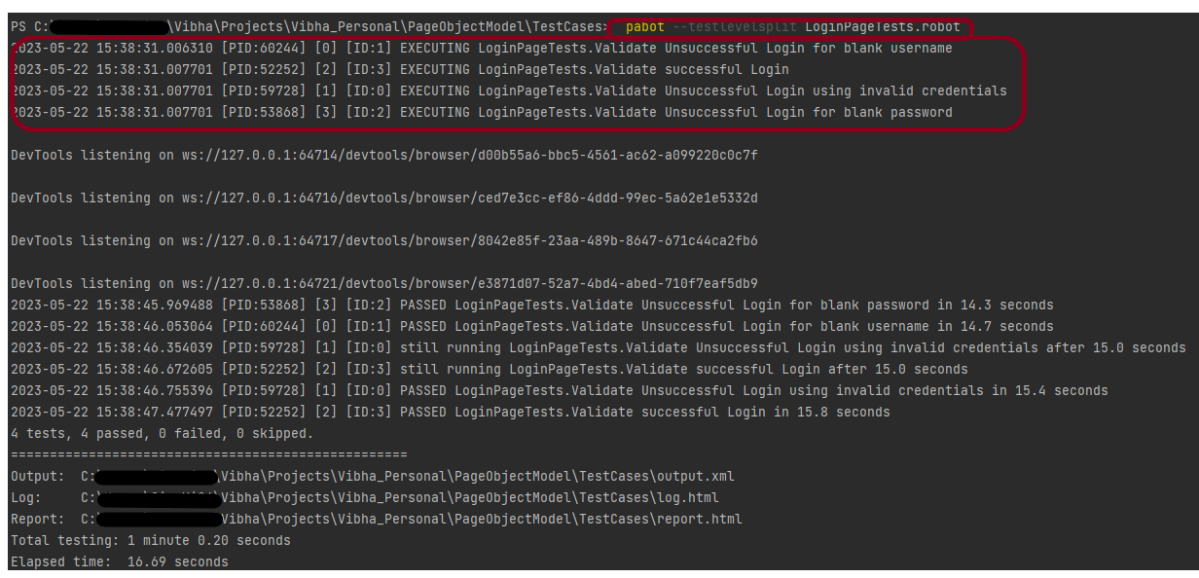
Step 10 – Split execution on test level

In this case, the tests present in a test file will be executed parallelly.

 pabot --testlevelsplit LoginPageTests.robot

The below image shows that all the tests present in LoginPageTests.robot file started parallelly.

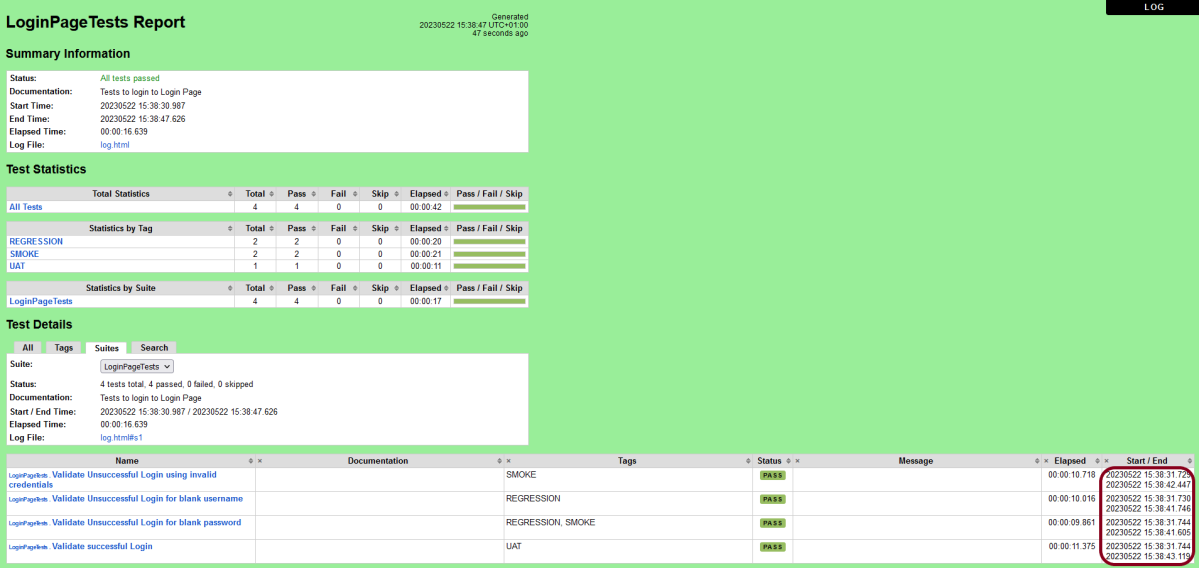
The below report shows that all the tests are started simultaneously.

That’s it! Congratulations on making it through this tutorial and hope you found it useful! Happy Learning!!

Additional Tutorials

How to Install Python on Windows 11
How to install and setup Robot Framework for Python
How to rerun failed tests in Robot Framework
Page Object Model in the Robot Framework
How to integrate Robot Framework with Jenkins
How to load data from CSV files in the Robot Framework?

Page Object Model in the Robot Framework

HOME

In this tutorial, we will discuss Page Object Model in the Robot Framework.

What is Page Object Model Framework?

Page Object is a prominent Design Pattern in test automation for improving test maintenance and eliminating code duplication. A page object is an object-oriented class that acts as an interface to your AUT’s page. The methods of this page object class are then used by the tests anytime they need to interact with the UI of that page. The benefit is that if the page’s UI changes, just the code within the page object needs to update, rather not the tests themselves. As a result, all updates to accommodate that new UI are centralized.

Prerequisite:

  1. Install Python
  2. Install PIP
  3. Install Robot Framework
  4. Install Robot framework Selenium Library
  5. Install PyCharm IDE

Please refer to this tutorial to install Robot Framework – How to install and setup Robot Framework for Python.

Implementation Steps

Step 1.1 – Open PyCharm and create a new project. Go to File and select New Project from the main menu.

Step 1.2 – Choose the project location. Click the “Browse” button next to the Location field and specify the directory for your project.

Deselect the Create a main.py welcome script checkbox because you will create a new Python file for this tutorial.

Click on the “Create” Button.

Step 1.3 – A new dialog appears asking to open the project using any one of the given options. I have selected New Window as I like to have separate windows for each project.

Below is the image of the new project created in PyCharms.

How to create Page Object Model tests in Robot Framework?

Step 2 – Create 3 new directories in the new project

Right-Click on the project, select New->Directory, and provide the name as TestCases, Drivers, and Resources

Below is the image of the new directories.

Step 3 – Download ChromeBinaries and place in Drivers directory

This directory contains the browser binary in it. As we are using Chrome, will keep chromedriver.exe here.

The tests are going to use the Chrome browser, so we need to download the ChromeBinaries to open a blank browser in Chrome.

https://chromedriver.chromium.org/

I will rename chromedriver.exe to Chrome.

Step 4 – Create Test Files

This directory contains multiple test case files consisting of test steps. 

Right-click on the new directory and select New File and provide the name as LoginPageTests.robot and ForgetPasswordTests.robot as shown below:

Below is the code for LoginPageTests.robot

*** Settings ***
Documentation       Tests to login to Login Page
Library     SeleniumLibrary
Test Setup      Open the Browser with URL
Test Teardown   Close Browser Session
Resource       ../Resources/GenericResources.robot
Resource       ../Resources/LoginResources.robot
Resource      ../Resources/DashboardResources.robot

*** Test Cases ***

Validate Unsuccessful Login using invalid credentials

    LoginResources.Fill the login form     ${valid_username}       ${invalid_password}
    LoginResources.Verify the error message is correct


Validate Unsuccessful Login for blank username

     LoginResources.Fill the login form     ${blank_username}       ${valid_password}
     LoginResources.Verify the error message is displayed for username


Validate Unsuccessful Login for blank password

     LoginResources.Fill the login form     ${valid_username}       ${blank_password}
     LoginResources.Verify the error message is displayed for password


Validate successful Login


    LoginResources.Fill the login form     ${valid_username}       ${valid_password}
    DashboardResources.Verify Dashboard page opens

Below is the code for ForgetPasswordTests.robot

*** Settings ***
Documentation       Tests to validate Forgot Your Password Page functionality
Library     SeleniumLibrary
Test Setup      Open the Browser with URL
Test Teardown   Close Browser Session
Resource       ../Resources/GenericResources.robot
Resource       ../Resources/LoginResources.robot
Resource      ../Resources/ForgetPasswordResources.robot


*** Test Cases ***

Validate Reset Password Functionality

    LoginResources.Go to Forgot Your Password Page
    ForgetPasswordResources.Verify Forgot Your Password Page opens
    ForgetPasswordResources.Fill the Forgot Password Page
    ForgetPasswordResources.Verify the message

Validate Cancel Functionality

    LoginResources.Go to Forgot Your Password Page
    ForgetPasswordResources.Verify Forgot Your Password Page opens
    ForgetPasswordResources.Cancel the Reset Password
    ForgetPasswordResources.Verify that Login Page is displayed


Step 5 – Create Resources file for each page

It maintains the files which contain page elements as well as corresponding keywords. 

Right-click on the new directory and select New File and provide the name as LoginResources.robot, DashboardResources.robot, GenericResources.robot, and ForgetPasswordResources.robot as shown below:

GenericResources.robot contains the keywords that are common to all the tests, like the opening of the browser or closing of the browser.

*** Settings ***
Documentation    A resource file with reusable keywords and variables.
Library     SeleniumLibrary

*** Variables ***
${valid_username}     Admin
${valid_password}       admin123
${invalid_username}     1234
${invalid_password}     45678
${blank_username}
${blank_password}
${url}      https://opensource-demo.orangehrmlive.com/web/index.php/auth/login
${browser_name}      Chrome

*** Keywords ***

Open the Browser with URL
    Create Webdriver    ${browser_name}  executable_path=/Vibha_Personal/RobotFramework_Demo/drivers/${browser_name}
    Go To       ${url}
    Maximize Browser Window
    Set Selenium Implicit Wait    5

Close Browser Session
    Close Browser

Below is the code for LoginResources.robot

*** Settings ***
Documentation        All the page objects and keywords of landing page
Library     SeleniumLibrary

*** Variables ***
${login_error_message}      css:.oxd-alert-content--error
${dashboard_title}       css:.oxd-topbar-header-breadcrumb-module
${missing_username_error_message}    xpath://*[@class='oxd-form']/div[1]/div/span
${missing_password_error_message}   xpath://*[@class='oxd-form']/div[2]/div/span
${forgot_password_link}   xpath://div[@class='orangehrm-login-forgot']/p

*** Keywords ***

Fill the login form
    [Arguments]    ${username}      ${password}
   Input Text    css:input[name=username]   ${username}
   Input Password    css:input[name=password]   ${password}
   Click Button    css:.orangehrm-login-button


Verify the error message is correct
    Element Text Should Be    ${login_error_message}    Invalid credentials


Verify the error message is displayed for username
     Element Text Should Be    ${missing_username_error_message}      Required

Verify the error message is displayed for password
      Element Text Should Be    ${missing_password_error_message}      Required

Go to Forgot Your Password Page
    Click Element      ${forgot_password_link}

Below is the code for DashboardResources.robot

*** Settings ***
Documentation        All the page objects and keywords of Dashboard page
Library     SeleniumLibrary

*** Variables ***
${dashboard_title}       css:.oxd-topbar-header-breadcrumb-module

*** Keywords ***

Verify Dashboard page opens
    Element Text Should Be    ${dashboard_title}      Dashboard

Below is the code for ForgetPasswordResources.robot

*** Settings ***
Documentation       All the page objects and keywords of Forget Password page
Library     SeleniumLibrary

*** Variables ***
${forgot_page_title}       css:.orangehrm-forgot-password-title
${username}     css:.oxd-input--active
${reset_btn}     css:.orangehrm-forgot-password-button--reset
${cancel_btn}    css:.orangehrm-forgot-password-button--cancel
${reset_message}      xpath://div[@class='orangehrm-card-container']/h6
${login_page_title}   xpath://*[@class='orangehrm-login-slot']/h5

*** Keywords ***

Verify Forgot Your Password Page opens
    Element Text Should Be    ${forgot_page_title}      Reset Password

Fill the Forgot Password Page
   Input Text        ${username}     abc@gmail.com
   Click Button    ${reset_btn}

Verify the message
    Element Text Should Be    ${reset_message}      Reset Password link sent successfully

Cancel the Reset Password
    Click Button    ${cancel_btn}

Verify that Login Page is displayed
    Element Text Should Be    ${login_page_title}       Login

All the below-mentioned keywords are derived from SeleniumLibrary. The functionality of keywords mentioned above:

1. Create Webdriver − The keyword creates an instance of Selenium WebDriver.

2. Go To – This keyword navigates the current browser window to the provided URL.

3. Maximize Browser Window – This keyword maximizes the current browser window.

4. Set Selenium Implicit Wait – This keyword sets the implicit wait value used by Selenium.

5. Input Text − This keyword is used to type the given text in the specified textbox identified by the locator name:username.

6. Input Password – This keyword is used to type the given text in the specified password identified by the locator name:password.

The difference compared to Input Text is that this keyword does not log the given password on the INFO level.

7. Click button – This keyword is used to click the button identified by the locator. In this case, it is “Login” button.

8. Element Text Should Be – This keyword is used to verify that the current page contains the exact text identified by the locator. Here, we are checking the exact text “Invalid Credentials”.

These keywords are present in SeleniumLibrary. To know more about these keywords, please refer to this document – https://robotframework.org/SeleniumLibrary/SeleniumLibrary.htm.

To run this script, go to the command line and go to directory tests.

Step 6 – Execute the tests

We need the below command to run the Robot Framework script.

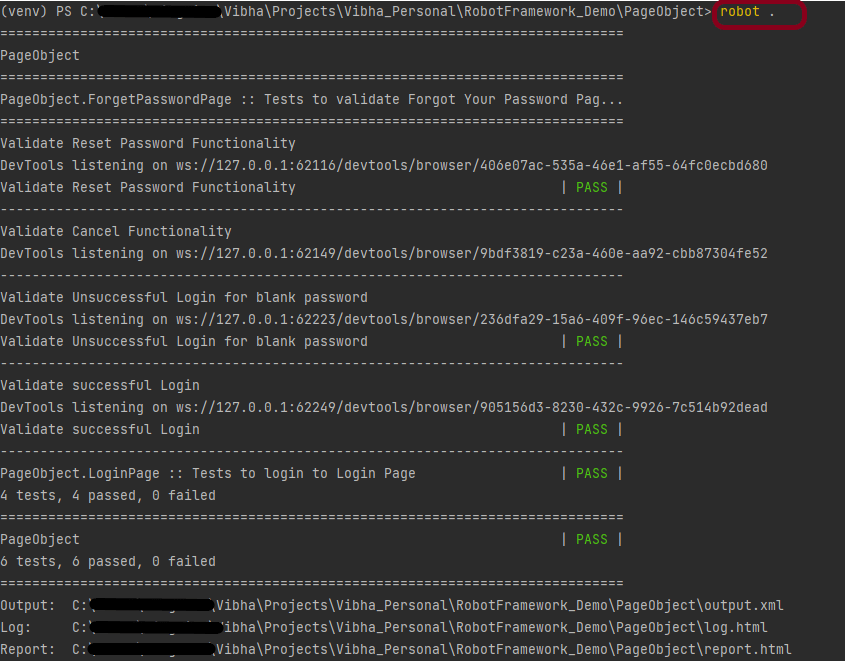
robot .

The output of the above program is

Step 7 – View Report and Log

We have the test case passed. The Robot Framework generates log.html, output.xml, and report.html by default.

Let us now see the report and log details.

Report

Right-click on report.html. Select Open In->Browser->Chrome(any browser of your wish).

The Report generated by the framework is shown below:

Log

Robot Framework has multiple log levels that control what is shown in the automatically generated log file. The default Robot Framework log level is INFO.

Right-click on log.html. Select Open In->Browser->Chrome(any browser of your wish).

That’s it! Congratulations on making it through this tutorial and hope you found it useful! Happy Learning!!

Additional Tutorials

How to Install Python on Windows 11
How to install and setup Robot Framework for Python
How to rerun failed tests in Robot Framework
How to implement tagging in Robot Framework
 How to set variable values from Runtime command in Robot Framework
How to load data from CSV files in the Robot Framework?

How to load data from CSV files in the Robot Framework?

HOME

In this tutorial, we will discuss data-driven testing in the Robot Framework.

What is Data Driven Testing?

Data Driven Testing is a type of software testing in which test data is maintained in table or spreadsheet format. Data-driven testing enables testers to provide a single test script that may perform tests for all test data from a table and expect the test results to be returned to the same table. Table-driven testing is another name for parameterized testing.

Prerequisite:

  1. Install Python
  2. Install PIP
  3. Install Robot Framework
  4. Install Robot framework Selenium Library
  5. Install PyCharm IDE

Please refer to this tutorial to install Robot Framework – How to install and setup Robot Framework for Python.

Implementation Steps:

Step 1.1 – Open PyCharm and create a new project. Go to File and select New Project from the main menu.

Step 1.2 – Choose the project location. Click the “Browse” button next to the Location field and specify the directory for your project.

Deselect the Create a main.py welcome script checkbox because you will create a new Python file for this tutorial.

Click on the “Create” Button.

Step 1.3 – A new dialog appears asking to open the project using any one of the given options. I have selected New Window as I like to have separate windows for each project.

Below is the image of the new project created in PyCharms.

Step 2 – Add datadriver package to the PyCharms

Go to File->Settings ->Project:RobotFramework_Demo ->Python Interpreter.

Click on the “+” sign and enter datadriver in the search bar. It will show a list of packages. Select the “robotframework-datadriver” package and click on the “Install Package”.

Once the package is installed, it can be seen under the package list as shown below:

Step 3 – Create a new directory in the new project

Right-Click on the project, select New->Directory and provide the name as DataDriven

Below is the image of the new directory.

Right-click on the new directory and select New File and provide the name as DataDrivenTesting_Demo.robot as shown below:

Step 4 – Create a test data file (.csv)

Create a folder with the name of Resources in the DataDriven directory.

Add a data.csv file that contains the test data in it.

Make sure that fields are separated by commas.

Step 5 – Download ChromeBinaries from the below location

The tests are going to use the Chrome browser, so we need to download the ChromeBinaries to open a blank browser in Chrome.

https://chromedriver.chromium.org/

The chromedriver and geckodriver are placed in a folder name drivers in the RobotFramework_Demo project. I have renamed chromedriver to Chrome and geckodriver to Firefox.

Step 6 – Create a Data Driven Test

We are now going to write test cases. The test case details will be as follows :

A locator is an identifier for the web elements used to identify an element on the web page like id, name, class, xpath, css selector.

To know more about locators, refer to these Selenium Tutorials:

 Locators in Selenium – Locate by ID, ClassName,  Name, TagName,  LinkText, PartialLinkText

Dynamic XPath  in Selenium WebDriver

CSS Selector in Selenium WebDriver

Below is an example of a Data-Driven Test.

*** Settings ***
Documentation    To validate the Login Form
Library     SeleniumLibrary
Library    DataDriver       file=Resources/data.csv     encoding=utf_8      dialect=unix
Test Template    Validate Unsuccessful Login

*** Variables ***
${browser_name}     Chrome
${login_btn}        css:.orangehrm-login-button
${login_error_message}      css:.oxd-alert-content--error


*** Test Cases ***
Login to form using ${Username} and ${Password}     abc     123


*** Keywords ***
Validate Unsuccessful Login
    [Arguments]    ${Username}   ${Password}
    Open the Browser with URL
    Fill the login form     ${Username}   ${Password}
    verify error message is correct


Open the Browser with URL
    Create Webdriver    ${browser_name}  executable_path=/Vibha_Personal/RobotFramework_Demo/drivers/${browser_name}
    Go To    https://opensource-demo.orangehrmlive.com/web/index.php/auth/login
    Maximize Browser Window
    Set Selenium Implicit Wait    2

Fill the login form
  [Arguments]        ${Username}       ${Password}
   Input Text        name:username     ${Username}
   Input Password    name:password     ${Password}
   Click Button    ${login_btn}

Verify error message is correct
    Element Text Should Be    ${login_error_message}   Invalid credentials
     
Close Browser Session
    Close Browser

In the below image, it shows that there are 3 steps to creating a Data-Driven test from an external data source like .csv.

All the below-mentioned keywords are derived from SeleniumLibrary. The functionality of keywords mentioned above:

1. Create Webdriver − The keyword creates an instance of Selenium WebDriver.

2. Go To – This keyword navigates the current browser window to the provided url.

3. Maximize Browser Window – This keyword maximizes the current browser window.

4. Set Selenium Implicit Wait – This keyword sets the implicit wait value used by Selenium.

5. Input Text − This keyword is used to type the given text in the specified textbox identified by the locator name:username.

6. Input Password – This keyword is used to type the given text in the specified password identified by the locator name:password.

The difference compared to Input Text is that this keyword does not log the given password on the INFO level.

7. Click button – This keyword is used to click the button identified by the locator. In this case, it is “Login” button.

8. Element Text Should Be – This keyword is used to verify that the current page contains the exact text identified by the locator. Here, we are checking the exact text “Invalid Credentials”.

These keywords are present in SeleniumLibrary. To know more about these keywords, please refer to this document – https://robotframework.org/SeleniumLibrary/SeleniumLibrary.htm.

To run this script, go to the command line and go to directory tests.

Step 7 – Execute the tests

We need the below command to run the Robot Framework script.

robot ExternalDatDrivenTests_Demo.robot

The output of the above program is

Step 8 – View Report and Log

We have the test case passed. The Robot Framework generates log.html, output.xml, and report.html by default.

Let us now see the report and log details.

Report

Right-click on report.html. Select Open In->Browser->Chrome(any browser of your wish).

The Report generated by the framework is shown below:

Log

Robot Framework has multiple log levels that control what is shown in the automatically generated log file. The default Robot Framework log level is INFO.

Right-click on log.html. Select Open In->Browser->Chrome(any browser of your wish).

That’s it! Congratulations on making it through this tutorial and hope you found it useful! Happy Learning!!
Data-Driven Testing in Robot Framework 

HOME

In this tutorial, we will discuss data-driven testing in the Robot Framework.

What is Data Driven Testing?

Data Driven Testing is a type of software testing in which test data is maintained in table or spreadsheet format. Data-driven testing enables testers to provide a single test script that may perform tests for all test data from a table and expect the test results to be returned to the same table. Table-driven testing is another name for parameterized testing.

Prerequisite:

  1. Install Python
  2. Install PIP
  3. Install Robot Framework
  4. Install Robot framework Selenium Library
  5. Install PyCharm IDE

Please refer to this tutorial to install Robot Framework – How to install and setup Robot Framework for Python.

Implementation Steps:

Step 1.1 – Open PyCharm and create a new project. Go to File and select New Project from the main menu.

Step 1.2 – Choose the project location. Click the “Browse” button next to the Location field and specify the directory for your project.

Deselect the Create a main.py welcome script checkbox because you will create a new Python file for this tutorial.

Click on the “Create” Button.

Step 1.3 – A new dialog appears asking to open the project using any one of the given options. I have selected New Window as I like to have separate windows for each project.

Below is the image of the new project created in PyCharms.

Step 2 – Create a new directory in the new project

Right-Click on the project, select New->Directory and provide the name as DataDriven

Below is the image of the new directory.

Right-click on the new directory and select New File and provide the name as DataDrivenTesting_Demo.robot as shown below:

Step 3 – Download ChromeBinaries from the below location

The tests are going to use the Chrome browser, so we need to download the ChromeBinaries to open a blank browser in Chrome.

https://chromedriver.chromium.org/

The chromedriver and geckodriver are placed in a folder name drivers in the RobotFramework_Demo project. I have renamed chromedriver to Chrome and geckodriver to Firefox.

Step 4 – Create a Data Driven Test

We are now going to write test cases. The test case details will be as follows :

A locator is an identifier for the web elements used to identify an element on the web page like id, name, class, xpath, css selector.

To know more about locators, refer to these Selenium Tutorials:

 Locators in Selenium – Locate by ID, ClassName,  Name, TagName,  LinkText, PartialLinkText

Dynamic XPath  in Selenium WebDriver

CSS Selector in Selenium WebDriver

Below is an example of a Data-Driven Test

*** Settings ***
Documentation   To validate the Login form
Library     SeleniumLibrary
Test Teardown   Close Browser
Test Template   Validate UnSuccesful Login
Documentation   To validate the Login form
Library     SeleniumLibrary
Test Template   Validate UnSuccesful Login

*** Variables ***
${browser_name}     Chrome
${login_btn}        css:.orangehrm-login-button
${login_error_message}      css:.oxd-alert-content--error


*** Test Cases ***              username        password
Invalid username                abc             admin123
Invalid password                Admin           abc
Special characters              @#$             %$^&
Invalid username and password   abc             abc123


*** Keywords ***
Validate UnSuccesful Login
    [Arguments]     ${username}     ${password}
    Open the Browser with URL
    Fill the login form         ${username}      ${password}
    Verify the error message is correct
    Close Browser Session

Open the Browser with URL
    Create Webdriver    ${browser_name}  executable_path=/Vibha_Personal/RobotFramework_Demo/drivers/${browser_name}
    Go To    https://opensource-demo.orangehrmlive.com/web/index.php/auth/login
    Maximize Browser Window
    Set Selenium Implicit Wait    2

Fill the login Form
    [arguments]         ${username}          ${password}
    Input Text          name:username        ${username}
    Input Password      name:password        ${password}
    Click Button        ${login_btn}


Verify the error message is correct
   ${result}=   Get Text    ${login_error_message}
   Should Be Equal As Strings     ${result}     Invalid credentials

Close Browser Session
    Close Browser

In the below image, it shows that there are 3 steps to creating a Data-Driven test.

All the below-mentioned keywords are derived from SeleniumLibrary. The functionality of keywords mentioned above:

. Create Webdriver − The keyword creates an instance of Selenium WebDriver.

2. Go To – This keyword navigates the current browser window to the provided url.

3. Maximize Browser Window – This keyword maximizes the current browser window.

4. Set Selenium Implicit Wait – This keyword sets the implicit wait value used by Selenium.

5. Input Text − This keyword is used to type the given text in the specified textbox identified by the locator name:username.

6. Input Password – This keyword is used to type the given text in the specified password identified by the locator name:password.

The difference compared to Input Text is that this keyword does not log the given password on the INFO level.

7. Click button – This keyword is used to click the button identified by the locator. In this case, it is “Login” button.

8. ${result} – This is a variable that holds the text value of the error message that is located by css:.oxd-alert-content–error.

9. Get Text – This keyword returns the text value of the element identified by located by css:.oxd-alert-content–error.

10. Should Be Equal As Strings – This keyword is used from builtIn keyword. This keyword returns false if objects are unequal after converting them to strings.

These keywords are present in SeleniumLibrary. To know more about these keywords, please refer to this document – https://robotframework.org/SeleniumLibrary/SeleniumLibrary.htm.

To run this script, go to the command line and go to directory tests.

Step 5 – Execute the tests

We need the below command to run the Robot Framework script.

 robot DataDrivenTesting_Demo.robot

The output of the above program is

Step 6 – View Report and Log

We have the test case passed. The Robot Framework generates log.html, output.xml, and report.html by default.

Let us now see the report and log details.

Report

Right-click on report.html. Select Open In->Browser->Chrome(any browser of your wish).

The Report generated by the framework is shown below:

Log

Robot Framework has multiple log levels that control what is shown in the automatically generated log file. The default Robot Framework log level is INFO.

Right-click on log.html. Select Open In->Browser->Chrome(any browser of your wish).

That’s it! Congratulations on making it through this tutorial and hope you found it useful! Happy Learning!!

How to run all the tests from the folder in Robot Framework

HOME

In this tutorial, we will discuss various commands to execute the tests in Robot Framework using Selenium WebDriver.

Prerequisite:

  1. Install Python
  2. Install PIP
  3. Install Robot Framework
  4. Install Robot framework Selenium Library
  5. Install PyCharm IDE

Please refer to this tutorial to install Robot Framework – How to install and setup Robot Framework for Python.

Implementation Steps:

Step 1.1 – Open PyCharm and create a new project. Go to File and select “New Project” from the main menu.

Step 1.2 – Choose the project location. Click the “Browse” button next to the Location field and specify the directory for your project.

Deselect the Create a main.py welcome script checkbox because you will create a new Python file for this tutorial.

Click on the “Create” Button.

Step 1.3 – A new dialog will appear asking to Open the project using any one of the given options. I have selected New Window as I like to have separate windows for each project.

Below is the image of the new project created in PyCharms.

How to set variable values from Runtime command?

Step 2 – Create a new directory in the new project

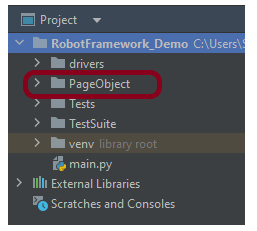
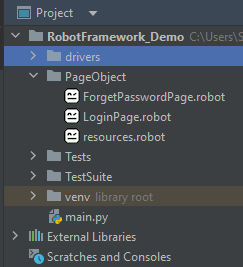
Right-Click on the project, select New->Directory and provide name as PageObject

Below is the image of the new directory.

Right-click on the new directory and select New File and provide the name as LoginPage.robot and ForgetPasswordPage.robot as shown below:

Step 3 – Download ChromeBinaries from the below location

The tests are going to use the Chrome browser, so we need to download the ChromeBinaries to open a blank browser in Chrome.

https://chromedriver.chromium.org/

The chromedriver and geckodriver are placed in a folder name drivers in the RobotFramework_Demo project. I have renamed chromedriver to chrome and geckodriver to firefox.

Step 4 – Create 2 Selenium Tests – LoginPage.robot and ForgetPasswordPage.robot

LoginPage.robot

*** Settings ***
Documentation       Tests to login to Login Page
Library     SeleniumLibrary

*** Variables ***
${valid_username}     Admin
${valid_password}       admin123
${invalid_username}     1234
${invalid_password}     45678
${blank_username}
${blank_password}
${url}      https://opensource-demo.orangehrmlive.com/web/index.php/auth/login
${browser_name}      Chrome
${login_error_message}      css:.oxd-alert-content--error
${dashboard_title}       css:.oxd-topbar-header-breadcrumb-module
${missing_username_error_message}    xpath://*[@class='oxd-form']/div[1]/div/span
${missing_password_error_message}   xpath://*[@class='oxd-form']/div[2]/div/span


*** Test Cases ***

Validate Unsuccessful Login using invalid credentials
    [Tags]    SMOKE
    Open the Browser with URL
    Fill the login form     ${valid_username}       ${invalid_password}
    Verify the error message is correct
    Close Browser Session

Validate Unsuccessful Login for blank username
    [Tags]    REGRESSION
    Open the Browser with URL
    Fill the login form     ${blank_username}       ${valid_password}
    Verify the error message is displayed for username
    Close Browser Session

Validate Unsuccessful Login for blank password
    [Tags]    SMOKE     REGRESSION
    Open the Browser with URL
    Fill the login form     ${valid_username}       ${blank_password}
    Verify the error message is displayed for password
    Close Browser Session

Validate successful Login
    [Tags]    UAT
    Open the Browser with URL
    Fill the login form     ${valid_username}       ${valid_password}
    Verify Dashboard page opens
    Close Browser Session

*** Keywords ***

Open the Browser with URL
    Create Webdriver    ${browser_name}  executable_path=/Vibha_Personal/RobotFramework_Demo/drivers/${browser_name}
    Go To       ${url}
    Maximize Browser Window
    Set Selenium Implicit Wait    5

Fill the login form
   [Arguments]    ${username}      ${password}
   Input Text    css:input[name=username]   ${username}
   Input Password    css:input[name=password]   ${password}
   Click Button    css:.orangehrm-login-button

Verify the error message is correct
    Element Text Should Be    ${login_error_message}    Invalid credentials

Verify Dashboard page opens
    Element Text Should Be    ${dashboard_title}      Dashboard

Verify the error message is displayed for username
     Element Text Should Be    ${missing_username_error_message}      Required

Verify the error message is displayed for password
      Element Text Should Be    ${missing_password_error_message}      Required

Close Browser Session
    Close Browser

ForgetPasswordPage.robot

*** Settings ***
Documentation       Tests to validate Forgot Your Password Page functionality
Library     SeleniumLibrary

*** Variables ***
${forgot_password_link}   xpath://div[@class='orangehrm-login-forgot']/p
${forgot_page_title}       css:.orangehrm-forgot-password-title
${username}     css:.oxd-input--active
${reset_btn}     css:.orangehrm-forgot-password-button--reset
${cancel_btn}    css:.orangehrm-forgot-password-button--cancel
${reset_message}      xpath://div[@class='orangehrm-card-container']/h6
${login_page_title}   xpath://*[@class='orangehrm-login-slot']/h5


*** Test Cases ***

Validate Reset Password Functionality

    Open the Browser with URL
    Go to Forgot Your Password Page
    Verify Forgot Your Password Page opens
    Fill the Forgot Password Page
    Verify the message
    Close Browser Session


Validate Cancel Functionality

    Open the Browser with URL
    Go to Forgot Your Password Page
    Verify Forgot Your Password Page opens
    Cancel the Reset Password
    Verify that Login Page is displayed
    Close Browser Session

*** Keywords ***

Open the Browser with URL
    Create Webdriver    ${browser_name}  executable_path=/Vibha_Personal/RobotFramework_Demo/drivers/${browser_name}
    Go To       ${url}
    Maximize Browser Window
    Set Selenium Implicit Wait    5

Go to Forgot Your Password Page
    Click Element      ${forgot_password_link}

Verify Forgot Your Password Page opens
    Element Text Should Be    ${forgot_page_title}      Reset Password

Fill the Forgot Password Page
   Input Text        ${username}     abc@gmail.com
   Click Button    ${reset_btn}

Verify the message
    Element Text Should Be    ${reset_message}      Reset Password link sent successfully

Cancel the Reset Password
    Click Button    ${cancel_btn}

Verify that Login Page is displayed
    Element Text Should Be    ${login_page_title}       Login

Close Browser Session
    Close Browser

Step 5 – Execute various Commands

5.1. Execute all tests in a Directory

When we want to execute all the tests present in a directory, we can use the below command:

robot  .

LoginPage contains 4 tests and ForgetPasswordPage contains 2 tests. The output of the above program is

5.2. Execute a test file

When we want to execute only 1 test file present in the directory, we can use the below command:

robot  LoginPage.robot

LoginPage contains 4 tests. The output of the above program executes 4 tests as shown below:

5.3. Execute a test by test name

When we want to execute a test by its name, we can use the below command:

robot -t "Validate successful Login" .

The output of the above program is

5.4. Execute a test by Regular Expression

When we don’t know the complete name of the test case, but a term or functionality, we can use a regular expression to find the test. Here, we have a test with the name “Validate Cancel Functionality” in “ForgetPasswordPage.robot”. So, the regular expression will find this test and will execute.

robot -t "*Cancel*" .

The output of the above program is

That’s it! Congratulations on making it through this tutorial and hope you found it useful! Happy Learning!!

How to rerun failed tests in Robot Framework

HOME

In this tutorial, we will rerun the failed tests in Robot Framework.

We occasionally experience rendering problems, which cause our Test Cases to fail. And we must run our complete Test Suite once more. This will be a major pain if you are working on a complicated project with many suite files or many Test Cases.

Rerunning only failed test cases after completion and providing a single report can alleviate this major pain in Robot Framework.

Robot Framework provides two attributes “–rerunfailed” and “–merge” merge will rerun the failure and merge the different results for a single report.

Prerequisite:

  1. Install Python
  2. Install PIP
  3. Install Robot Framework
  4. Install Robot framework Selenium Library
  5. Install PyCharm IDE

Please refer to this tutorial to install Robot Framework – How to install and setup Robot Framework for Python.

Implementation Steps:

Step 1.1 – Open PyCharm and create a new project. Go to File and select “New Project” from the main menu.

Step 2 – Choose the project location. Click the “Browse” button next to the Location field and specify the directory for your project.

Deselect the Create a main.py welcome script checkbox because you will create a new Python file for this tutorial.

Click on the “Create” Button.

Step 1.3 – A new dialog will appear asking to Open the project using any one of the given options. I have selected New Window as I like to have separate windows for each project.

Below is the image of the new project created in PyCharms.

Step 2 – Create a new directory in the new project

Right-Click on the project, select New->Directory and provide name as Tests

Below is the image of the new directory.

Right-click on the new directory and select New File and provide the name as RerunFailedTests.robot as shown below:

Step 3 – Download ChromeBinaries from the below location

The tests are going to use the Chrome browser, so we need to download the ChromeBinaries to open a blank browser in Chrome.

https://chromedriver.chromium.org/

The chromedriver is placed in a folder name drivers in the RobotFramework_Demo project.

Step 4 – Create a simple Selenium Test

*** Settings ***
Documentation       Tests to login to Login Page
Library     SeleniumLibrary

*** Variables ***
${valid_username}     Admin
${valid_password}       admin123
${invalid_username}     1234
${invalid_password}     45678
${blank_username}
${blank_password}
${url}      https://opensource-demo.orangehrmlive.com/web/index.php/auth/login
${browser_name}      Chrome
${login_error_message}      css:.oxd-alert-content--error
${dashboard_title}       css:.oxd-topbar-header-breadcrumb-module
${missing_username_error_message}    xpath://*[@class='oxd-form']/div[1]/div/span
${missing_password_error_message}   xpath://*[@class='oxd-form']/div[2]/div/span


*** Test Cases ***

Validate Unsuccessful Login using invalid credentials
    [Tags]    SMOKE
    Open the Browser with URL
    Fill the login form     ${valid_username}       ${invalid_password}
    Verify the error message is correct
    Close Browser Session

Validate Unsuccessful Login for blank username
    [Tags]    REGRESSION
    Open the Browser with URL
    Fill the login form     ${blank_username}       ${valid_password}
    Verify the error message is displayed for username
    Close Browser Session

Validate Unsuccessful Login for blank password
    [Tags]    SMOKE     REGRESSION
    Open the Browser with URL
    Fill the login form     ${valid_username}       ${blank_password}
    Verify the error message is displayed for password
    Close Browser Session

Validate successful Login
    [Tags]    UAT
    Open the Browser with URL
    Fill the login form     ${valid_username}       ${valid_password}
    Verify Dashboard page opens
    Close Browser Session

*** Keywords ***

Open the Browser with URL
    Create Webdriver    ${browser_name}  executable_path=/Vibha_Personal/RobotFramework_Demo/drivers/${browser_name}
    Go To       ${url}
    Maximize Browser Window
    Set Selenium Implicit Wait    5

Fill the login form
   [Arguments]    ${username}      ${password}
   Input Text    css:input[name=username]   ${username}
   Input Password    css:input[name=password]   ${password}
   Click Button    css:.orangehrm-login-button

Verify the error message is correct
    Element Text Should Be    ${login_error_message}    Invalid credentials

Verify Dashboard page opens
    Element Text Should Be    ${dashboard_title}      Dashboard

Verify the error message is displayed for username
     Element Text Should Be    ${missing_username_error_message}      Required

Verify the error message is displayed for password
      Element Text Should Be    ${missing_password_error_message}      Required!

Close Browser Session
    Close Browser

Step 5 – Execute the tests

We need the below command to run the Robot Framework script. This is the normal execution of your test suite and save your output in output1.xml

robot --output output1.xml RerunFailedTests.robot

The output of the above program is

Let us check the output1.xml file.

We can see that Test 3 failed here.

Below is the report generated by the Robot Framework

Now, let us rerun the failed tests using the below command. I intentionally failed my test in the last run. In this run, I will fix the test. I will change the expected result from Required! to Required. This checks the failure results in the output1.xml file and reruns the failures once again and saves the new result in the output2.xml file

robot --rerunfailed output1.xml --output output2.xml RerunFailedTests.robot

The output of the above program is

A new output file named output2.xml is generated.

Let us check the output2.xml file.

This command merges the previous XML file and recent XML file after re-run to show in a single report

rebot --output output1.xml --merge output1.xml output2.xml    

The output of the above program is

Check the Report generated by the Robot Framework. We can see all the tests are passed now.

That’s it! Congratulations on making it through this tutorial and hope you found it useful! Happy Learning!!