In Java, a properties file is a simple text-based file used to store configuration or settings in key-value pairs. It provides a convenient way to externalize application-specific parameters that can be easily modified without modifying the source code.
Properties File always stores information about the configuration parameters such as project configuration data such as URL, username, password, and project settings config like browser name, environment, and so on.
Properties files have a “.properties” extension.
How to write data in a Properties File in XML Format?
Java API got java.util.Properties class and it has several utility stores() methods to store properties in either Text or XML format. In order to store property in text format, Store() method can be used. storeToXML() is used to make in XML format.
You can write properties to a properties file using the Properties class. Create a Properties object and set the key-value pairs
Properties properties = new Properties();
properties.setProperty("username", "Vibha");
properties.setProperty("password", "XML");
Specify the output file path and create an FileOutputStream object.
FileOutputStream fileOutputStream = new FileOutputStream("src/test/resources/userCreatedXML.xml");
Write the properties to the output stream in XML format
properties.storeToXML(fileOutputStream, "Sample XML Properties file created");
Below is a complete example:
package org.example;

import java.io.FileInputStream;
import java.io.FileOutputStream;
import java.io.IOException;
import java.util.Properties;

public class WritePropertiesXMLExample {

    public static void main(String args[]) {

        Properties properties = new Properties();
        properties.setProperty("username", "Vibha");
        properties.setProperty("password", "XML");

        try {
            // userCreated.properties is created at the mentioned path
            FileOutputStream fileOutputStream = new FileOutputStream("src/test/resources/userCreatedXML.xml");

            // storeToXML() method is used to write the properties into properties xml file
            properties.storeToXML(fileOutputStream, "Sample XML Properties file created");
            fileOutputStream.close();
        } catch (IOException ex) {
            ex.printStackTrace();
        }
    }
}
FileOutputStream: This class is used to create or overwrite the existing property file.
Pass this stream into the “storeToXML()” method of “Properties”, which writes the contents of the “Properties” object into the file in XML Format.
The output of the above execution is
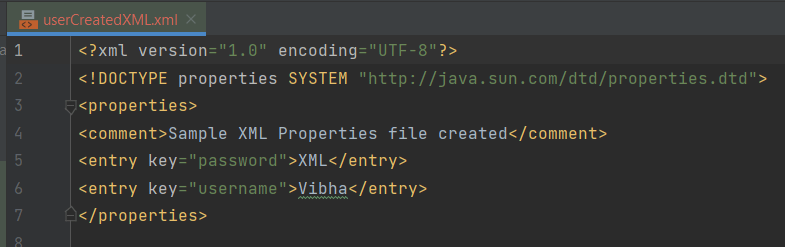
userCreatedXML.xml file is created in src/test/resources.
The userCreatedXML.xml file is shown below:
Thank you for completing this tutorial! I’m glad you found it helpful. Happy learning and cheers to your success!
In Java, a properties file is a simple text-based file used to store configuration or settings in key-value pairs. It provides a convenient way to externalize application-specific parameters that can be easily modified without modifying the source code.
Properties File always stores information about the configuration parameters such as project configuration data such as URL, username, password, and project settings config like browser name, environment, and so on.
Properties files have a “.properties” extension.
Why do we need a Properties File?
Properties files provide a convenient way to store configuration settings or parameters that can be easily modified without modifying the source code. It is not always a best practice to store the values as hardcoded in the project.
With properties files, you can have different versions of the file tailored for specific environments (e.g., development, testing, production). Each environment can have its own set of configurations while sharing a common structure and keys.
How to write data in a Properties File?
You can write properties to a properties file using the Properties class. Below is an example of how to do this:
package org.example;

import java.io.FileNotFoundException;
import java.io.FileOutputStream;
import java.io.IOException;
import java.util.Properties;

public class WritePropertiesExample {

    public static void main(String args[]) {

        // Creating properties files from Java program
        Properties properties = new Properties();

        try {
            // userCreated.properties is created at the mentioned path
            FileOutputStream fileOutputStream = new FileOutputStream("src/test/resources/userCreated.properties");

            properties.setProperty("username", "Vibha");
            properties.setProperty("password", "Admin");

            // store() method is used to write the properties into properties file
            properties.store(fileOutputStream, "Sample way of creating Properties file from Java program");

            fileOutputStream.close();
        } catch (IOException ex) {
            ex.printStackTrace();
        }
    }
}
FileOutputStream: This class is used to create or overwrite the existing property file.
Pass this stream into the “store()” method of “Properties”, which writes the contents of the “Properties” object into the file.
The output of the above execution is
userCreated.properties file is created in src/test/resources.
The userCreated.properties file is shown below:
Thank you for completing this tutorial! I’m glad you found it helpful. Happy learning and cheers to your success!
Are you familiar with Rest API and want to test your understanding? This post has 25 useful Rest API multiple-choice questions (quiz) to self-test your knowledge of Rest API.
You can find the questions for the below-mentioned answers in this post –
Here is a brief explanation of the different status codes
– 401: Unauthorized – The request requires user authentication. – 402: Payment Required – This status code is reserved for future use. – 403: Forbidden – The server understood the request but refuses to authorize it. – 404: Not Found – The server can’t find the requested page.
6) 1) 500
Here’s a brief explanation of the different status codes:
– 500: Internal Server Error – The server encountered an unexpected condition that prevented it from fulfilling the request. – 501: Not Implemented – The server either does not recognize the request method, or it lacks the ability to fulfill the request. – 502: Bad Gateway – The server received an invalid response from the upstream server while trying to fulfill the request. – 504: Gateway Timeout – The server, while acting as a gateway or proxy, did not receive a timely response from the upstream server.
7) 3) Success
8) 1) CREATE
CREATE is not an HTTP method. The standard HTTP methods include:
– GET: Retrieve data from a server. – POST: Send data to a server to create a resource. – PUT: Update or create a resource on the server with the provided data. – DELETE: Remove a resource from the server. – OPTIONS: Describe the communication options for the target resource. – HEAD: Similar to GET but without the response body. – PATCH: Apply partial modifications to a resource. – TRACE: Perform a message loop-back test along the path to the target resource. – CONNECT: Establish a tunnel to the server identified by the target resource.
It clearly indicates the resource (/users) and the specific item of that resource ({id}).
16) 1) 403
403: Forbidden – This status indicates that the server understands the request but refuses to authorize it.
404: Not Found – Indicates that the requested resource could not be found on the server.
406: Not Acceptable – Indicates that the server cannot generate a response that is acceptable to the client based on the accept headers sent in the request
409: Conflict – Indicates that the request could not be completed due to a conflict with the current state of the resource, such as a version control conflict.
17) 3) The resource requested has been found and moved temporarily to new URL location.
18) 4) Informational
19) 2) PUT updates the entire resource, while PATCH updates only specific fields of a resource
20) 2) It defines the format of the request payload
21) 3) It provides authentication credentials for accessing protected resources
22) 2) The property that a method can be called multiple times without different outcomes
23) 2) To retrieve the communication options available on a resource or server
Are you familiar with REST APIs and want to test your understanding? This post contains 25 useful REST API multiple-choice questions (quiz) to self-test your knowledge of REST API development.
16. Which of the following HTTP Status code means FORBIDDEN, states that user is not having access to method being used for example, delete access without admin rights?
1) 2) Representational State Transfer 2) 2) HTTP 3) 4) Request Header 4) 3) Both (1) and (2) 5) 2) 404 6) 1) 500 7) 3) Success 8) 1) CREATE 9) 1) POST 10) 2) PUT 11) 1) /{resource}/{resource-id}/{sub-resource}/{sub-resource-id} 12) 2) Created 13) 1) GET, POST, PUT, DELETE 14) 2) DELETE 15) 1) GET /users/{id} 16) 1) 403 17) 3) The resource requested has been found and moved temporarily to new URL location. 18) 4) Informational 19) 2) PUT updates the entire resource, while PATCH updates only specific fields of a resource 20) 2) It defines the format of the request payload 21) 3) It provides authentication credentials for accessing protected resources 22) 2) The property that a method can be called multiple times without different outcomes 23) 2) To retrieve the communication options available on a resource or server 24) 3) curl 25) 4) no-cache/no-store
A Data Driven Framework is a software testing framework that separates the test script logic from the test data. The test data is stored separately in external files like csv, xlsx, or databases that allows easy maintenance of the framework. In data driven framework, the test scripts retrieves the input values and expected results from the external source and write the actual result to the same source like spreadsheets, XML files, CSV files or database.
Project Structure
Here is the final snapshot of our project.
Dependency List
Selenium – 4.21.0
TestNG – 7.10.2
Apache POI – 5.2.5
Commons – 2.16.1
Maven Surefire – 3.2.5
Maven Compiler – 3.13.0
Java 17
Maven – 3.9.6
Implementation Steps
Step 1- Download and Install Java
Selenium needs Java to be installed on the system to run the tests. Click here to learn How to install Java.
Step 2 – Download and setup Eclipse IDE on the system
The Eclipse IDE (integrated development environment) provides strong support for Java developers, which is needed to write Java code. Click here to learn How to install Eclipse.
Step 3 – Setup Maven
To build a test framework, we need to add a number of dependencies to the project. It is a very tedious and cumbersome process to add each dependency manually. So, to overcome this problem, we use a build management tool. Maven is a build management tool that is used to define project structure, dependencies, build, and test management. Click here to learn How to install Maven.
In this example, we will access 2 web pages, “Login” and “Home” pages.
Hence, we will create 2 Java classes in Page Layer – LoginPage.java and HomePage.java and a BasePage class to initialize the driver using PageFactory.
BasePage
package com.example.pages;

import org.openqa.selenium.WebDriver;
import org.openqa.selenium.support.PageFactory;

public class BasePage {
    public WebDriver driver;

    public BasePage(WebDriver driver) {
        this.driver = driver;
        PageFactory.initElements(driver,this);
    }

}
LoginPage
package com.example.pages;

import com.example.utils.ExcelUtils;
import org.openqa.selenium.WebDriver;
import org.openqa.selenium.WebElement;
import org.openqa.selenium.support.FindBy;
import org.openqa.selenium.support.PageFactory;

public class LoginPage extends BasePage{

    public LoginPage(WebDriver driver) {
        super(driver);

    }

    @FindBy(name = "username")
    public WebElement userName;

    @FindBy(name = "password")
    public WebElement password;

    @FindBy(xpath = "//*[@class='oxd-form']/div[1]/div/span")
    public WebElement missingUsernameErrorMessage;

    @FindBy(xpath = "//*[@class='oxd-form']/div[2]/div/span")
    public WebElement missingPasswordErrorMessage;

    @FindBy(xpath = "//*[@class='oxd-form']/div[3]/button")
    public WebElement login;

    @FindBy(xpath = "//*[@id='app']/div[1]/div/div[1]/div/div[2]/div[2]/div/div[1]/div[1]/p")
    public  WebElement errorMessage;


    public void login(String strUserName, String strPassword) {

        userName.sendKeys(strUserName);
        password.sendKeys(strPassword);
        login.click();

    }

    public String getMissingUsernameText() {
        return missingUsernameErrorMessage.getText();
    }

    public String getMissingPasswordText() {
        return missingPasswordErrorMessage.getText();
    }

    public String getErrorMessage() {
        return errorMessage.getText();
    }

    public LoginPage saveTestResults(int row, int column) {
        ExcelUtils.rowNumber = row ;
        ExcelUtils.columnNumber = column;
        return this;
    }

}
HomePage
import org.openqa.selenium.WebDriver;
import org.openqa.selenium.WebElement;
import org.openqa.selenium.support.FindBy;
import org.openqa.selenium.support.PageFactory;

public class HomePage extends BasePage {

    public HomePage(WebDriver driver) {
        super(driver);

    }

    @FindBy(xpath = "//*[@id='app']/div[1]/div[1]/header/div[1]/div[1]/span/h6")
    public  WebElement homePageUserName;

    public String getHomePageText() {
        return homePageUserName.getText();
    }

}
Step 7 – Create an ExcelUtils Class
In order to manipulate excel files and do excel operations, we should create an excel file and called it “ExcelUtils” under utils package as shown below.
package com.example.utils;

import org.apache.poi.ss.usermodel.DataFormatter;
import org.apache.poi.xssf.usermodel.XSSFCell;
import org.apache.poi.xssf.usermodel.XSSFRow;
import org.apache.poi.xssf.usermodel.XSSFSheet;
import org.apache.poi.xssf.usermodel.XSSFWorkbook;

import java.io.FileInputStream;
import java.io.FileNotFoundException;
import java.io.FileOutputStream;
import java.io.IOException;

public class ExcelUtils {

    public static final String testDataExcelFileName = "testdata.xlsx"; //Global test data excel file
    public static final String currentDir = System.getProperty("user.dir");  //Main Directory of the project
    public static final String resourcePath = "\\src\\test\\resources\\";  //Main Directory of the project
    public static String testDataExcelPath = null; //Location of Test data excel file
    private static XSSFWorkbook excelWorkBook; //Excel WorkBook
    private static XSSFSheet excelWorkSheet; //Excel Sheet
    private static XSSFCell cell; //Excel cell
    private static XSSFRow row; //Excel row
    public static int rowNumber; //Row Number
    public static int columnNumber; //Column Number
    public static FileInputStream ExcelFile;
    public static DataFormatter formatter;
    public static FileOutputStream fileOut;


    // This method has two parameters: "Test data excel file name" and "Excel sheet name"
    // It creates FileInputStream and set excel file and excel sheet to excelWBook and excelWSheet variables.
    public static void setExcelFileSheet(String sheetName) throws IOException {

        testDataExcelPath = currentDir + resourcePath;

        // Open the Excel file
        ExcelFile = new FileInputStream(testDataExcelPath + testDataExcelFileName);
        excelWorkBook = new XSSFWorkbook(ExcelFile);
        excelWorkSheet = excelWorkBook.getSheet(sheetName);

    }

    //This method reads the test data from the Excel cell.
    public static String getCellData(int rowNum, int colNum) {
        cell = excelWorkSheet.getRow(rowNum).getCell(colNum);
        formatter = new DataFormatter();
        return formatter.formatCellValue(cell);
    }

    //This method takes row number as a parameter and returns the data of given row number.
    public static XSSFRow getRowData(int rowNum) {
        row = excelWorkSheet.getRow(rowNum);
        return row;
    }

    //This method gets excel file, row and column number and set a value to the that cell.
    public static void setCellData(String value, int rowNum, int colNum) throws IOException {
        row = excelWorkSheet.getRow(rowNum);
        cell = row.getCell(colNum);
        if (cell == null) {
            cell = row.createCell(colNum);
            cell.setCellValue(value);
        } else {
            cell.setCellValue(value);
        }

        // Write to the workbook
        fileOut = new FileOutputStream(testDataExcelPath + testDataExcelFileName);
        excelWorkBook.write(fileOut);
        fileOut.flush();
        fileOut.close();
    }
}
In this file, I wrote all excel operation methods.
setExcelFileSheet: This method has two parameters: “testdata.xlsx” and “LoginData”. It creates FileInputStream and set excel file and excel sheet to excelWorkBook and excelWorkSheet variables.
getCellData: This method reads the test data from the Excel cell. We are passing row numbers and column numbers as parameters.
getRowData: This method takes row number as a parameter and returns the data of the given row number.
setCellData: This method gets an excel file, row, and column number and sets a value to that cell.
Step 8 – Create a Listener Class
We need to create a TestNG Listener class to check the status of each of the test.
import com.example.tests.BaseTests;
import org.openqa.selenium.WebDriver;
import org.testng.ITestContext;
import org.testng.ITestListener;
import org.testng.ITestResult;
import java.io.IOException;

public class TestListener implements ITestListener {

    private static String getTestMethodName(ITestResult iTestResult) {
        return iTestResult.getMethod().getConstructorOrMethod().getName();
    }

    @Override
    public void onStart(ITestContext iTestContext) {
        System.out.println("I am in onStart method :" + iTestContext.getName());
    }

    @Override
    public void onFinish(ITestContext iTestContext) {
        System.out.println("I am in onFinish method :" + iTestContext.getName());
    }

    @Override
    public void onTestStart(ITestResult iTestResult) {
        System.out.println("I am in onTestStart method :" + getTestMethodName(iTestResult) + ": start");
    }

    @Override
    public void onTestSuccess(ITestResult iTestResult)  {
        System.out.println("I am in onTestSuccess method :" + getTestMethodName(iTestResult) + ": succeed");
        try {
            ExcelUtils.setCellData("PASSED", ExcelUtils.rowNumber, ExcelUtils.columnNumber);
        } catch (IOException e) {
            throw new RuntimeException(e);
        }
    }

    @Override
    public void onTestFailure(ITestResult iTestResult)  {
        System.out.println("I am in onTestFailure method :" + getTestMethodName(iTestResult) + " failed");
        try {
            ExcelUtils.setCellData("FAILED", ExcelUtils.rowNumber, ExcelUtils.columnNumber);
        } catch (IOException e) {
            throw new RuntimeException(e);
        }
    }

    @Override
    public void onTestSkipped(ITestResult iTestResult) {
        System.out.println("I am in onTestSkipped method :" + getTestMethodName(iTestResult) + ": skipped");
        try {
            ExcelUtils.setCellData("SKIPPED", ExcelUtils.rowNumber, ExcelUtils.columnNumber);
        } catch (IOException e) {
            throw new RuntimeException(e);
        }
    }

    @Override
    public void onTestFailedButWithinSuccessPercentage(ITestResult iTestResult) {
        System.out.println("Test failed but it is in defined success ratio " + getTestMethodName(iTestResult));
    }
}
Step 9 – Create a BaseTests Class
This BaseTests class contains the setup and tearDown methods to initialize the driver at the start of the test and exit the driver at the end of the test.
import org.openqa.selenium.WebDriver;
import org.openqa.selenium.chrome.ChromeDriver;
import org.openqa.selenium.chrome.ChromeOptions;
import org.testng.annotations.AfterMethod;
import org.testng.annotations.BeforeMethod;

import java.time.Duration;

public class BaseTests {

    public static WebDriver driver;
    public final static int TIMEOUT = 10;

    @BeforeMethod
    public void setup() {

        ChromeOptions options = new ChromeOptions();
        options.addArguments("--remote-allow-origins=*");
        options.addArguments("--no-sandbox");
        options.addArguments("--disable-dev-shm-usage");
        options.addArguments("--headless");
        driver = new ChromeDriver(options);
        driver.manage().window().maximize();
        driver.get("https://opensource-demo.orangehrmlive.com/");
        driver.manage().timeouts().implicitlyWait(Duration.ofSeconds(TIMEOUT));

    }

    @AfterMethod
    public void tearDown() {
        driver.quit();
    }

}
Step 10 – Create a Test Excel File
Create a test file – testdata.xlsx and place it in src/test/resources. I have stored the following data in the file.
Test Case Name – Name of the test case
Username
Password
ExpectedResponse – This is the response we expect to get from the execution for the particular test.
ActualResponse – This is the response we get after the execution of the particular test
Status – This could be pass, fail, skip
Step 11 – Create the Tests in src/test/java
In the below LoginPageTests class, we have 4 different tests and we are failing test – validCredentials() to show that the test result will be saved in testdata.xlsx file for both passed and failed tests.
package com.example.tests;

import com.example.pages.HomePage;
import com.example.pages.LoginPage;
import com.example.utils.ExcelUtils;
import com.example.utils.TestListener;
import org.openqa.selenium.WebDriver;
import org.testng.Assert;
import org.testng.annotations.BeforeTest;
import org.testng.annotations.Listeners;
import org.testng.annotations.Test;
import java.io.IOException;

@Listeners({TestListener.class })
public class LoginPageTests extends BaseTests{

    String actualResponse;

    @BeforeTest
    public void setupTestData() throws IOException {

        System.out.println("Setup Test Data");
        ExcelUtils.setExcelFileSheet("LoginData");
    }

    @Test
    public void invalidCredentials() throws IOException {

        LoginPage objLoginPage = new LoginPage(driver);
        objLoginPage.login(ExcelUtils.getCellData(1,1), ExcelUtils.getCellData(1,2));
        actualResponse = objLoginPage.getErrorMessage();
        ExcelUtils.setCellData(actualResponse,1,4);
        objLoginPage.saveTestResults(1,5);
        Assert.assertEquals(actualResponse,ExcelUtils.getCellData(1,3));
    }

    @Test
    public void missingUsername() throws IOException {

        LoginPage objLoginPage = new LoginPage(driver);
        objLoginPage.login(ExcelUtils.getCellData(2,1), ExcelUtils.getCellData(2,2));
        actualResponse = objLoginPage.getMissingUsernameText();
        ExcelUtils.setCellData(actualResponse,2,4);
        objLoginPage.saveTestResults(2,5);
        Assert.assertEquals(actualResponse,ExcelUtils.getCellData(2,3));
    }

    @Test
    public void missingPassword() throws IOException {

        LoginPage objLoginPage = new LoginPage(driver);
        objLoginPage.login(ExcelUtils.getCellData(3,1), ExcelUtils.getCellData(3,2));
        actualResponse = objLoginPage.getMissingPasswordText();
        ExcelUtils.setCellData(actualResponse,3,4);
        objLoginPage.saveTestResults(3,5);
        Assert.assertEquals(actualResponse,ExcelUtils.getCellData(3,3));
    }

    //Fail this test
    @Test
    public void validCredentials() throws IOException {

        LoginPage objLoginPage = new LoginPage(driver);
        objLoginPage.login(ExcelUtils.getCellData(4,1), ExcelUtils.getCellData(4,2));
        HomePage objHomePage = new HomePage(driver);
        actualResponse = objHomePage.getHomePageText();
        ExcelUtils.setCellData(actualResponse,4,4);
        objLoginPage.saveTestResults(4,5);
        Assert.assertEquals(actualResponse,ExcelUtils.getCellData(4,3));
    }

}
Step 12 – Create testng.xml at the root of the project
<?xml version="1.0" encoding="UTF-8"?>
<!DOCTYPE suite SYSTEM "https://testng.org/testng-1.0.dtd">
<suite name="Data Driven Framework">
    <test name="Login Test">
        <classes>
            <class name="com.example.tests.LoginPageTests"/>
        </classes>
    </test> <!-- Test -->
</suite> <!-- Suite -->
Step 13 – Run the tests through testng.xml
Right-click on the testng.xml and select “Run ..\testng.xml”.
The output of the above execution is
As expected, 3 test are passed and 1 test is failed.
The testdata.xlsx file will be updated with the actual response and the test execution status as shown in the below image.
Note – Make sure to close the excel workbook before starting the test execution, otherwise the test execution will be in the hung state.
Step 14 – View TestNG Reports
If you are using IntelliJ, the HTML Reports do not generate automatically. Go to the Configuration -> Listeners -> select Use default Reporters.
The TestNG Reports will be generated in test-output folder.
We are concerned about 2 reports – index.html and emailable-report.html.
index.html
emailable-report.html
Summary:
The test scripts in Data Driven Framework can be reused with different sets of test data.
The Test data can be easily modified without modifying the actual code implementation.
This framework has used excel as an external source to store the test data and test results.
In Java, a properties file is a simple text-based file used to store configuration or settings in key-value pairs. It provides a convenient way to externalize application-specific parameters that can be easily modified without modifying the source code.
Properties File is always storing information about the configuration parameters such as project configuration data such as URL, username, password, and project settings config like browser name, environment, and so on.
Properties files have a “.properties” extension.
Why do we need Properties File?
Properties files provide a convenient way to store configuration settings or parameters that can be easily modified without modifying the source code. It is not always a best practice to store the values as hard coded in the project.
With properties files, you can have different versions of the file tailored for specific environments (e.g., development, testing, production). Each environment can have its own set of configurations while sharing common structure and keys.
How to read data in a Properties File?
Steps to implement:
Let us create a properties file (name it as config.properties)
Add configuration data to the properties file.
Create a java class to read the config file (name it as ConfigFileReader)
1.Create a Property File
Create a text file with the “.properties“ extension and define key-value pairs in it. For example, create a file named “config.properties”.
2. Add configuration data to the properties file.
We have added the configuration data to the property file in key-value pairs :
FileInputStream: This class is used to read data from a file in the form of a sequence of bytes.load Method: The load method of the Properties class is used to read a properties file from an input stream.
The output of the above execution is
Congratulations on making it through this tutorial and hope you found it useful! Happy Learning!! Cheers!!
Are you familiar with Cucumber and want to test your understanding? This post contains 25 useful Cucumber multiple-choice questions (quiz) to self-test your knowledge of Cucumber.
You can find the questions for the below-mentioned answers in this post –
Are you familiar with Cucumber and want to test your understanding? This post has 25 useful Cucumber multiple-choice questions (quiz) to self-test your knowledge of Cucumber.
Scenario Outline: Login to Home Page
  Given user is logged in
  When user clicks <link>
  Then user will be logged out

  @mobile
  Examples:
    | link                   |
    |  mobile logout |

  @desktop
  Examples:
    | link                    |
    | desktop logout |
1) b) Selenium is the open-source test automated tool to test web-based UI which supports many different languages like Java, Python, Perl, PHP, Ruby, and C#.
2) a) Interface
WebDriver is an interface in Selenium which provides a simple interface to interact with and test web applications. It encompasses several implementations like ChromeDriver, FirefoxDriver, and others, each corresponding to different web browsers.
3) e) WebElement
WebElement is not considered a standalone component of Selenium; instead, it is an interface within Selenium WebDriver used to represent elements on a web page.
4) b) ASP
5) b) Compilation error- Cannot instantiate the type WebDriver
In Selenium, WebDriveris an interface, and you cannot instantiate an interface directly. You need to create an instance of a class that implements the WebDriverinterface, such as ChromeDriver, FirefoxDriver, etc.
WebDriver driver = new ChromeDriver();
6) c) Chromedriver
To run Selenium WebDriver scripts on the Chrome browser, we use ChromeDriver.
// Initialize ChromeDriver
WebDriver driver = new ChromeDriver();
7) d) i, ii, iii
8) a) thread.sleep();
It can be used to pause the execution in Java (and consequently in Selenium tests) for a specified duration, it is not considered a Selenium-specific wait mechanism.
11) b) driver.close() closes the current window and d) driver.quit() closes every associated window with this driver and quits the driver
12) b) //tag-name[@attribute=’attribute value’]
13) a) isDisplayed()
It returns true if the element is visible and false if it is not.
14) b) isEnabled()
It returns true if the element is enabled and false if it is not.
15) b) StaleElementReferenceException
This exception is thrown when a web element that was previously located is no longer present in the DOM (Document Object Model). If the web page is refreshed or modified after locating an element, the reference to that element may become stale, leading to this exception.
16) b) .*
17) a) WebElement element = driver.findElement(By.xpath(“//*[contains(text(), ‘ QAAutomation’)]”));
i. navigate().to("url") - driver.navigate().to("https://www.qaautomation.expert");
ii. open("url") - driver.get("https://www.qaautomation.expert");
20) a) sendKeys() is used to enter the text inthe textbox.
// Locate the text box element
WebElement textBox = driver.findElement(By.id("textboxId"));

// Enter text into the text box
textBox.sendKeys("Sample text");



 QA Automation Expert