To have a successful and effective implementation of a test framework, it is always advisable that the test framework supports test execution in multiple ways.
The most commonly used ways to execute tests in Cucumber Framework are by running the tests using JUnit and TestNG.
To execute tests using JUnit, we need to create a JUnit Test Runner. Whereas, we need a Maven project to execute Cucumber tests from Command-Line.
Table of Contents
Create a Maven project and add the below-mentioned dependencies to your Maven project.
<project xmlns="http://maven.apache.org/POM/4.0.0" xmlns:xsi="http://www.w3.org/2001/XMLSchema-instance"
  xsi:schemaLocation="http://maven.apache.org/POM/4.0.0 http://maven.apache.org/xsd/maven-4.0.0.xsd">
  <modelVersion>4.0.0</modelVersion>

  <groupId>com.example</groupId>
  <artifactId>Cucumber_TestNG_Demo</artifactId>
  <version>1.0-SNAPSHOT</version>
  <packaging>jar</packaging>

  <name>Cucumber_TestNG_Demo</name>
  <url>http://maven.apache.org</url>

  <properties>
    <project.build.sourceEncoding>UTF-8</project.build.sourceEncoding>
    <cucumber.version>7.15.0</cucumber.version>
    <selenium.version>4.16.1</selenium.version>
    <testng.version>7.9.0</testng.version>
    <maven.compiler.plugin.version>3.12.1</maven.compiler.plugin.version>
    <maven.surefire.plugin.version>3.2.3</maven.surefire.plugin.version>
    <maven.compiler.source.version>17</maven.compiler.source.version>
    <maven.compiler.target.version>17</maven.compiler.target.version>
  </properties>

  <dependencies>

    <dependency>
      <groupId>io.cucumber</groupId>
      <artifactId>cucumber-java</artifactId>
      <version>${cucumber.version}</version>
    </dependency>

    <dependency>
      <groupId>io.cucumber</groupId>
      <artifactId>cucumber-testng</artifactId>
      <version>${cucumber.version}</version>
      <scope>test</scope>
    </dependency>

    <!-- Selenium -->
    <dependency>
      <groupId>org.seleniumhq.selenium</groupId>
      <artifactId>selenium-java</artifactId>
      <version>${selenium.version}</version>
    </dependency>

    <!-- TestNG -->
    <dependency>
      <groupId>org.testng</groupId>
      <artifactId>testng</artifactId>
      <version>${testng.version}</version>
      <scope>test</scope>
    </dependency>

  </dependencies>
  <build>
    <plugins>
      <plugin>
        <groupId>org.apache.maven.plugins</groupId>
        <artifactId>maven-compiler-plugin</artifactId>
        <version>${maven.compiler.plugin.version}</version>
        <configuration>
          <source>${maven.compiler.source.version}</source>
          <target>${maven.compiler.target.version}</target>
        </configuration>
      </plugin>
      <plugin>
        <groupId>org.apache.maven.plugins</groupId>
        <artifactId>maven-surefire-plugin</artifactId>
        <version>${maven.surefire.plugin.version}</version>
        <configuration>
          <suiteXmlFiles>
            <suiteXmlFile>testng.xml</suiteXmlFile>
          </suiteXmlFiles>
        </configuration>
      </plugin>
    </plugins>
  </build>

</project>
For this tutorial, we are using 2 feature files.
LoginPage.feature
Feature: Login to HRM Application

  Background:
    Given User is on HRMLogin page "https://opensource-demo.orangehrmlive.com/"

  @ValidCredentials
  Scenario: Login with valid credentials

    When User enters username as "Admin" and password as "admin123"
    Then User should be able to login successfully

  @InvalidCredentials
  Scenario Outline: Login with invalid credentials

    When User enters username as "<username>" and password as "<password>"
    Then User should be able to see error message "<errorMessage>"

    Examples:
      | username   | password  | errorMessage                      |
      | Admin      | admin12$$ | Invalid credentials               |
      | admin$$    | admin123  | Invalid credentials               |
      | abc123     | xyz$$     | Invalid credentials               |
HomePage.feature
Feature: Login to Home

  Background:
    Given User is on HRMLogin page "https://opensource-demo.orangehrmlive.com/"

  @ValidCredentialsHome
  Scenario: Login with valid credentials to got to home page

    When User enters username as "Admin" and password as "admin123"
    Then User should be able to login successfully and new Home page opens
Run Test from Command Line
1. Running all the tests
1. Open the command prompt and change the directory to the project location where pom.xml is present.
C:\Users\Documents\Vibha\Automation\Cucumber_Selenium_TestNG
2. All feature files should be in src/test/resources and create the Cucumber Runner class as CucumberRunnerTest.
Note:- The Runner class name should end with Test to execute the tests from Command Line
Run the following command in the command prompt:
mvn clean test
mvn clean test runs Cucumber Features using Cucumber’s JUnit Runner. The @RunWith (Cucumber.class) annotation on the TestRunner class tells JUnit to start Cucumber. Cucumber runs time parses the command-line options to know what feature to run, where the Glue Code lives, what plugins to use, and so on.

3. The below screenshot shows that CucumberRunnerTest class is triggered.

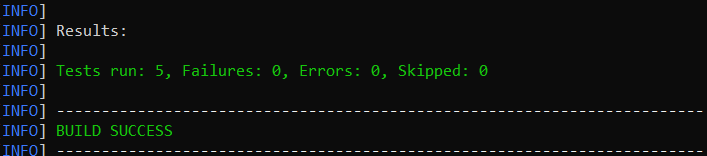
4. The below screenshot shows the build success output.
Cucumber provides several options that can be passed to on the command line.
2. Running Scenarios using Tags
If you are using Maven and want to run a subset of scenarios tagged with @ValidCredentials.
mvn clean test -Dcucumber.filter.tags="@ValidCredentials"
The output of the above program is

3. Running a Feature file
Suppose you want to run a single Feature File from the command line, then use the below syntax
mvn clean test -Dcucumber.features="src/test/resources/features/HomePage.feature"
The output of the above program is

4. Creating Cucumber Report from Command Line
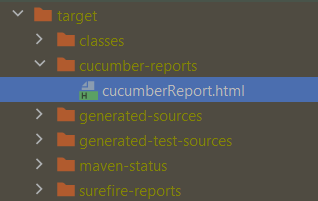
If we want to generate a different report, then we can use the following command and see the HTML report generate at the location mentioned:
mvn clean test -Dcucumber.plugin="html:target/cucumber-reports/cucumberReport.html"

The output of the above program is
5. Passing multiple Parameters
If we want to pass more than one parameter, then we can use the following command
mvn clean test -Dcucumber.features="src/test/resources/features/LoginPage.feature" -Dcucumber.filter.tags="@ValidCredentials"
The output of the above program is

6. Running a Scenario without a tag
If we want to run a single Scenario from the command line and no tag is assigned to that scenario, this is how we specify
mvn clean test -Dcucumber.features="src/test/resources/features/LoginPage.feature:7"

The output of the above program is

That’s it! Congratulations on making it through this tutorial and hope you found it useful! Happy Learning!!
In the next tutorial, I explained to run Cucumber Gradle tests from Command Line.
 QA Automation Expert
Running a Feature file from Command Line
not working anymore ?
cucumber ver 7.3
LikeLike
I have tried and we can run a feature file from commandline with version 7.3.1 using same command : mvn test -Dcucumber.options=”src/test/resources/features/Login.feature”. To run a particular tag, this command works : mvn test -Dcucumber.filter.tags=”@InvalidCredentials”
LikeLike
you have to use “cucumber.features” instead of “cucumber.options”
LikeLike
how to run mulitple feature files, each feature file has its own tag and i have mentioned it in the pom.xml file, I want to run it from the mvn command prompt. Kindly help. Its needed urgently for me.
LikeLike
Hi, there are many ways to do this.
1. mvn clean test -Dcucumber.filter.tags=”@Login or @Home” (if you have assigned tags to the feature file)
2. mvn clean test -Dcucumber.features=”src/test/resources/features/HomePage.feature -Dcucumber.features=”src/test/resources/features/LoginPage.feature” (using name of the feature file)
LikeLike
mvn test -Dcucumber.options=”–tags @TC1″
and mvn test -Dcucumber.options=”–help”
it runs the cucumber test cases but not the desired action it performs, for example, when running mvn test _dcucumber.options”–tags @TC1″ it runs @TC2 since I mentioned that in the TestRunner class, it doesn’t override similarly I tried various cmd, and it executes the tests but not the desired actions
LikeLike
is their any suggestion or solution
LikeLike
mvn clean test -Dcucumber.filter.tags=”@TC1″. Use this command to run a specific tag through command line by overriding the testrunner tags.
LikeLike
test -Dcucumber.filter.tags=”@TC1″. this works other than other commands like
mvn test -Dcucumber.options=”–plugin junit:target/cucumber-reports/cucumberReport.xml
or this
mvn test -Dcucumber.options=”src/test/resources/features/CucumberTagsExample.feature:12″
it doesn’t work it is running the whole test scenarios
LikeLike
-Dcucumber.options is no longer supported. So, when we will use this command, it will run all the tests. Now, we have different commands for features, plugins in cucumber. I have updated the tutorial with the new commands
LikeLike
test -Dcucumber.filter.tags=”@TC1″. this works other than other commands like
mvn test -Dcucumber.options=”–plugin junit:target/cucumber-reports/cucumberReport.xml
or this
mvn test -Dcucumber.options=”src/test/resources/features/CucumberTagsExample.feature:12″
it doesn’t work it is running the whole test scenarios
LikeLike
I tried above script with junit getting below error.
“Using auto detected provider org.apache.maven.surefire.junitplatform.JUnitPlatformProvider”
LikeLike
mvn clean test -Dcucumber.features=”src/test/resources/features/HomePage.feature”
While running above command , getting Unknown lifecycle phase error from CLI.
LikeLike
I know it happens sometimes with some messed up windows configuration. In that case, try using the command like this ( mvn clean test -D”cucumber.features=src/test/resources/features/HomePage.feature”)
LikeLike