Table of Content
- What is Grouped Assertions in JUnit5?
- What is JUnit5?
- Types of AssertAll assertions
What is Grouped Assertions in JUnit5?
Grouped assertions in JUnit 5 help make your tests cleaner and more readable by allowing you to group related assertions together with a single failure message if any of them fail. This is particularly useful when you want to ensure that multiple conditions are true in a given test scenario.
JUnit 5 supports an additional Assertion feature called Grouped assertions. In JUnit4, when you have to assert let’s say – 3 different conditions, then you need to write 3 different assertions and they will be executed sequentially. Imagine, 2nd assertion fails, then the program stops there and will not go to the 3rd assertion. To overcome this problem, JUnit5 has a new assertion called Grouped assertion that execute all the conditions present within it using assertAll(), irrespective of the fact if any assertion fails or not and generate a consolidated report with all the failures. To be honest, I love this feature and use very frequently.
All JUnit Jupiter assertions are static methods. They come from class:
org.junit.jupiter.api.Assertions
What is JUnit5?
JUnit 5 is composed of several different modules from three different sub-projects.
JUnit 5 = JUnit Platform + JUnit Jupiter + JUnit Vintage
The JUnit Platform serves as a foundation for launching testing frameworks on the JVM. It also defines the Test Engine API for developing a testing framework that runs on the platform.
JUnit Jupiter is the combination of the new programming model and extension model for writing tests and extensions in JUnit 5. The Jupiter sub-project provides a Test Engine for running Jupiter-based tests on the platform.
JUnit Vintage provides a Test Engine for running JUnit 3 and JUnit 4 based tests on the platform. It requires JUnit 4.12 or later to be present on the classpath or module path.
To use JUnit5, add the Junit5 maven dependency to the POM.xml
<dependency>
    <groupId>org.junit.jupiter</groupId>
    <artifactId>junit-jupiter-engine</artifactId>
    <version>511.4</version>
    <scope>test</scope>
</dependency>

<dependency>
	<groupId>org.junit.jupiter</groupId>
	<artifactId>junit-jupiter-api</artifactId>
    <version>5.11.4</version>
	<scope>test</scope>
</dependency>
Types of AssertAll assertions
Grouped Assertions With Heading As Parameter
Grouped Assertions with Same Assertion Type
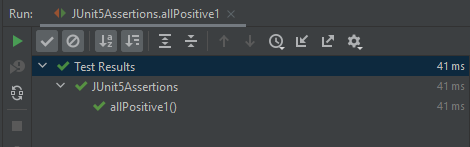
Example 1 – The following example demonstrates positive assertions using `assertAll()` in JUnit 5. All assertions in this example are of the same type, specifically `assertEquals()`, grouped within an `assertAll()` assertion. The heading parameter for this group of assertions is “GroupedAssertionsWithSameAssertionType”.
@Test
void allPositive1() {
   assertAll(
     "GroupedAssertionsWithSameAssertionType",
      () -> assertEquals(8, 5+3, "8 is not sum of 5 and 3"),
      () -> assertEquals("java", "JAVA".toLowerCase()),
      () -> assertEquals(16,4*4,"16 is not product of 4 and 4")
   );
}
Result
As all 3 assertions pass, so the final result passes.
Grouped Assertions with Different Assertion Types
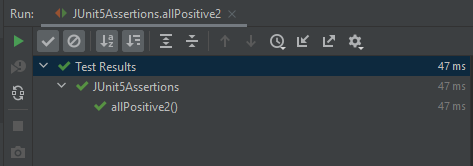
Example 2 – The following example demonstrates using `assertAll()` in JUnit 5 to group assertions of different types – assertEquals(), assertNotNull and assertNotEquals() within a single test. It consists of the heading parameter with the value “GroupedAssertionsWithDifferentAssertionType”.
@Test
void allPositive2() {

    String str ="Spring";
    assertAll(
        "GroupedAssertionsWithDifferentAssertionType",
         () -> assertEquals(8, 5+3, "8 is not sum of 5 and 3"),
         () -> assertNotNull(str, () -> "The string should be null"),
         () -> assertEquals("java", "JAVA".toLowerCase()),
         () -> assertNotEquals(20,5*3,"20 is product of 5 and 3")
    );
 }
Result
As all 3 assertions pass, so the final result passes.
Grouped Assertions with multiple failure
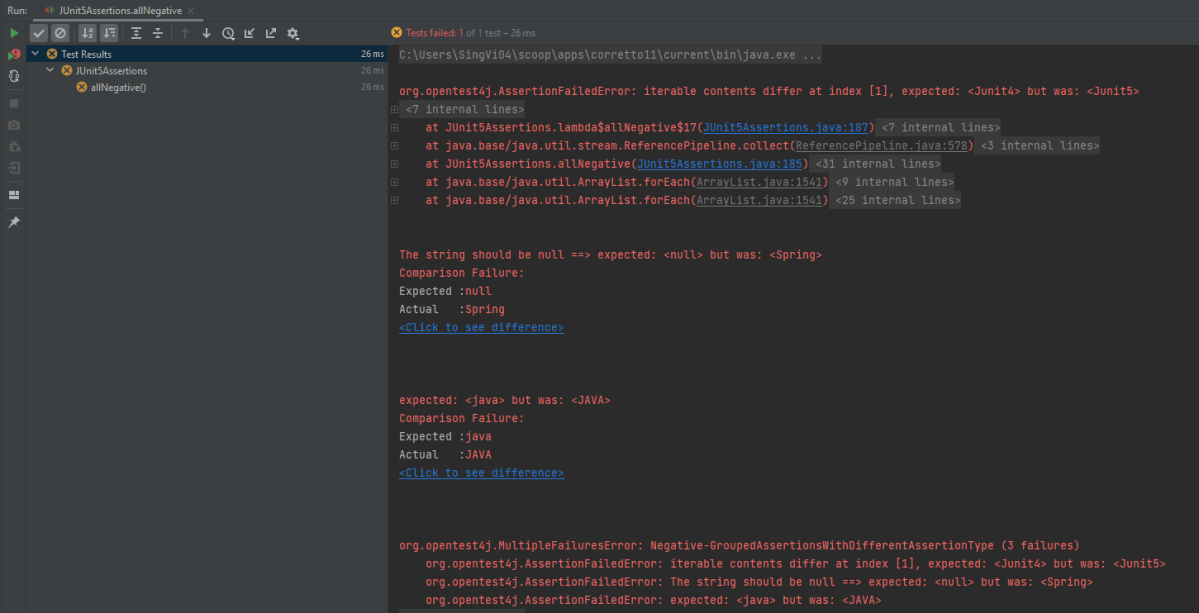
Example 3 – In the below example, out of 4 assertions, 3 assertions are failing, so the output will have the detail about all 3 assertion errors.
 @Test
 void allNegative() {

    String str ="Spring";
    Iterable<String> iterat1 = new ArrayList<>(asList("Java", "Junit4", "Test"));
    Iterable<String> iterat2 = new ArrayList<>(asList("Java", "Junit5", "Test"));

    assertAll(
        "Negative-GroupedAssertionsWithDifferentAssertionType",
        () -> assertIterableEquals(iterat1, iterat2),
        () -> assertNull(str, () -> "The string should be null"),
        () -> assertEquals("java", "JAVA"),
        () -> assertNotEquals(20,5*3,"20 is product of 5 and 3")
     );
 }
Result
As one of the asserts in the group fails, instead of AssertionFailureError it results in MultipleFailuresError thereby displaying the heading of the grouped assertion passed as the input parameter i.e. Negative-GroupedAssertionsWithDifferentAssertionType in this example. This image shows all the 3 assertion failures.
Assertion 1 fails as we were expecting JUnit4, but response has JUnit5
Assertion 2 fails as the string was not NULL.
Assertion 3 fails as Java is not equal to JAVA (case sensitivity).
Grouped Assertions Without Heading As Parameter
Grouped Assertions with Same Assertion Type
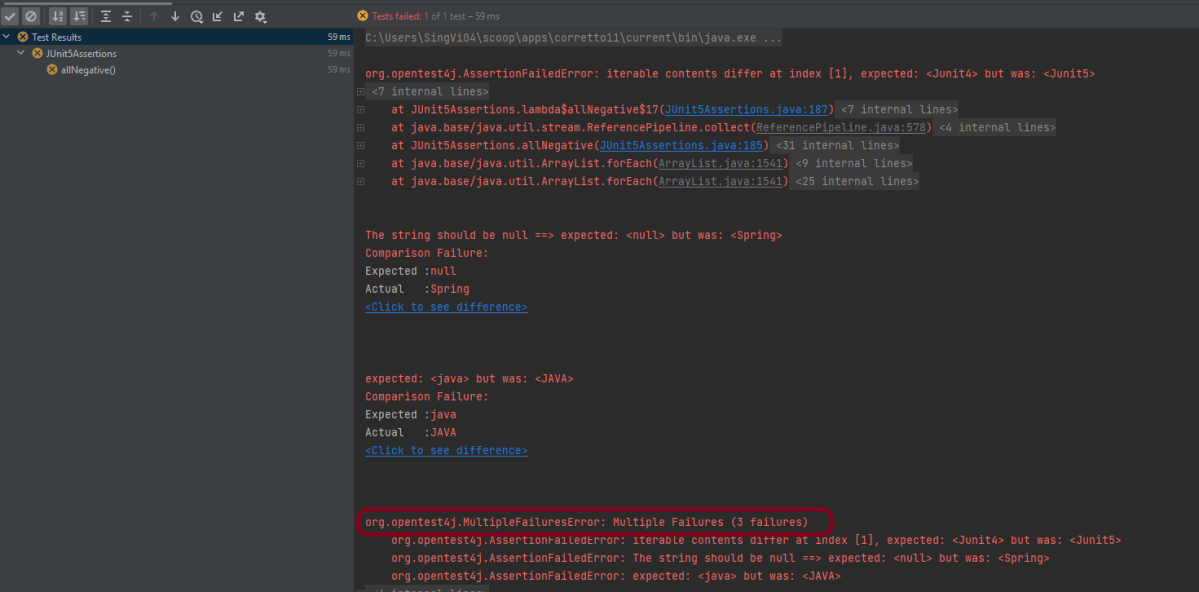
The assertAll () can be implemented without using the heading parameter. The below example is the same as the above one, we are just skipping the heading part.
@Test
void allNegative() {

      String str ="Spring";
      Iterable<String> iterat1 = new ArrayList<>(asList("Java", "Junit4", "Test"));
      Iterable<String> iterat2 = new ArrayList<>(asList("Java", "Junit5", "Test"));

     // In a grouped assertion all assertions are executed, and all failures will be reported together
      assertAll(
          () -> assertIterableEquals(iterat1, iterat2),
          () -> assertNull(str, () -> "The string should be null"),
          () -> assertEquals("java", "JAVA"),
          () -> assertNotEquals(20,5*3,"20 is product of 5 and 3")
      );
  }
Result
The result displays without a heading.
Nested Or Dependent Grouped Assertions
Example with Outer assertAll() Passing and Nested assertAll() Executing
When one assertAll() includes one or more assertAll() then these are referred to as Nested or Dependent grouped assertions.
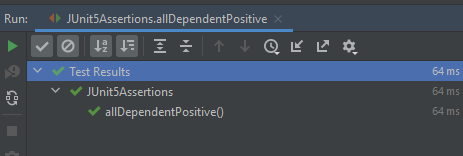
Example 1 – In this case, first, the assertAll() validates if the sum is correct or not. The sum is correct here, so the control moves to the nested assertAll() to verify all the assertions present within it.
@Test
void allDependentPositive() {

   String str ="Spring";

   // Within a code block, if an assertion fails the subsequent code in the same block will be skipped.
    assertAll(
         "DependentPositiveAssertions",
         () -> {
                assertEquals(8, 5 + 3, "8 is not sum of 5 and 3");

                // Executed only if the previous assertion is valid.
                assertAll("sub-heading",
                   () -> assertNotNull(str, () -> "The string should be null"),
                   () -> assertEquals("java", "JAVA".toLowerCase()),
                   () -> assertEquals(20, 5 * 4, "20 is product of 5 and 4")
                ); // end of inner AssertAll()
           }

      );  // end of outer AssertAll()
 }
Result
All the assertions within nested assertAll() are passes. So the final result passes.
Example of Outer AssertAll() Causing Nested AssertAll() Not to Execute
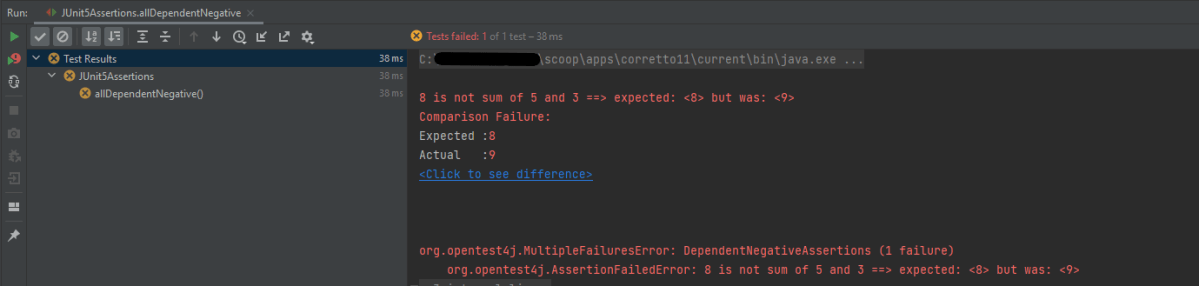
Example 2 – In the below example, outer AssertAll() fails, so all the assertions within nested/dependent assertAll() are not executed.
 @Test
 void allDependentNegative() {

    String str ="Spring";

    // Within a code block, if an assertion fails the subsequent code in the same block will be skipped.
    assertAll(
       "DependentPositiveAssertions",
        () -> {
                assertEquals(8, 5 + 4, "8 is not sum of 5 and 3");

                // Executed only if the previous assertion is valid.
                assertAll("sub-heading",
                   () -> assertNull(str, () -> "The string should be null"),
                   () -> assertNotEquals("java", "JAVA".toLowerCase()),
                   () -> assertNotEquals(20, 5 * 4, "20 is product of 5 and 4")
               ); // end of inner AssertAll()
           }

        ); // end of outer AssertAll()
    }
Result
Example of Outer AssertAll() allows Nested AssertAll(), but nested AssertAll fails
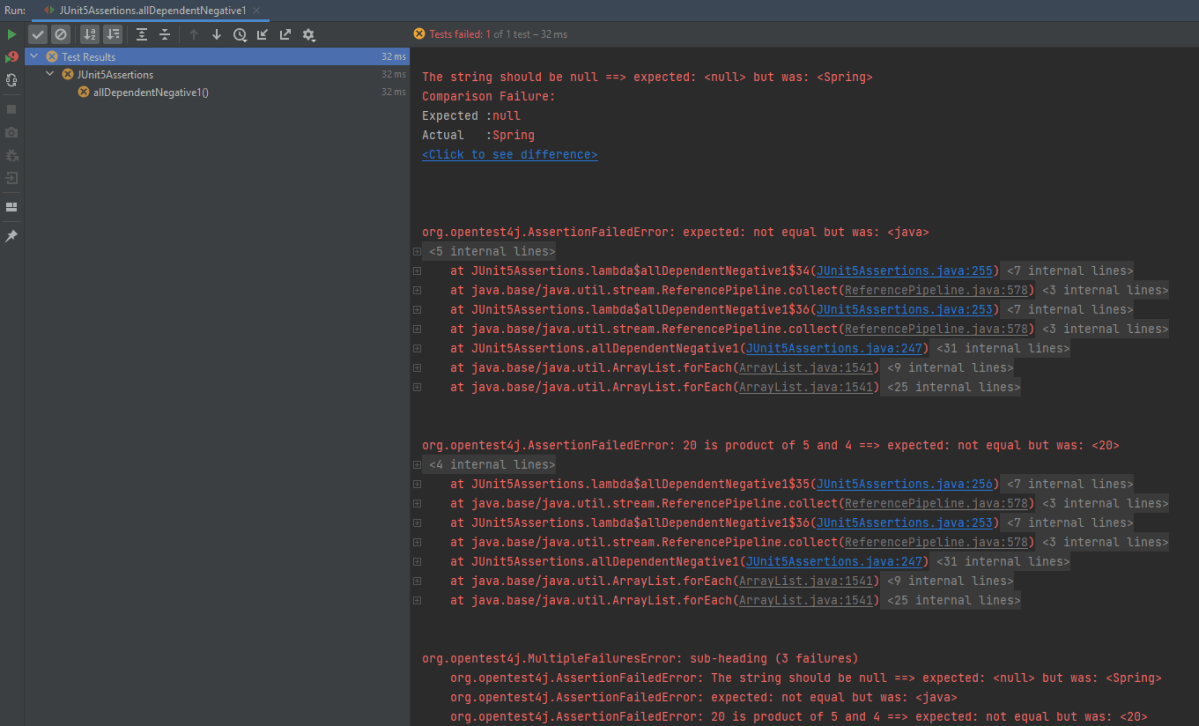
Example 3 – In the below example, outer AssertAll() passes, so all the assertions within nested/dependent assertAll() are executed. But due to the failure of assertNull, the nested assertions are not evaluated, and the report will indicate the failure of `assertNull` first
@Test
void allDependentNegative1() {

    String str ="Spring";

   // Within a code block, if an assertion passes the subsequent code in the same block will be executed.
    assertAll(
      "DependentNegativeAssertions",
      () -> {
             assertEquals(8, 5 + 3, "8 is not sum of 5 and 3");

             // Executed only if the previous assertion is valid.
             assertAll("sub-heading",
               () -> assertNull(str, () -> "The string should be null"),
               () -> assertNotEquals("java", "JAVA".toLowerCase()),
               () -> assertNotEquals(20, 5 * 4, "20 is product of 5 and 4")
             ); // end of inner AssertAll()
         }

      ); // end of outer AssertAll()
    }
Result
The nested assertions have failed. So they can be seen in the execution status.
In short,
- When first assertAll() method passes, then all the subsequent assertions within that block will be executed and these assertions can further pass or fails.
- When the first assertAll() assertion fails, then the execution of subsequent assertions is skipped.
That’s it! Congratulations on making it through this tutorial and hope you found it useful! Happy Learning!!
 QA Automation Expert