Security testing is crucial in software testing. It helps identify security threats early. Addressing these threats resolves potential problems for you and your users.
In this article, we will discuss the basics of security testing in software testing. We will cover what it is and why it is important.
Table of Content
- What is Security Testing?
- Why Security Testing is Important?
- Types of Security Testing
- Security testing in software development
What is Security Testing?
Security testing is a critical process in the software development lifecycle. It aims at identifying vulnerabilities in software applications and systems. It also focuses on mitigating these threats. The goal of the process is to discover potential security breaches, misconfigurations, and malicious code which could compromise the system. Security testing methods include penetration testing, vulnerability scanning, and code reviews.
Why Security Testing is Important?
1.Identify Vulnerabilities: Security testing helps detect vulnerabilities in software applications. These include weaknesses like SQL injection, cross-site scripting (XSS), and buffer overflow. It evaluates how well the application or system can withstand potential attacks and unauthorized intrusions.
2. Maintain User Trust: Implementing robust security testing helps build trust between users and organizations. Users are more likely to engage with platforms that demonstrate a strong commitment to data security and privacy.
3. Compliance and Legal Requirements: Organizations often need to comply with regulatory standards such as GDPR, HIPAA, or PCI DSS. Security testing helps ensure that systems adhere to these requirements and avoid legal repercussions. Example includes
- The Payment Card Industry Data Security Standard (PCI DSS) for credit card data.
- The System and Organization Controls 2 (SOC 2) for handling data stored in the cloud.
- The Health Insurance Portability and Accountability Act (HIPPA) for safeguarding sensitive patient information.
4. Ensure Data Protection: Testing confirms whether sensitive data is properly protected against unauthorized access and data breaches. This includes evaluating encryption methods, data transmission security, and access controls.
Types of Security Testing
1.Vulnerability Scan – Vulnerability scanning is the process of scanning software for known vulnerabilities or weaknesses. This type of testing involves using automated testing tools like Burp Suite, Open VAS, Acunetix and so on to identify potential security flaws in your software. Examples of such flaws include outdated software components, weak passwords, or insecure network configurations.
2. Penetration Testing – It takes the proactive approach of simulating real-world cyber attacks. Ethical hackers are employed to mimic the tactics of malicious actors. This provides valuable insights into the software’s strengths and weaknesses.
Penetration testers look out for vulnerabilities associated with authentication and authorization flaws. It also looks out for security weaknesses related to network configurations, such as open ports or unencrypted network traffic.
3. Risk Assessment – Risk assessment involves identifying potential threats to your software. It also involves assessing the likelihood and negative impacts of those threats. This type of testing typically involves analyzing the software’s architecture, design, and implementation. The goal is to identify potential security risks. Examples of these risks include data breaches, denial of service (DOS) attacks, or malware and viruses.
4. Security Scanning – Security scanning involves using automated tools to scan software for potential security vulnerabilities. These tools may include software or hardware-based scanners that can detect a wide range of security issues.
Security scanning may include tests for common vulnerabilities such as SQL injection, cross-site scripting (XSS), and buffer overflow attacks.
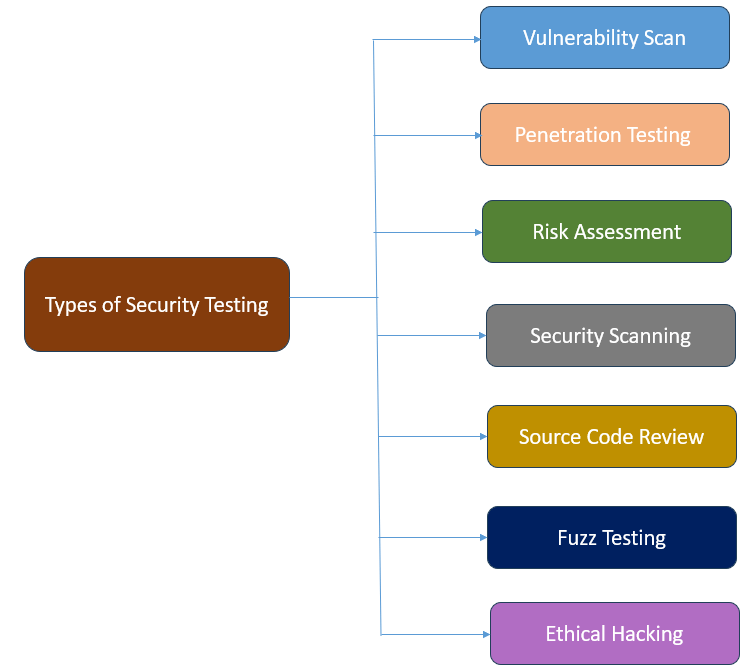
5. Source Code Review – The primary aim of source code review is to detect security flaws. It also identifies logical errors and vulnerabilities. This is done by manually or automatically examining the source code of the application. The review process often involves more than one person. Independent security experts, rather than the development team, usually conduct it. This way, the specialists can identify and report potential security and functional issues. As a result, the quality of the product and its security is improved.
6. Fuzz Testing – Fuzz testing is used to identify vulnerabilities, bugs, and security loopholes in software applications by inputting a large volume of random, unexpected, or invalid data into the application. The focus is on testing the application’s robustness and error-handling capabilities, often without knowledge of the source code.
7. Ethical Hacking – Ethical hacking is a cybersecurity practice where an authorized individual, known as an ethical hacker or a white-hat hacker, simulates potential attacks on a computer system or network. The primary aim is to identify and fix security vulnerabilities before malicious hackers can exploit them. Some of these vulnerabilities include phishing attacks, social engineering attacks, or physical security breaches.
Security testing in software development
Security testing can be effectively incorporated into different stages of the Software Development Lifecycle (SDLC):
Requirement Analysis – At this stage, security requirements should be identified, documented, and integrated into the project scope. Use threat modeling to anticipate potential security threats and define security controls needed to mitigate them.
Design Phase – Conduct security reviews of the design and architecture. Evaluate the architecture for security best practices like secure communication protocols, authentication mechanisms, and data encryption.
Development – Educate developers on secure coding practices, and include guidelines for writing secure code. Integrate Static Application Security Testing (SAST) tools to scan the code for vulnerabilities as it is being written.
Testing – Perform Dynamic Application Security Testing (DAST) on the running application to identify vulnerabilities. Conduct penetration testing to simulate real-world attacks and explore the application’s resilience.
Deployment: Ensure that the deployment environment is securely configured. Conduct security scanning and audits to verify the security posture of the application and its environment.
Maintenance: Regularly monitor, update, and re-assess the application for security vulnerabilities as new threats emerge. Perform periodic security audits and compliance checks to confirm ongoing adherence to security standards.
 QA Automation Expert