Integration Testing of Springboot with Cucumber and TestNG

HOME

In this tutorial, I am going to build an automation framework to test the Springboot application with Cucumber, Rest Assured, and TestNG.

What is Springboot?

Spring Boot is an open-source micro-framework maintained by a company called Pivotal. It provides Java developers with a platform to get started with an auto-configurable production-grade Spring application. With it, developers can get started quickly without losing time on preparing and configuring their Spring application.

What is Cucumber?

Cucumber is a software tool that supports behavior-driven development (BDD). Cucumber can be defined as a testing framework, driven by plain English. It serves as documentation, automated tests, and development aid – all in one.

This framework consists of:

  1. Springboot – 2.5.2
  2. Cucumber – 7.3.4
  3. Java 11
  4. TestNG – 7.3.4
  5. Maven – 3.8.1
  6. RestAssured – 5.1.1

Steps to setup Cucumber Test Automation Framework for API Testing using Rest-Assured

  1. Add SpringbootTest, Rest-AssuredJUnit, and Cucumber dependencies to the project
  2. Create a source folder src/test/resources and create a feature file under src/test/resources
  3. Create the Step Definition class or Glue Code for the Test Scenario under the src/test/java directory
  4. Create a Cucumber Runner class under the src/test/java directory
  5. Run the tests from Cucumber Test Runner
  6. Run the tests from Command Line
  7. Run the tests from TestNG
  8. Generation of TestNG Reports
  9. Cucumber Report Generation

Below is the structure of a SpringBoot application project
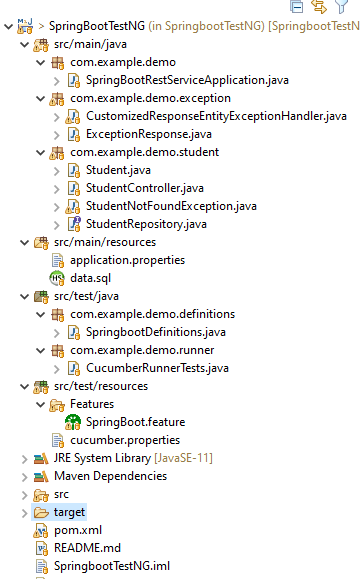
We need the below files to create a SpringBoot Application.

SpringBootRestServiceApplication.java

The Spring Boot Application class is generated with Spring Initializer. This class acts as the launching point for the application.

import org.springframework.boot.SpringApplication;
import org.springframework.boot.autoconfigure.SpringBootApplication;

@SpringBootApplication
public class SpringBootRestServiceApplication {

    public static void main(String[] args) {

        SpringApplication.run(SpringBootRestServiceApplication.class, args);
    }
}

Student.java

This is JPA Entity for Student class

import javax.persistence.Entity;
import javax.persistence.GeneratedValue;
import javax.persistence.Id;
import javax.validation.constraints.NotBlank;
import javax.validation.constraints.NotNull;
import javax.validation.constraints.Size;

@Entity
public class Student {
    @Id
    @GeneratedValue
    private Long id;

    @NotNull
    @Size(min = 4, message = "Name should have atleast 4 characters")
    private String name;

    @NotBlank(message = "passportNumber is mandatory")
    private String passportNumber;

    public Student() {
        super();
    }

    public Student(Long id, String name, String passportNumber) {
        super();
        this.id = id;
        this.name = name;
        this.passportNumber = passportNumber;
    }

    public Long getId() {
        return id;
    }

    public void setId(Long id) {
        this.id = id;
    }

    public String getName() {
        return name;
    }

    public void setName(String name) {
        this.name = name;
    }

    public String getPassportNumber() {
        return passportNumber;
    }

    public void setPassportNumber(String passportNumber) {
        this.passportNumber = passportNumber;
    }
}

StudentRepository.java 

This is JPA Repository for Student. This is created using Spring Data JpaRepository.

import org.springframework.data.jpa.repository.JpaRepository;
import org.springframework.stereotype.Repository;

@Repository
public interface StudentRepository extends JpaRepository<Student, Long>{

}

StudentController.java

Spring Rest Controller exposes all services on the student resource.

import static org.springframework.hateoas.server.mvc.WebMvcLinkBuilder.linkTo;
import static org.springframework.hateoas.server.mvc.WebMvcLinkBuilder.methodOn;
import java.net.URI;
import java.util.List;
import java.util.Optional;
import javax.validation.Valid;
import org.springframework.beans.factory.annotation.Autowired;
import org.springframework.hateoas.EntityModel;
import org.springframework.hateoas.server.mvc.WebMvcLinkBuilder;
import org.springframework.http.ResponseEntity;
import org.springframework.web.bind.annotation.GetMapping;
import org.springframework.web.bind.annotation.PathVariable;
import org.springframework.web.bind.annotation.PostMapping;
import org.springframework.web.bind.annotation.RequestBody;
import org.springframework.web.bind.annotation.RestController;
import org.springframework.web.servlet.support.ServletUriComponentsBuilder;

@RestController
public class StudentController {

    @Autowired
    private StudentRepository studentRepository;

    @GetMapping("/students")
    public List<Student> retrieveAllStudents() {
        return studentRepository.findAll();
    }

    @GetMapping("/students/{id}")
    public EntityModel<Student> retrieveStudent(@PathVariable long id) {
        Optional<Student> student = studentRepository.findById(id);

        if (!student.isPresent())
            throw new StudentNotFoundException("id-" + id);

        EntityModel<Student> resource = EntityModel.of(student.get());

        WebMvcLinkBuilder linkTo = linkTo(methodOn(this.getClass()).retrieveAllStudents());

        resource.add(linkTo.withRel("all-students"));

        return resource;
    }

    @PostMapping("/students")
    public ResponseEntity<Object> createStudent(@Valid @RequestBody Student student) {
        Student savedStudent = studentRepository.save(student);

        URI location = ServletUriComponentsBuilder.fromCurrentRequest().path("/{id}")
                .buildAndExpand(savedStudent.getId()).toUri();

        return ResponseEntity.created(location).build();

    }
}

application.properties

Spring Boot automatically loads the application.properties whenever it starts up. You can de-reference values from the property file in the java code through the environment.

spring.jpa.defer-datasource-initialization=true

data.sql 

Data is loaded from data.sql into the Student table. Spring Boot would execute this script after the tables are created from the entities.

insert into student values(10001,'Annie', 'E1234567');
insert into student values(20001,'John', 'A1234568');
insert into student values(30001,'David','C1232268');
insert into student values(40001,'Amy','D213458');

Test Automation Framework Implementation

Step 1 – Add SpringbootTest, Cucumber, Rest-Assured, and TestNG dependencies to the project (Maven project)

 <properties>
        <project.build.sourceEncoding>UTF-8</project.build.sourceEncoding>
        <rest-assured.version>5.1.1</rest-assured.version>
        <cucumber.version>7.3.4</cucumber.version>
    </properties>

<dependencies>
        
        <dependency>
            <groupId>org.springframework.boot</groupId>
            <artifactId>spring-boot-starter-test</artifactId>
            <scope>test</scope>
        </dependency>

        <dependency>
            <groupId>io.rest-assured</groupId>
            <artifactId>rest-assured</artifactId>
            <version>${rest-assured.version}</version>
            <scope>test</scope>
        </dependency>

        <dependency>
            <groupId>io.cucumber</groupId>
            <artifactId>cucumber-java</artifactId>
            <version>${cucumber.version}</version>
        </dependency>

        <dependency>
            <groupId>io.cucumber</groupId>
            <artifactId>cucumber-testng</artifactId>
            <version>${cucumber.version}</version>
            <scope>test</scope>
        </dependency>

        <dependency>
            <groupId>io.cucumber</groupId>
            <artifactId>cucumber-spring</artifactId>
            <version>${cucumber.version}</version>
            <scope>test</scope>
        </dependency>

</dependencies>

Step 2 – Create a source folder src/test/resources and create a feature file under src/test/resources

By default, the Maven project has an src/test/java directory only. Create a new Source Folder under src/test with the name of resources. Create a folder name as Features within the src/test/resources directory.

Create a feature file to test the Springboot application. Below is a sample feature file.

Feature: Verify springboot application using Cucumber and TestNG

  @ReceiveUserDetails
  Scenario Outline: Send a valid Request to get user details
    Given I send a request to the URL "/students" to get user details
    Then The response will return status 200 
    And The response contains id <studentID> and names "<studentNames>" and passport_no "<studentPassportNo>"

    Examples:
      |studentID    |studentNames  |studentPassportNo|
      |10001        |Annie         |E1234567         |
      |20001        |John          |A1234568         |
      |30001        |David         |C1232268         |
      |40001        |Amy           |D213458          |
      
   
  @CreateUser
  Scenario: Send a valid Request to create a user 
    Given I send a request to the URL "/students" to create a user with name "Annie" and passportNo "E1234567"
    Then The response will return status 201
    And Resend the request to the URL "/students" and the response returned contains name "Annie" and passport_no "E1234567"

Step 3 – Create the Step Definition class or Glue Code for the Test Scenario under src/test/java
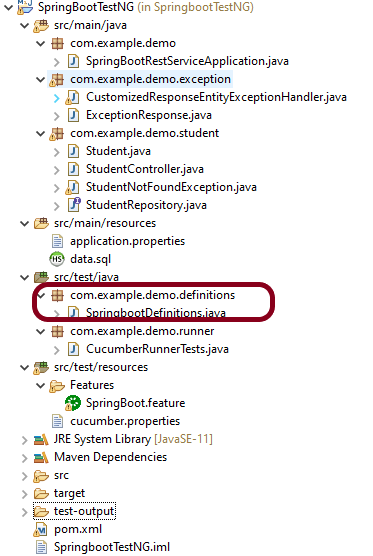
The corresponding step definition file of the above feature file is shown below.

import static io.restassured.RestAssured.given;
import static org.hamcrest.Matchers.containsString;
import static org.hamcrest.Matchers.equalTo;
import static org.hamcrest.Matchers.hasItem;
import org.json.JSONObject;
import org.springframework.boot.test.context.SpringBootTest;
import org.springframework.boot.web.server.LocalServerPort;
import io.cucumber.java.en.Given;
import io.cucumber.java.en.Then;
import io.cucumber.spring.CucumberContextConfiguration;
import io.restassured.RestAssured;
import io.restassured.http.ContentType;
import io.restassured.response.ValidatableResponse;
import io.restassured.specification.RequestSpecification;

@CucumberContextConfiguration
@SpringBootTest(webEnvironment = SpringBootTest.WebEnvironment.RANDOM_PORT)
public class SpringbootDefinitions {

	private final static String BASE_URI = "http://localhost";

	@LocalServerPort
	private int port;

	private ValidatableResponse validatableResponse, validatableResponse1;

	private void configureRestAssured() {
		RestAssured.baseURI = BASE_URI;
		RestAssured.port = port;
	}

	protected RequestSpecification requestSpecification() {
		configureRestAssured();
		return given();
	}

	@Given("I send a request to the URL {string} to get user details")
	public void getStudentDetails(String endpoint) throws Throwable {
		validatableResponse = requestSpecification().contentType(ContentType.JSON).when().get(endpoint).then();
		System.out.println("RESPONSE :" + validatableResponse.extract().asString());
	}

	@Given("I send a request to the URL {string} to create a user with name {string} and passportNo {string}")
	public void createStudent(String endpoint, String studentName, String studentPassportNumber) throws Throwable {

		JSONObject student = new JSONObject();
		student.put("name", studentName);
		student.put("passportNumber", studentPassportNumber);

		validatableResponse = requestSpecification().contentType(ContentType.JSON).body(student.toString()).when()
				.post(endpoint).then();
		System.out.println("RESPONSE :" + validatableResponse.extract().asString());
	}

	@Then("The response will return status {int}")
	public void verifyStatusCodeResponse(int status) {
		validatableResponse.assertThat().statusCode(equalTo(status));

	}

	@Then("The response contains id {int} and names {string} and passport_no {string}")
	public void verifyResponse(int id, String studentName, String passportNo) {
		validatableResponse.assertThat().body("id", hasItem(id)).body(containsString(studentName))
				.body(containsString(passportNo));

	}

	@Then("Resend the request to the URL {string} and the response returned contains name {string} and passport_no {string}")
	public void verifyNewStudent(String endpoint, String studentName, String passportNo) {

		validatableResponse1 = requestSpecification().contentType(ContentType.JSON).when().get(endpoint).then();
		System.out.println("RESPONSE :" + validatableResponse1.extract().asString());
		validatableResponse1.assertThat().body(containsString(studentName)).body(containsString(passportNo));

	}
}

To make Cucumber aware of your test configuration you can annotate a configuration class on your glue path with @CucumberContextConfiguration and with one of the following annotations: @ContextConfiguration, @ContextHierarchy, or @BootstrapWith.It is imported from:

import io.cucumber.spring.CucumberContextConfiguration;

As we are using SpringBoot, we are annotating the configuration class with @SpringBootTest. It is imported from:

import org.springframework.boot.test.context.SpringBootTest;

By default, @SpringBootTest does not start the webEnvironment to refine further how your tests run. It has several options: MOCK(default), RANDOM_PORT, DEFINED_PORT, NONE.

RANDOM_PORT loads a WebServerApplicationContext and provides a real web environment. The embedded server is started and listens on a random port. LocalServerPort is imported from the package:

import org.springframework.boot.web.server.LocalServerPort;

Step 4 – Create a Cucumber TestNG Runner class under src/test/java

A runner will help us to run the feature file and acts as an interlink between the feature file and StepDefinition Class. The TestRunner should be created within the directory src/test/java.

import io.cucumber.testng.AbstractTestNGCucumberTests;
import io.cucumber.testng.CucumberOptions;

@CucumberOptions(features = {"src/test/resources/Features"}, glue = {"com.example.demo.definitions"})
public class CucumberRunnerTests extends AbstractTestNGCucumberTests {

}

The @CucumberOptions annotation is responsible for pointing to the right feature package, configuring the plugin for a better reporting of tests in the console output, and specifying the package where extra glue classes may be found. We use it to load configuration and classes that are shared between tests.

Step 5 – Run the tests from Cucumber Test Runner

You can execute the test script by right-clicking on TestRunner class -> Run As TestNG in Eclipse.

In case you are using IntelliJ, select Run CucumberRunnerTests.

SpringBootTest creates an application context containing all the objects we need for the Integration Testing It, starts the embedded server, creates a web environment, and then enables methods to do Integration testing.

Step 6 – Run the tests from Command Line

Use the below command to run the tests through the command line.

mvn clean test

Step 7 – Run the tests from TestNG

Create a testng.xml in the project as shown below:

<?xml version="1.0" encoding="UTF-8"?>
<!DOCTYPE suite SYSTEM "https://testng.org/testng-1.0.dtd">
<suite name = "Suite1">
  <test name = "SpringBoot Cucumber TestNG Demo">
    <classes>
          <class name = "com.example.demo.runner.CucumberRunnerTests"/>
     </classes>  
   </test>
</suite>

Step 8 – Generation of TestNG Reports

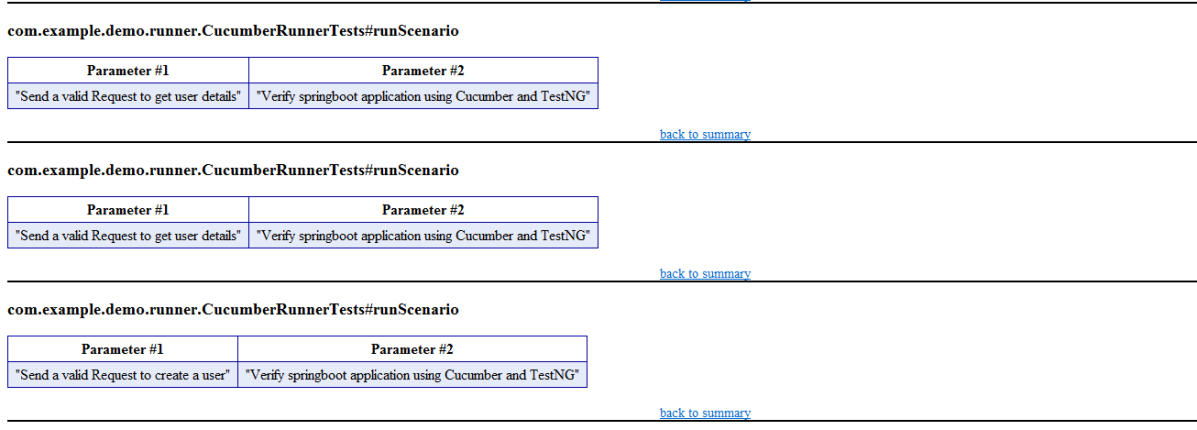
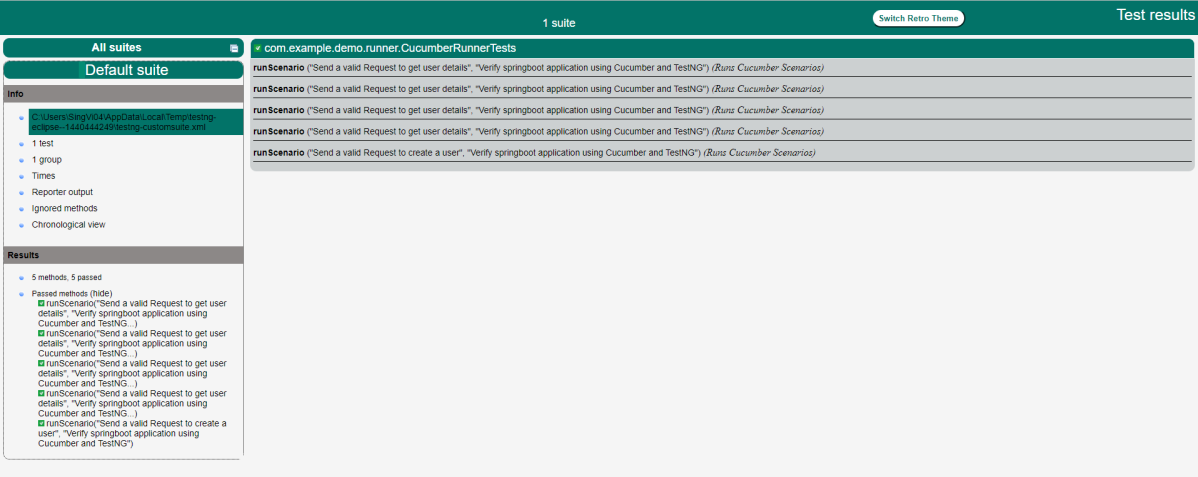
TestNG generates various types of reports under the test-output folder like emailable-report.html, index.html, testng-results.xml.

We are interested in the “emailable-report.html” report. Open “emailable-report.html”, as this is an HTML report, and open it with the browser. The below image shows emailable-report.html.

TestNG also produce “index.html” report, and it resides under test-output folder. The below image shows index.html report.
Step 9 – Cucumber Report Generation

Add cucumber.properties under src/test/resources and add the below instruction in the file.

cucumber.publish.enabled=true

The link to the Cucumber Report is present in the execution status.

Below is the image of the Cucumber Report generated using the Cucumber Service.

Complete Source Code:
Refer to GitHub for the source code.

Congratulations!! We are able to build a test framework to test the SpringBoot application using Cucumber, Rest Assured, and TestNG.

XML Unmarshalling – Convert XML to Java objects using JAXB Version 3

HOME

The previous tutorial explain the Marshalling of Java Object to XML using JAXB Version 3.

There are tutorials about marshalling and unmarshalling XML using JAXB Version 2.

Marshalling – How to convert Java Objects to XML using JAXB

UnMarshalling- How to convert XML to Java Objects using JAXB

As of Java 11, JAXB is not part of the JRE anymore, and you need to configure the relevant libraries via your dependency management system, for example, either Maven or Gradle.

Configure the Java compiler level to be at least 11 and add the JAXB Version 3 dependencies to your pom file.

<!-- JAXB API v3.0.1 -->
<dependency>
    <groupId>jakarta.xml.bind</groupId>
    <artifactId>jakarta.xml.bind-api</artifactId>
    <version>3.0.1</version>
</dependency>

<!-- JAXB v3.0.2 reference implementation (curiously with com.sun coordinates) -->
<dependency>
    <groupId>com.sun.xml.bind</groupId>
    <artifactId>jaxb-impl</artifactId>
    <version>3.0.2</version>
    <scope>runtime</scope>
</dependency>

To know about the difference between JAXB Version 2 and JAXB Version3, refer this tutorial.

Sample XML Structure

<?xml version="1.0" encoding="UTF-8" standalone="yes"?>
<EmployeeDetail>
    <firstName>Terry</firstName>
    <lastName>Mathew</lastName>
    <age>30</age>
    <salary>75000.0</salary>
    <designation>Manager</designation>
    <contactNumber>+919999988822</contactNumber>
    <emailId>abc@test.com</emailId>
    <gender>female</gender>
    <maritalStatus>married</maritalStatus>
</EmployeeDetail>

Now, let us create the Java Objects (POJO) of above XML.

import jakarta.xml.bind.annotation.XmlAccessType;
import jakarta.xml.bind.annotation.XmlAccessorType;
import jakarta.xml.bind.annotation.XmlRootElement;

@XmlRootElement(name = "EmployeeDetail")
@XmlAccessorType(XmlAccessType.FIELD)
public class Employee {

	private String firstName;
	private String lastName;
	private int age;
	private double salary;
	private String designation;
	private String contactNumber;
	private String emailId;
	private String gender;
	private String maritalStatus;

	public Employee() {
		super();

	}

	// Getter and setter methods
	public String getFirstName() {
		return firstName;
	}

	public void setFirstName(String firstName) {
		this.firstName = firstName;
	}

	public String getLastName() {
		return lastName;
	}

	public void setLastName(String lastName) {
		this.lastName = lastName;
	}

	public int getAge() {
		return age;
	}

	public void setAge(int age) {
		this.age = age;
	}

	public double getSalary() {
		return salary;
	}

	public void setSalary(double salary) {
		this.salary = salary;
	}

	public String getDesignation() {
		return designation;
	}

	public void setDesignation(String designation) {
		this.designation = designation;
	}

	public String getContactNumber() {
		return contactNumber;
	}

	public void setContactNumber(String contactNumber) {
		this.contactNumber = contactNumber;
	}

	public String getEmailId() {
		return emailId;
	}

	public void setEmailId(String emailId) {
		this.emailId = emailId;
	}

	public String getGender() {
		return gender;
	}

	public void setGender(String gender) {
		this.gender = gender;
	}

	public String getMaritalStatus() {
		return maritalStatus;
	}

	public void setMaritalStatus(String maritalStatus) {
		this.maritalStatus = maritalStatus;
	}

    @Override
	public String toString() {
		return "Employee [FirstName=" + firstName + ", LastName=" + lastName + ", Age=" + age + ", Salary=" + salary
				+ ", Designation=" + designation + ", ContactNumber=" + contactNumber + ", EmailId=" + emailId
				+ ", Gender=" + gender + ", MaritalStatus=" + maritalStatus + "]";
	}
}

Let’s create a simple program using the JAXBContext which provides an abstraction for managing the XML/Java binding information necessary to implement the JAXB binding framework operations and unmarshal.

import java.io.File;

import org.junit.Test;

import jakarta.xml.bind.JAXBContext;
import jakarta.xml.bind.JAXBException;
import jakarta.xml.bind.Unmarshaller;

public class JAXBDeserialization {

	@Test
	public void JAXBUnmarshalTest() {

		try {

			String userDir = System.getProperty("user.dir");
			File file = new File(userDir + "\\src\\test\\resources\\JAXB_XML.xml");

			JAXBContext jaxbContext = JAXBContext.newInstance(Employee.class);

			Unmarshaller jaxbUnmarshaller = jaxbContext.createUnmarshaller();
			Employee employee = (Employee) jaxbUnmarshaller.unmarshal(file);
			System.out.println(employee);

		} catch (JAXBException e) {
			e.printStackTrace();
		}

	}

When we run the code above, we may check the console output to verify that we have successfully converted XML data into a Java object:

This response is the result of the toString() method in POJO Class.

There is another way to get the values of each node of XML.

   @Test
	public void JAXBUnmarshalTest1() {

		try {

			String userDir = System.getProperty("user.dir");
			File file = new File(userDir + "\\src\\test\\resources\\JAXB_XML.xml");

			JAXBContext jaxbContext = JAXBContext.newInstance(Employee.class);

			Unmarshaller jaxbUnmarshaller = jaxbContext.createUnmarshaller();
			Employee employee = (Employee) jaxbUnmarshaller.unmarshal(file);

			System.out.println("FirstName: " + employee.getFirstName());
			System.out.println("LastName: " + employee.getLastName());
			System.out.println("Age: " + employee.getAge());
			System.out.println("Salary: " + employee.getSalary());
			System.out.println("Contact Number: " + employee.getContactNumber());
			System.out.println("Designation: " + employee.getDesignation());
			System.out.println("Gender: " + employee.getGender());
			System.out.println("EmailId: " + employee.getEmailId());
			System.out.println("MaritalStatus: " + employee.getMaritalStatus());

		} catch (JAXBException e) {
			e.printStackTrace();
		}

	}

When we run the code above, we may check the console output to verify that we have successfully converted XML data into a Java object:

The Unmarshaller class governs the process of deserializing XML data into newly created Java content trees, optionally validating the XML data as it is unmarshalled. It provides overloading of unmarshal methods for many input kinds.

We are done! Congratulations on making it through this tutorial and hope you found it useful! Happy Learning!!

XML Marshalling – Convert Java objects to XML using JAXB Version 3

HOME

The previous tutorials have explained marshalling and unmarshalling of XML using JAXB Version 2.

As of Java 11, JAXB is not part of the JRE anymore, and you need to configure the relevant libraries via your dependency management system, for example, either Maven or Gradle.

Configure the Java compiler level to be at least 11 and add the JAXB Version 3 dependencies to your pom file.

<!-- JAXB API v3.0.1 -->
<dependency>
    <groupId>jakarta.xml.bind</groupId>
    <artifactId>jakarta.xml.bind-api</artifactId>
    <version>3.0.1</version>
</dependency>

<!-- JAXB v3.0.2 reference implementation (curiously with com.sun coordinates) -->
<dependency>
    <groupId>com.sun.xml.bind</groupId>
    <artifactId>jaxb-impl</artifactId>
    <version>3.0.2</version>
    <scope>runtime</scope>
</dependency>
Difference between javax.xml.* and jakarta.xml.*

Eclipse foundation rebrand the Java EE javax.xml.* to Jakarta EE jakarta.xml.*.

Below are some JAXB APIs in versions 2 and 3.

//@Since 3.0.0, rebrand to Jakarta.xml

import jakarta.xml.bind.annotation.XmlAccessType;
import jakarta.xml.bind.annotation.XmlAccessorType;
import jakarta.xml.bind.annotation.XmlRootElement;
import jakarta.xml.bind.annotation.XmlElement;
import jakarta.xml.bind.annotation.XmlTransient;
import jakarta.xml.bind.annotation.XmlType;

import jakarta.xml.bind.JAXBContext;
import jakarta.xml.bind.JAXBException;
import jakarta.xml.bind.Marshaller;
import jakarta.xml.bind.PropertyException;
import jakarta.xml.bind.Unmarshaller;

//JAXB Version 2.0

import javax.xml.bind.annotation.XmlAccessType;
import javax.xml.bind.annotation.XmlAccessorType;
import javax.xml.bind.annotation.XmlElement;
import javax.xml.bind.annotation.XmlRootElement;
import javax.xml.bind.annotation.XmlTransient;
import javax.xml.bind.annotation.XmlType;

import javax.xml.bind.JAXBContext;
import javax.xml.bind.JAXBException;
import javax.xml.bind.Marshaller;
import javax.xml.bind.PropertyException;
import javax.xml.bind.Unmarshaller;
Sample XML Structure
<?xml version="1.0" encoding="UTF-8" standalone="yes"?>
<EmployeeDetail>
    <firstName>Terry</firstName>
    <lastName>Mathew</lastName>
    <age>30</age>
    <salary>75000.0</salary>
    <designation>Manager</designation>
    <contactNumber>+919999988822</contactNumber>
    <emailId>abc@test.com</emailId>
    <gender>female</gender>
    <maritalStatus>married</maritalStatus>
</EmployeeDetail>

Now, let us create the Java Objects (POJO) of the above XML.

import jakarta.xml.bind.annotation.XmlAccessType;
import jakarta.xml.bind.annotation.XmlAccessorType;
import jakarta.xml.bind.annotation.XmlRootElement;

@XmlRootElement(name = "EmployeeDetail")
@XmlAccessorType(XmlAccessType.FIELD)
public class Employee {

	private String firstName;
	private String lastName;
	private int age;
	private double salary;
	private String designation;
	private String contactNumber;
	private String emailId;
	private String gender;
	private String maritalStatus;

	public Employee() {
		super();

	}

	// Getter and setter methods
	public String getFirstName() {
		return firstName;
	}

	public void setFirstName(String firstName) {
		this.firstName = firstName;
	}

	public String getLastName() {
		return lastName;
	}

	public void setLastName(String lastName) {
		this.lastName = lastName;
	}

	public int getAge() {
		return age;
	}

	public void setAge(int age) {
		this.age = age;
	}

	public double getSalary() {
		return salary;
	}

	public void setSalary(double salary) {
		this.salary = salary;
	}

	public String getDesignation() {
		return designation;
	}

	public void setDesignation(String designation) {
		this.designation = designation;
	}

	public String getContactNumber() {
		return contactNumber;
	}

	public void setContactNumber(String contactNumber) {
		this.contactNumber = contactNumber;
	}

	public String getEmailId() {
		return emailId;
	}

	public void setEmailId(String emailId) {
		this.emailId = emailId;
	}

	public String getGender() {
		return gender;
	}

	public void setGender(String gender) {
		this.gender = gender;
	}

	public String getMaritalStatus() {
		return maritalStatus;
	}

	public void setMaritalStatus(String maritalStatus) {
		this.maritalStatus = maritalStatus;
	}

    @Override
	public String toString() {
		return "Employee [FirstName=" + firstName + ", LastName=" + lastName + ", Age=" + age + ", Salary=" + salary
				+ ", Designation=" + designation + ", ContactNumber=" + contactNumber + ", EmailId=" + emailId
				+ ", Gender=" + gender + ", MaritalStatus=" + maritalStatus + "]";
	}
}

Let’s create a simple program using the JAXBContext which provides an abstraction for managing the XML/Java binding information necessary to implement the JAXB binding framework operations.

import java.io.StringWriter;

import org.junit.Test;

import jakarta.xml.bind.JAXBContext;
import jakarta.xml.bind.JAXBException;
import jakarta.xml.bind.Marshaller;
import jakarta.xml.bind.PropertyException;

public class JAXBSerialization {

	@Test
	public void serializationTest1() {

		try {

			Employee employee = new Employee();

			employee.setFirstName("Terry");
			employee.setLastName("Mathew");
			employee.setAge(30);
			employee.setSalary(75000);
			employee.setDesignation("Manager");
			employee.setContactNumber("+919999988822");
			employee.setEmailId("abc@test.com");
			employee.setMaritalStatus("married");
			employee.setGender("female");

			// Create JAXB Context
			JAXBContext context = JAXBContext.newInstance(Employee.class);

			// Create Marshaller
			Marshaller jaxbMarshaller = context.createMarshaller();

			// Required formatting
			jaxbMarshaller.setProperty(Marshaller.JAXB_FORMATTED_OUTPUT, Boolean.TRUE);

			// Print XML String to Console
			StringWriter sw = new StringWriter();

			// Write XML to StringWriter
			jaxbMarshaller.marshal(employee, sw);

			// Verify XML Content
			String xmlContent = sw.toString();
			System.out.println(xmlContent);

		} catch (PropertyException e) {
			e.printStackTrace();

		} catch (JAXBException e) {

		}
	}

}

When we run the code above, we may check the console output to verify that we have successfully converted the Java object into XML:

The Marshaller class is responsible for governing the process of serializing Java content trees back into XML data.

I hope this has helped you to understand the use of JAXB Version 3.

We are done! Congratulations on making it through this tutorial and hope you found it useful! Happy Learning!!

How to test JSON Request using GSON API

HOME

In this tutorial, I will explain the testing of a JSON Payload using GSON API.

Refer to the below tutorials to understand how GSON works:-

Serialization – How to convert Java Object To JSON Object Using Gson API

Deserialization – How to create JSON Object to JAVA Object Using Gson API

Add below dependency to POM.xml to use Gson API.

<dependency>
    <groupId>com.google.code.gson</groupId>
    <artifactId>gson</artifactId>
    <version>2.8.9</version>
</dependency>

As we know, we can use toJson() to convert the JAVA objects to JSON Payload.

In the below example, I have created a POJO class with the name of EmployeeDetails. This class contains the data members corresponding to the JSON nodes and their corresponding getter and setter methods.

public class EmployeeDetails {

	// private variables or data members of pojo class
	private String name;
	private double salary;
	private int age;

	public String getName() {
		return name;
	}

	public void setName(String name) {
		this.name = name;
	}

	public double getSalary() {
		return salary;
	}

	public void setSalary(double salary) {
		this.salary = salary;
	}

	public int getAge() {
		return age;
	}

	public void setAge(int age) {
		this.age = age;
	}

}

Below, will create a JSON payload and pass it as a request body to the Rest API.

	@Test
	public void createEmployee() throws IOException {

		// Just create an object of Pojo class
		EmployeeDetails emp = new EmployeeDetails();
		emp.setName("GsonTest");
		emp.setSalary(50000);
		emp.setAge(25);

		// Converting a Java class object to a JSON payload as string using Gson
		Gson builder = new GsonBuilder().setPrettyPrinting().create();
		String employeePrettyJsonPayload = builder.toJson(emp);
		System.out.println("Request");
		System.out.println(employeePrettyJsonPayload);
		System.out.println("=========================================");
		System.out.println("Response");

		// GIVEN
		given()
              .baseUri("http://dummy.restapiexample.com/api")
              .contentType(ContentType.JSON).body(emp)

		// WHEN
		.when()
               .post("/v1/create")

		// THEN
		.then()
              .assertThat().statusCode(200)
              .body("status", equalTo("success"))
			  .body("data.name", equalTo("GsonTest"))
              .body("data.salary", equalTo(50000))
			  .body("data.age", equalTo(25))
              .body("message", equalTo("Successfully! Record has been added."))
              .log().body();

	}
}

Output

We are done! Congratulations on making it through this tutorial and hope you found it useful! Happy Learning!!

@XmlElementWrapper Annotation for XML – JAXB

HOME

The previous tutorials explain how to use JAXB(Java Architecture for XML Binding) to parse XML documents to Java objects and vice versa. This is also called Marshalling and Unmarshalling.

This tutorial explains @XmlElementWrapper Annotation.

Configure the Java compiler level to be at least 11 and add the JAXB dependencies to the pom file.

<?xml version="1.0" encoding="UTF-8"?>

<project xmlns="http://maven.apache.org/POM/4.0.0" xmlns:xsi="http://www.w3.org/2001/XMLSchema-instance"
  xsi:schemaLocation="http://maven.apache.org/POM/4.0.0 https://maven.apache.org/xsd/maven-4.0.0.xsd">
  <modelVersion>4.0.0</modelVersion>

  <groupId>org.example</groupId>
  <artifactId>JAXBDemo</artifactId>
  <version>0.0.1-SNAPSHOT</version>

  <name>JAXBDemo</name>
  <url>http://www.example.com</url>

  <properties>  

    <project.build.sourceEncoding>UTF-8</project.build.sourceEncoding>
    <maven.compiler.source>11</maven.compiler.source>
    <maven.compiler.target>11</maven.compiler.target>
  </properties>

  <dependencies>
    <dependency>
      <groupId>junit</groupId>
      <artifactId>junit</artifactId>
      <version>4.13.2</version>
      <scope>test</scope>
  </dependency>
    
 <dependency>
    <groupId>com.sun.xml.bind</groupId>
    <artifactId>jaxb-impl</artifactId>
    <version>2.3.3</version>
   </dependency>
 </dependencies>
   
</project>

@XmlElementWrapper generates a wrapper element around XML representation. This is primarily intended to be used to produce a wrapper XML element around collections.

This annotation can be used with the following annotations –  XmlElementXmlElementsXmlElementRefXmlElementRefsXmlJavaTypeAdapter.

@XmlElementWrapper and @XmlElement (Wrapped collection)

Let us understand this with the help of an example shown below.

@XmlRootElement(name = "CustomerDetails")
@XmlAccessorType(XmlAccessType.FIELD)
public class Customer {

	private int id;

	private String name;
	private int yearOfBirth;
	private String emailId;
	private String streetAddress;

	private String postcode;

	@XmlElementWrapper(name = "emergencyContacts")
	@XmlElement(name = "Contact")
	private List<String> emergencyContacts;

	public Customer() {
		super();
	}

	public Customer(int id, String name, int yearOfBirth, String emailId, String streetAddress, String postcode,
			List<String> emergencyContacts) {
		super();
		this.id = id;
		this.name = name;
		this.yearOfBirth = yearOfBirth;
		this.emailId = emailId;
		this.streetAddress = streetAddress;
		this.postcode = postcode;
		this.emergencyContacts = emergencyContacts;
	}

	public int getId() {
		return id;
	}

	public void setId(int id) {
		this.id = id;
	}

	public String getName() {
		return name;
	}

	public void setName(String name) {
		this.name = name;
	}

	public int getYearOfBirth() {
		return yearOfBirth;
	}

	public void setYearOfBirth(int yearOfBirth) {
		this.yearOfBirth = yearOfBirth;
	}

	public String getEmailId() {
		return emailId;
	}

	public void setEmailId(String emailId) {
		this.emailId = emailId;
	}

	public String getStreetAddress() {
		return streetAddress;
	}

	public void setStreetAddress(String streetAddress) {
		this.streetAddress = streetAddress;
	}

	public String getPostcode() {
		return postcode;
	}

	public void setPostcode(String postcode) {
		this.postcode = postcode;
	}

	public List<String> getEmergencyContacts() {
		return emergencyContacts;
	}

	public void setEmergencyContacts(List<String> emergencyContacts) {
		this.emergencyContacts = emergencyContacts;
	}
}

Now, let us create a Test to convert these Java Objects to XML.

   @Test
	public void Test() {

		try {

			Customer cust = new Customer();
			cust.setId(1111);
			cust.setName("Tim");
			cust.setYearOfBirth(1988);
			cust.setEmailId("Test@test.com");
			cust.setStreetAddress("6, JaySmith, Dublin");
			cust.setPostcode("A12 YP22");

			cust.setEmergencyContacts(Arrays.asList("98675 12312", "88881 23415", "44123 67453"));

			// Create JAXB Context
			JAXBContext context = JAXBContext.newInstance(Customer.class);

			// Create Marshaller
			Marshaller jaxbMarshaller = context.createMarshaller();

			// Required formatting
			jaxbMarshaller.setProperty(Marshaller.JAXB_FORMATTED_OUTPUT, Boolean.TRUE);

			// Write XML to StringWriter
			StringWriter sw = new StringWriter();
			jaxbMarshaller.marshal(cust, sw);

			// Print XML Content
			String xmlContent = sw.toString();
			System.out.println(xmlContent);

		} catch (PropertyException e) {
			e.printStackTrace();

		} catch (JAXBException e) {

		}
	}

The output of the above program is

Here, contact is within emergencyContacts, because contact is @XmlElement.

Use Only @XmlElementWrapper

@XmlRootElement(name = "CustomerDetails")
@XmlAccessorType(XmlAccessType.FIELD)

public class Customer {

	private int id;

	private String name;
	private int yearOfBirth;
	private String emailId;
	private String streetAddress;

	private String postcode;

	@XmlElementWrapper(name = "emergencyContacts")
 //	@XmlElement(name = "Contact") //Commented this
	private List<String> emergencyContacts;

	public Customer() {
		super();
	}

	public Customer(int id, String name, int yearOfBirth, String emailId, String streetAddress, String postcode,
			List<String> emergencyContacts) {
		super();
		this.id = id;
		this.name = name;
		this.yearOfBirth = yearOfBirth;
		this.emailId = emailId;
		this.streetAddress = streetAddress;
		this.postcode = postcode;
		this.emergencyContacts = emergencyContacts;
	}

The output of the above program is

Here, there is no contact within emergencyContacts, it is because there is no @XmlElement for contact.

Do not use @XmlElementWrapper (Unwrapped collection)

@XmlRootElement(name = "CustomerDetails")
@XmlAccessorType(XmlAccessType.FIELD)

public class Customer {

	private int id;

	private String name;
	private int yearOfBirth;
	private String emailId;
	private String streetAddress;

	private String postcode;

 //@XmlElementWrapper(name = "emergencyContacts") Commented this
	@XmlElement(name = "Contact")
	private List<String> emergencyContacts;

	public Customer() {
		super();
	}

	public Customer(int id, String name, int yearOfBirth, String emailId, String streetAddress, String postcode,
			List<String> emergencyContacts) {
		super();
		this.id = id;
		this.name = name;
		this.yearOfBirth = yearOfBirth;
		this.emailId = emailId;
		this.streetAddress = streetAddress;
		this.postcode = postcode;
		this.emergencyContacts = emergencyContacts;
	}

The output of the above program is

Here, there is no @XmlElementWrapper. So, all the contact appear as attributes of XML.

I hope this has helped to understand the usage of @XmlElementWrapper.

We are done! Congratulations on making it through this tutorial and hope you found it useful! Happy Learning!!

Deserialization – How to convert JSON to Map using Jackson API

HOME

This tutorial shows how to convert JSON to JAVA map using Jackson’s data binding. In the previous tutorials, I have explained converting Java Objects/Arrays to JSON String using Jackson API. You can refer below tutorials.

Serialization – How to create JSON Payload from Java Object – Jackson API

Deserialization – How to convert JSON to Java Object using Jackson API

How to create JSON Array Payload using POJO – Jackson API

How to create Nested JSON Object using POJO – Jackson API

To start with, we need to add Jackson Maven Dependency to the POM. Always add the latest version of Jackson dependency to your project.

<dependency>
    <groupId>com.fasterxml.jackson.core</groupId>
    <artifactId>jackson-databind</artifactId>
    <version>2.13.0</version>
</dependency

Deserialization converts a stream of bytes into a Java object that we can use in code.

We use Jackson’s ObjectMapper, as we did for serialization, using readValue() to process the input. Also, note our use of Jackson’s TypeReference, which we’ll use in all of our deserialization examples to describe the type of our destination Map.

   @Test
	public void DeserializationMapTest() throws JsonProcessingException {

		String employeeString = 
                     "{\r\n" 
                    + "  \"firstName\" : \"Deserialization\",\r\n"
				    + "  \"lastName\" : \"Test\",\r\n" 
                    + "  \"age\" : 25,\r\n" 
                    + "  \"salary\" : 50000.0,\r\n"
				    + "  \"designation\" : \"Manager\",\r\n" 
                    + "  \"contactNumber\" : \"+918882211111\",\r\n"
				    + "  \"emailId\" : \"abc@test.com\",\r\n" 
                    + "  \"gender\" : \"female\",\r\n"
				    + "  \"maritalStatus\" : \"single\"\r\n" 
                    + " }";

		Map<String, String> resultMap = new HashMap<String, String>();
		ObjectMapper mapper = new ObjectMapper();

		// Converting a JSON to Java Map
		try {
			resultMap = mapper.readValue(employeeString, new TypeReference<HashMap<String, String>>() {
			});
		} catch (JsonMappingException e) {
			e.printStackTrace();
		} catch (JsonProcessingException e) {
			e.printStackTrace();
		}

		System.out.println("Output Map :" + resultMap);
	}

Output

We can get the JSON from a file and convert it to a Hash Map too. Below is an example of the same.

   @Test
	public void PayloadFromFile() {

		String userDir = System.getProperty("user.dir");
		ObjectMapper mapper = new ObjectMapper();

		// Converting Employee JSON string to Employee class object
		Map<String, Object> empMap;
		try {
			empMap = mapper.readValue(new File(userDir + "\\src\\test\\resources\\JSONFromMap.json"),
					new TypeReference<Map<String, Object>>() {
					});

			System.out.println("Gender : " + empMap.get("gender"));
			System.out.println("DOB : " + empMap.get("DOB"));
			System.out.println("Name : " + empMap.get("name"));
			System.out.println("ContactNumber : " + empMap.get("contactNumber"));
			System.out.println("SkillSet : " + empMap.get("skillset"));
		} catch (StreamReadException e) {
			e.printStackTrace();
		} catch (DatabindException e) {
			e.printStackTrace();
		} catch (IOException e) {
			e.printStackTrace();
		}

	}

Output

We are done! Congratulations on making it through this tutorial and hope you found it useful! Happy Learning!!

Deserialization – How to convert JSON to Java Object using Jackson API

HOME

The previous tutorial explains the Serializarion process that means converting Java Objects to JSON Payload. This is done using Jackson API. This tutorial explains the Deserialization, means converting JSON Payload to Java Objects.

Deserialization – It is the reverse of serializing. In this process, we will read the Serialized byte stream from the file and convert it back into the Class instance representation. Here, we are converting a JSON Object to an Employee class object.

We are using Jackson API for Serialization and Deserialization. So, add the Jackson dependency to the project.

<dependency>
    <groupId>com.fasterxml.jackson.core</groupId>
    <artifactId>jackson-databind</artifactId>
    <version>2.13.0</version>
</dependency>

Below is the sample code of the Employee table, which contains the data members needed for Employee JSON and their corresponding getter and setter methods.

public class Employee {
 
    // private variables or data members of POJO class
    private String firstName;
    private String lastName;
    private int age;
    private double salary;
    private String designation;
    private String contactNumber;
    private String emailId;
 
    // Getter and setter methods
    public String getFirstName() {
        return firstName;
    }
 
    public void setFirstName(String firstName) {
        this.firstName = firstName;
    }
 
    public String getLastName() {
        return lastName;
    }
 
    public void setLastName(String lastName) {
        this.lastName = lastName;
    }
 
    public int getAge() {
        return age;
    }
 
    public void setAge(int age) {
        this.age = age;
    }
 
    public double getSalary() {
        return salary;
    }
 
    public void setSalary(double salary) {
        this.salary = salary;
    }
 
    public String getDesignation() {
        return designation;
    }
 
    public void setDesignation(String designation) {
        this.designation = designation;
    }
     
    public String getContactNumber() {
        return contactNumber;
    }
 
    public void setContactNumber(String contactNumber) {
        this.contactNumber = contactNumber;
    }
 
    public String getEmailId() {
        return emailId;
    }
 
    public void setEmailId(String emailId) {
        this.emailId = emailId;
    }
 
}

Now, let us create a Test Class to show Deserialization.

    @Test
    public void deserializationTest() {
 
        Employee employee = new Employee();
        employee.setFirstName("Tim");
        employee.setLastName("Tran");
        employee.setAge(49);
        employee.setSalary(89000);
        employee.setDesignation("Manager");
        employee.setContactNumber("+3538944412341");
        employee.setEmailId("ttran@test.com");
 
        // Converting a Java class object to a JSON payload as string
        ObjectMapper mapper = new ObjectMapper();
        String employeeJson = null;
        try {
            employeeJson = mapper.writeValueAsString(employee);
        } catch (JsonProcessingException e) {
            e.printStackTrace();
        }
 
        // Converting Employee json string to Employee class object

        try {
            Employee employee2 = mapper.readValue(employeeJson, Employee.class);
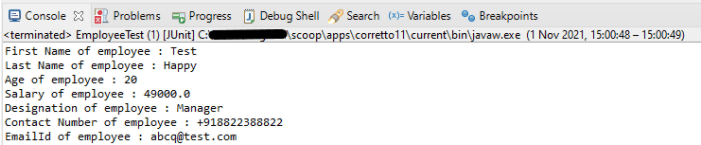
            System.out.println("First Name of employee : " + employee2.getFirstName());
            System.out.println("Last Name of employee : " + employee2.getLastName());
            System.out.println("Age of employee : " + employee2.getAge());
            System.out.println("Salary of employee : " + employee2.getSalary());
            System.out.println("Designation of employee : " + employee2.getDesignation());
            System.out.println("Contact Number of employee : " + employee2.getContactNumber());
            System.out.println("EmailId of employee : " + employee2.getEmailId());
        } catch (JsonMappingException e) {
            e.printStackTrace();
        } catch (JsonProcessingException e) {
            e.printStackTrace();
        }

    }

We can read JSON String and convert it back to Java Object as shown below. We will use readValue() to deserialize JSON content from the given file into a given Java type.

This is my JSON saved in a file placed at Desktop.

Below is the Test

@Test
public void readJson() {
 
    ObjectMapper mapper = new ObjectMapper();
 
    // Converting Employee JSON string to Employee class object
    try {
          Employee employee2 = mapper.readValue(new File(
                "C:\\Users\\Vibha\\Desktop\\Employee.json"),
                Employee.class);
          System.out.println("First Name of employee : " + employee2.getFirstName());
          System.out.println("Last Name of employee : " + employee2.getLastName());
          System.out.println("Age of employee : " + employee2.getAge());
          System.out.println("Salary of employee : " + employee2.getSalary());
          System.out.println("Designation of employee : " + employee2.getDesignation());
          System.out.println("Contact Number of employee : " + employee2.getContactNumber());
          System.out.println("EmailId of employee : " + employee2.getEmailId());
    } catch (StreamReadException e) {
        e.printStackTrace();
    } catch (DatabindException e) {
        e.printStackTrace();
    } catch (IOException e) {
        e.printStackTrace();
    }
}

I hope this has helped to clear your doubts regarding how to create Java Objects from JSON using Jackson API.

We are done! Congratulations on making it through this tutorial and hope you found it useful! Happy Learning!!

Serialization – How to convert Map to JSON string using Jackson API

HOME

This tutorial shows how to convert a Java map to JSON string using Jackson’s data binding. In the previous tutorials, I explained converting Java Objects/Arrays to JSON String using Jackson API. You can refer to the below tutorials.

Serialization – How to create JSON Payload from Java Object – Jackson API

How to create JSON Array Payload using POJO – Jackson API

How to create Nested JSON Object using POJO – Jackson API

To start off, add the latest Jackson dataformat Maven dependency to the project.

<dependency>
    <groupId>com.fasterxml.jackson.dataformat</groupId>
    <artifactId>jackson-dataformat-xml</artifactId>
    <version>2.13.0</version>
</dependency>

Sample JSON

{
  "skillset" : [ 
                 "Java",
                 "Teradata",
                 "Python", 
                 "Power BI" 
               ],
  "gender" : "female",
  "DOB" : "12-02-1985",
  "name" : "Vibha Singh",
  "contactNumber" : "+919999988822",
  "employeeId" : "10342256",
  "location" : "Dublin",
  "emailId" : "abc@test.com",
  "salary" : "75000.0"
}

First, we will populate a Map, then convert them into JSON and later write that JSON to a file.

	@Test
	public void SerializationMapTest() {

		ObjectMapper mapper = new ObjectMapper();
		Map<String, Object> inputMap = new HashMap<String, Object>();

		inputMap.put("employeeId", "10342256");
		inputMap.put("name", "Vibha Singh");
		inputMap.put("DOB", "12-02-1985");
		inputMap.put("salary", "75000.0");
		inputMap.put("location", "Dublin");
		inputMap.put("contactNumber", "+919999988822");
		inputMap.put("emailId", "abc@test.com");
		inputMap.put("gender", "female");

		List<String> skillset = new ArrayList<String>();

		skillset.add("Java");
		skillset.add("Teradata");
		skillset.add("Python");
		skillset.add("Power BI");

		inputMap.put("skillset", skillset);

		// Converting map to a JSON payload as string
		try {
			String employeePrettyJson = mapper.writerWithDefaultPrettyPrinter().writeValueAsString(inputMap);
			System.out.println(employeePrettyJson);
		} catch (JsonProcessingException e) {
			e.printStackTrace();
		}

		String userDir = System.getProperty("user.dir");

        //Writing JSON on a file
		try {
			mapper.writerWithDefaultPrettyPrinter()
					.writeValue(new File(userDir + "\\src\\test\\resources\\JSONFromMap.json"), inputMap);
		} catch (IOException e) {
			e.printStackTrace();
		}

	}
}

Output

As mentioned above, the new JSON is saved in a file and placed under src/test/resources.

Below is the file with JSON.

Congratulations, we are done. We have successfully created a JSON using HashMap.

Rest Assured – @JsonIgnoreProperties in Jackson

HOME

This tutorial will show how to ignore certain fields when serializing an object to JSON or deserializing the JSON to object using Jackson 2.x.

This is very useful when the Jackson defaults aren’t enough and we need to control exactly what gets serialized to JSON – and there are several ways to ignore properties. One of the most common way is the use of @JsonIgnore Annotation, but it has some limitations. One of the major limitation is that if it is applied to getter method only, it will ignore setter method too. So, we cannot control if we want a property to be ignored for either Serialization or Deserialization.

Moreover, when there is a requirement to ignore multiple properties, it is tedious to mention @JsonIgnore to all the properties which need to be ignored. Imagine there are 100 properties and we need to ignore 30 properties, it is tedious to mention @JsonIgnore to each properties.

To start of, add Jackson databind dependency to the project. Always add the latest dependency to your project.

<dependency>
    <groupId>com.fasterxml.jackson.core</groupId>
    <artifactId>jackson-databind</artifactId>
    <version>2.13.0</version>
</dependency>

We can ignore specific fields at the class level, using the @JsonIgnoreProperties annotation and specifying the fields by name.

Syntax

@JsonIgnoreProperties({"emailId","gender","maritalStatus"})

Sample JSON Payload

{
  "firstName" : "Vibha",
  "lastName" : "Singh",
  "age" : 30,
  "salary" : 75000.0,
  "designation" : "Manager",
  "contactNumber" : "+919999988822",
  "emailId" : "abc@test.com",
  "gender" : "female",
  "maritalStatus" : "married"
 }

We need to create POJO for above JSON. So, let us create a class called Employee. Then create the private data members corresponding to the the nodes of the JSON and the getter and setter methods of these data members.

POJO Class

@JsonIgnoreProperties({"emailId","gender","maritalStatus"})
public class Employee {

	// private variables or data members of pojo class
	private String firstName;
	private String lastName;
	private int age;
	private double salary;
	private String designation;
	private String contactNumber;
	private String emailId;
	private String gender;
	private String maritalStatus;

	// Getter and setter methods
	public String getFirstName() {
		return firstName;
	}

	public void setFirstName(String firstName) {
		this.firstName = firstName;
	}

	public String getLastName() {
		return lastName;
	}

	public void setLastName(String lastName) {
		this.lastName = lastName;
	}

	public int getAge() {
		return age;
	}

	public void setAge(int age) {
		this.age = age;
	}

	public double getSalary() {
		return salary;
	}

	public void setSalary(double salary) {
		this.salary = salary;
	}

	public String getDesignation() {
		return designation;
	}

	public void setDesignation(String designation) {
		this.designation = designation;
	}

	public String getContactNumber() {
		return contactNumber;
	}

	public void setContactNumber(String contactNumber) {
		this.contactNumber = contactNumber;
	}

	public String getEmailId() {
		return emailId;
	}

	public void setEmailId(String emailId) {
		this.emailId = emailId;
	}

	public String getGender() {
		return gender;
	}

	public void setGender(String gender) {
		this.gender = gender;
	}

	public String getMaritalStatus() {
		return maritalStatus;
	}

	public void setMaritalStatus(String maritalStatus) {
		this.maritalStatus = maritalStatus;
	}

}

Here, we have added emailId, gender and maritalStatus to @JsonIgnoreProperties as shown above.

Let us create a test where we pass values to all the nodes present in the JSON and see what happens to properties – emailId, gender and maritalStatus which are tagged as @JsonIgnoreProperties.

SerializationTest

    @Test
	public void serializationTest()  {

		// Create an object of POJO class
		Employee employee = new Employee();
		employee.setFirstName("Vibha");
		employee.setLastName("Singh");
		employee.setAge(30);
		employee.setSalary(75000);
		employee.setDesignation("Manager");
		employee.setContactNumber("+919999988822");
		employee.setEmailId("abc@test.com");
		employee.setMaritalStatus("married");
		employee.setGender("female");

		// Converting a Java class object to a JSON payload as string
		ObjectMapper mapper = new ObjectMapper();
		try {
			String employeeJson = mapper.writeValueAsString(employee);
			System.out.println(employeeJson);
			String employeePrettyJson = mapper.writerWithDefaultPrettyPrinter().writeValueAsString(employee);
			System.out.println(employeePrettyJson);
		} catch (JsonProcessingException e) {
			e.printStackTrace();
		}
}

Output

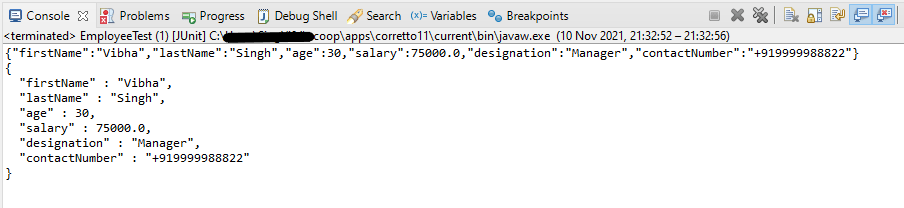
You can see that emailId, gender and maritalStatus are not present in JSON Payload.

Let us see the impact of @JsonIgnoreProperties to the setter or deserialized properties.

Deserialization Test

    @Test
	public void deserializationTest()  {

		String employeeString = "{\r\n"
				+ "  \"firstName\" : \"Deserialization\",\r\n"
				+ "  \"lastName\" : \"Test\",\r\n"
				+ "  \"age\" : 30,\r\n"
				+ "  \"salary\" : 75000.0,\r\n"
				+ "  \"designation\" : \"Manager\",\r\n"
				+ "  \"contactNumber\" : \"+919999988822\",\r\n"
				+ "  \"emailId\" : \"abc@test.com\",\r\n"
				+ "  \"gender\" : \"female\",\r\n"
				+ "  \"maritalStatus\" : \"married\"\r\n"
				+ " }";
		
	
		// Converting a JSON Payload to a JAVA Object
		ObjectMapper mapper = new ObjectMapper();
        Employee employee2 = null;

		try {
			employee2 = mapper.readValue(employeeString, Employee.class);
		} catch (JsonMappingException e) {
			e.printStackTrace();
		} catch (JsonProcessingException e) {
			e.printStackTrace();
		}

		System.out.println("First Name of employee : " + employee2.getFirstName());
		System.out.println("Last Name of employee : " + employee2.getLastName());
		System.out.println("Age of employee : " + employee2.getAge());
		System.out.println("Salary of employee : " + employee2.getSalary());
		System.out.println("Designation of employee : " + employee2.getDesignation());
		System.out.println("Contact Number of employee : " + employee2.getContactNumber());
		System.out.println("EmailId of employee : " + employee2.getEmailId());
		System.out.println("Marital Status of employee : " + employee2.getMaritalStatus());
		System.out.println("Gender of employee : " + employee2.getGender());

	}

Output

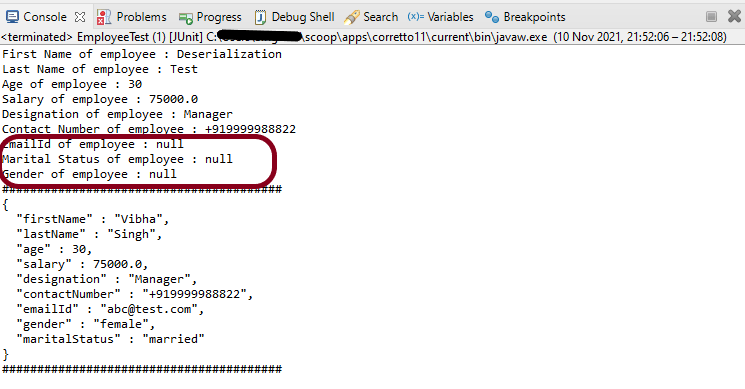
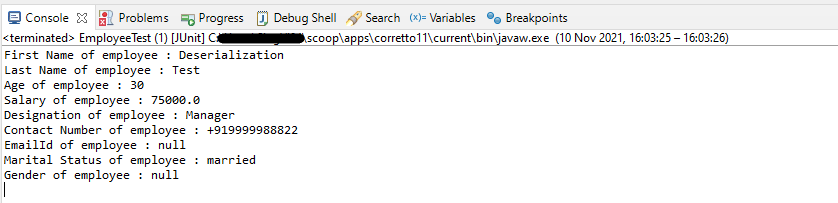
You can see that emailId, gender and maritalStatus – the values present in JSON for all of them are ignored and default values are retrieved.

POJO with allowGetters

allowGetters are enabled to allow “getters” to be used. This is commonly set to support defining “read-only” properties; ones for which there is a getter, but no matching setter: in this case, properties should be ignored for deserialization but NOT serialization. Another way to think about this setting is that setting it to `true` will “disable” ignoring of getters.

Default value is `false`, which means that getters with matching names will be ignored.

In the below example, I have defined emailId, gender and maritalStatus as allowGetters as True.

public class EmployeeTest {
	
	@Test
	public void serializationTest()  {

		Employee employee = new Employee();
		employee.setFirstName("Vibha");
		employee.setLastName("Singh");
		employee.setAge(30);
		employee.setSalary(75000);
		employee.setDesignation("Manager");
		employee.setContactNumber("+919999988822");
		employee.setEmailId("abc@test.com");
		employee.setMaritalStatus("married");
		employee.setGender("female");

		// Converting a Java class object to a JSON payload as string
		ObjectMapper mapper = new ObjectMapper();
      
        try {		
			String employeePrettyJson = mapper.writerWithDefaultPrettyPrinter().writeValueAsString(employee);
			System.out.println(employeePrettyJson);
		} catch (JsonProcessingException e) {
			e.printStackTrace();
		}
		
	}

	@Test
	public void deserializationTest() {

		String employeeString = "{\r\n"
				+ "  \"firstName\" : \"Deserialization\",\r\n"
				+ "  \"lastName\" : \"Test\",\r\n"
				+ "  \"age\" : 30,\r\n"
				+ "  \"salary\" : 75000.0,\r\n"
				+ "  \"designation\" : \"Manager\",\r\n"
				+ "  \"contactNumber\" : \"+919999988822\",\r\n"
				+ "  \"emailId\" : \"abc@test.com\",\r\n"
				+ "  \"gender\" : \"female\",\r\n"
				+ "  \"maritalStatus\" : \"married\"\r\n"
				+ " }";
		
	
		// Converting a JSON Payload to a JAVA Object
		ObjectMapper mapper = new ObjectMapper();

		 Employee employee2 = null;

		try {
			employee2 = mapper.readValue(employeeString, Employee.class);
		} catch (JsonMappingException e) {
			e.printStackTrace();
		} catch (JsonProcessingException e) {
			e.printStackTrace();
		}

		System.out.println("First Name of employee : " + employee2.getFirstName());
		System.out.println("Last Name of employee : " + employee2.getLastName());
		System.out.println("Age of employee : " + employee2.getAge());
		System.out.println("Salary of employee : " + employee2.getSalary());
		System.out.println("Designation of employee : " + employee2.getDesignation());
		System.out.println("Contact Number of employee : " + employee2.getContactNumber());
		System.out.println("EmailId of employee : " + employee2.getEmailId());
		System.out.println("Marital Status of employee : " + employee2.getMaritalStatus());
		System.out.println("Gender of employee : " + employee2.getGender());

	}

}

Output

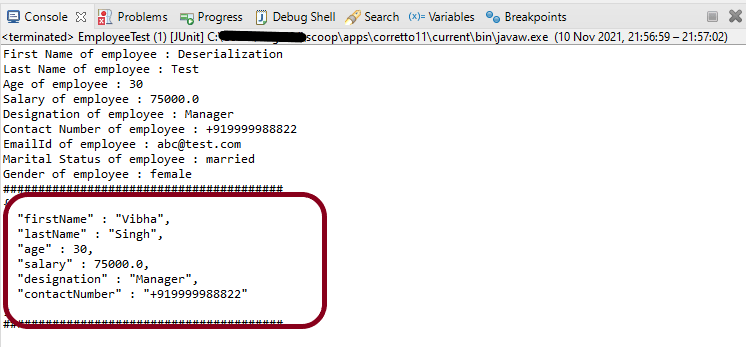
In the below image, it shows that values of emailId, gender and maritalStatus are ignored and default value is passed.

POJO with allowSetters

allowSetters – Property that can be enabled to allow “setters” to be used. This could be used to specify “write-only” properties; ones that should not be serialized out, but that may be provided in for deserialization. Another way to think about this setting is that setting it to `true` will “disable” ignoring of setters.

Default value is `false`, which means that setters with matching names will be ignored.

public class EmployeeTest {
	
	@Test
	public void serializationTest() {

		Employee employee = new Employee();
		employee.setFirstName("Vibha");
		employee.setLastName("Singh");
		employee.setAge(30);
		employee.setSalary(75000);
		employee.setDesignation("Manager");
		employee.setContactNumber("+919999988822");
		employee.setEmailId("abc@test.com");
		employee.setMaritalStatus("married");
		employee.setGender("female");

		// Converting a Java class object to a JSON payload as string
		ObjectMapper mapper = new ObjectMapper();
		try {		
			String employeePrettyJson = mapper.writerWithDefaultPrettyPrinter().writeValueAsString(employee);
			System.out.println(employeePrettyJson);
		} catch (JsonProcessingException e) {
			e.printStackTrace();
		}
		System.out.println("########################################");
	}

	@Test
	public void deserializationTest()  {

		String employeeString = "{\r\n"
				+ "  \"firstName\" : \"Deserialization\",\r\n"
				+ "  \"lastName\" : \"Test\",\r\n"
				+ "  \"age\" : 30,\r\n"
				+ "  \"salary\" : 75000.0,\r\n"
				+ "  \"designation\" : \"Manager\",\r\n"
				+ "  \"contactNumber\" : \"+919999988822\",\r\n"
				+ "  \"emailId\" : \"abc@test.com\",\r\n"
				+ "  \"gender\" : \"female\",\r\n"
				+ "  \"maritalStatus\" : \"married\"\r\n"
				+ " }";
		
	
		// Converting a JSON Payload to a JAVA Object
		ObjectMapper mapper = new ObjectMapper();

		 Employee employee2 = null;

		try {
			employee2 = mapper.readValue(employeeString, Employee.class);
		} catch (JsonMappingException e) {
			e.printStackTrace();
		} catch (JsonProcessingException e) {
			e.printStackTrace();
		}

		System.out.println("First Name of employee : " + employee2.getFirstName());
		System.out.println("Last Name of employee : " + employee2.getLastName());
		System.out.println("Age of employee : " + employee2.getAge());
		System.out.println("Salary of employee : " + employee2.getSalary());
		System.out.println("Designation of employee : " + employee2.getDesignation());
		System.out.println("Contact Number of employee : " + employee2.getContactNumber());
		System.out.println("EmailId of employee : " + employee2.getEmailId());
		System.out.println("Marital Status of employee : " + employee2.getMaritalStatus());
		System.out.println("Gender of employee : " + employee2.getGender());
		
		System.out.println("########################################");

	}

}

Output

We are done! Congratulations on making it through this tutorial and hope you found it useful! Happy Learning!!

Rest Assured – @JsonIgnore Annotation in Jackson API

HOME

This tutorial will show how to ignore certain fields when serializing an object to JSON using Jackson 2.x.

This is very useful when the Jackson defaults aren’t enough, and we need to control exactly what gets serialized to JSON – and there are several ways to ignore properties. One of the most common ways is the use of @JsonIgnore Annotation.

To start off, add Jackson’s databind dependency to the project. Always add the latest dependency to your project.

<dependency>
    <groupId>com.fasterxml.jackson.core</groupId>
    <artifactId>jackson-databind</artifactId>
    <version>2.13.0</version>
</dependency>

@JsonIgnore is used at field level to mark a property or list of properties to be ignored.

The Jackson’s @JsonIgnore annotation can be placed on fields, getters/setters and constructor parameters mark a property to be ignored during the serialization to JSON (or deserialization from JSON).  If @JsonIgnore is the only annotation associated with a property, it will also cause the whole property to be ignored: that is, if setter has this annotation and getter has no annotations, the getter is also effectively ignored.

Let us have an Employee JSON as shown below.

{
  "firstName" : "Vibha",
  "lastName" : "Singh",
  "age" : 30,
  "salary" : 75000.0,
  "designation" : "Manager",
  "contactNumber" : "+919999988822",
  "emailId" : "abc@test.com",
  "gender" : "female",
  "maritalStatus" : "married"
}

To learn about Serialization and Deserialization of a JSON Object using Jackson API, refer to this

To create a POJO of the above JSON, we need to create a class with the name Employee. Create private data members corresponding to these JSON nodes, and then create the corresponding getter and setter methods.

Here, I have assigned emailId and gender as @JsonIgnore.

public class Employee {

	// private variables or data members of pojo class
	private String firstName;
	private String lastName;
	private int age;
	private double salary;
	private String designation;
	private String contactNumber;

	@JsonIgnore
	private String emailId;

	@JsonIgnore
	private String gender;

	private String maritalStatus;

	// Getter and setter methods
	public String getFirstName() {
		return firstName;
	}

	public void setFirstName(String firstName) {
		this.firstName = firstName;
	}

	public String getLastName() {
		return lastName;
	}

	public void setLastName(String lastName) {
		this.lastName = lastName;
	}

	public int getAge() {
		return age;
	}

	public void setAge(int age) {
		this.age = age;
	}

	public double getSalary() {
		return salary;
	}

	public void setSalary(double salary) {
		this.salary = salary;
	}

	public String getDesignation() {
		return designation;
	}

	public void setDesignation(String designation) {
		this.designation = designation;
	}

	public String getContactNumber() {
		return contactNumber;
	}

	public void setContactNumber(String contactNumber) {
		this.contactNumber = contactNumber;
	}

	public String getEmailId() {
		return emailId;
	}

	public void setEmailId(String emailId) {
		this.emailId = emailId;
	}

	public String getGender() {
		return gender;
	}

	public void setGender(String gender) {
		this.gender = gender;
	}

	public String getMaritalStatus() {
		return maritalStatus;
	}

	public void setMaritalStatus(String maritalStatus) {
		this.maritalStatus = maritalStatus;
	}

}

Now, let us create a SerializationTest with the above-mentioned POJO.

	@Test
	public void serializationTest() {

		Employee employee = new Employee();
		employee.setFirstName("Vibha");
		employee.setLastName("Singh");
		employee.setAge(30);
		employee.setSalary(75000);
		employee.setDesignation("Manager");
		employee.setContactNumber("+919999988822");
		employee.setEmailId("abc@test.com");
		employee.setMaritalStatus("married");
		employee.setGender("female");

		// Converting a Java class object to a JSON payload as string
		ObjectMapper mapper = new ObjectMapper();

		try {
			String employeePrettyJson = mapper.writerWithDefaultPrettyPrinter().writeValueAsString(employee);
			System.out.println(employeePrettyJson);
		} catch (JsonProcessingException e) {
			e.printStackTrace();
		}

		System.out.println("########################################");

	}

Output

As you can see here that emailId and gender nodes are not present in this JSON payload.

Now, let us see an example of deserialization where nodes that are assigned as @JsonIgnore return null values.

@Test
	public void deserializationTest() throws JsonMappingException, JsonProcessingException  {

		String employeeString = "{\r\n"
				+ "  \"firstName\" : \"Deserialization\",\r\n"
				+ "  \"lastName\" : \"Test\",\r\n"
				+ "  \"age\" : 30,\r\n"
				+ "  \"salary\" : 75000.0,\r\n"
				+ "  \"designation\" : \"Manager\",\r\n"
				+ "  \"contactNumber\" : \"+919999988822\",\r\n"
				+ "  \"emailId\" : \"abc@test.com\",\r\n"
				+ "  \"gender\" : \"female\",\r\n"
				+ "  \"maritalStatus\" : \"married\"\r\n"
				+ " }";
		
	
		// Converting a Java class object to a JSON payload as string
		ObjectMapper mapper = new ObjectMapper();

		Employee employee2 = mapper.readValue(employeeString, Employee.class);
		System.out.println("First Name of employee : " + employee2.getFirstName());
		System.out.println("Last Name of employee : " + employee2.getLastName());
		System.out.println("Age of employee : " + employee2.getAge());
		System.out.println("Salary of employee : " + employee2.getSalary());
		System.out.println("Designation of employee : " + employee2.getDesignation());
		System.out.println("Contact Number of employee : " + employee2.getContactNumber());
		System.out.println("EmailId of employee : " + employee2.getEmailId());
		System.out.println("Marital Status of employee : " + employee2.getMaritalStatus());
		System.out.println("Gender of employee : " + employee2.getGender());

	}

Output

We have values for fields emailId and gender in JSON, but it has not been deserialized as you can see it has default values, not from JSON.

I hope this has helped you to understand @JsonIgnore. Cheers!! Have happy learning!!