Security testing involves evaluating a computing system’s security features. This ensures they function properly. It also protects the application’s users and data.
Security Testing is a type of software testing that aims to identify and address vulnerabilities and threats in an application to ensure that its data and resources are protected against potential intrusions, misuses, and breaches. The primary goal of security testing is to ensure that the software is robust and secure from external and internal threats.
What is Security Testing in API?
API security testing is a process of evaluating API endpoints to identify and remediate vulnerabilities such as fuzzy input, parameter tampering, or injection attacks. Historically, this was done through penetration testing or manual scanning of the APIs by an enterprise security team. However, teams are shifting to running API security tests as part of the DevOps pipeline, ensuring that security issues are caught early in the development lifecycle.
Why Do You Need API Security Testing?
1. Protection of Sensitive Data – APIs often handle sensitive data, including personal information, financial data, and proprietary business information. Security testing helps ensure that this data is protected from unauthorized access, breaches, and leaks. Examples: Ensure data in transit is encrypted; prevent exposure of Personally Identifiable Information (PII)
2. Prevent Unauthorized Access: APIs typically serve as the gateway to an application’s backend and other critical infrastructure. Security testing helps to identify and mitigate flaws in authentication and authorization mechanisms, preventing unauthorized access. Examples: Ensuring proper use of API keys, tokens, and OAuth; verifying role-based access control (RBAC).
3. Ensuring Service Availability: Malicious actors can exploit vulnerabilities to launch Denial-of-Service (DoS) attacks, overwhelming your APIs and making them unavailable to legitimate users. Robust API penetration testing tools help uncover these weaknesses, allowing you to implement measures that prevent such attacks and ensure reliable service for your users.
4. Maintaining Compliance: Industrial regulations, such as HIPAA, GDPR, ISO, and SOX, mandate specific security controls during data handling. Failure to comply with such regulations due to API vulnerabilities can lead to hefty fines and legal liabilities. Security testing ensures that APIs comply with these regulatory requirements and avoid legal penalties. Examples: Encrypting sensitive data, maintaining proper access logs, and ensuring data integrity.
5. Prevent Injection Attacks: Injection attacks, such as SQL injection and command injection, can compromise the security of API endpoints and underlying systems. Security testing helps identify and remediate these vulnerabilities by validating input handling and data sanitization processes. Examples: Testing for SQL injection flaws; ensuring proper input validation.
6. Improving Stakeholder Trust: Customers and partners entrust the company with their data when they interact with their APIs. Regular security testing demonstrates your commitment to data protection, strengthening business relationships, and fostering customer confidence in your services.
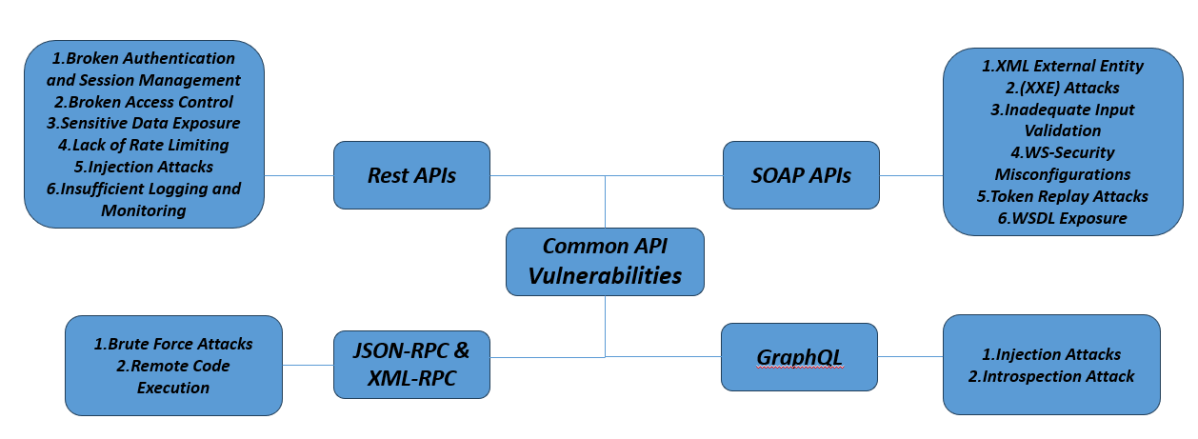
What are the common security vulnerabilities found in API?
Rest APIs
REST APIs or RESTful APIs are stateless APIs that use simple HTTP requests to access and use data. It is one of the most used types of API due to its simplicity and flexibility of implementation in any language.
Common Vulnerabilities in REST APIs
1. Broken Authentication and Session Management: Weak authentication mechanisms can lead to unauthorized access. Use of tokens and proper handling of sessions is crucial.
2. Broken Access Control: Insufficient enforcement of user permissions can lead to unauthorized access to endpoints. Implement role-based access control (RBAC) and least privilege principle.
3. Sensitive Data Exposure: Failure to encrypt sensitive data both in transit and at rest. Use HTTPS, encrypt sensitive data and avoid exposing unnecessary data in API responses.
4. Lack of Rate Limiting: Failure to implement request throttling can result in Denial of Service (DoS) attacks. Implement rate limiting and quotas to control abuse.
5. Injection Attacks: Attackers insert malicious code into the requests to manipulate the APIs’ intended behavior. SQL Injection, Host-Header Injection, and Command Injection are some of the most common attacks.
6. Insufficient Logging and Monitoring: Lack of proper logging mechanisms can lead to undetected security incidents. Enforce comprehensive logging and monitoring for suspicious activities.
SOAP APIs
SOAP, or Simple Object Access Protocol, uses XML-based messaging to transfer data between the client and server.
Common Vulnerabilities in SOAP APIs
1. XML External Entity (XXE) Attacks: An attacker can manipulate XML data to exploit vulnerabilities in the XML parsers. Disable DTDs (Document Type Definitions) and external entity references.
2. Inadequate Input Validation:SOAP messages may not be thoroughly checked for integrity. Validate and sanitize all incoming XML content.
3. WS-Security Misconfigurations:Weak or improperly configured WS-Security policies can lead to security lapses. Ensure robust WS-Security configurations including encryption and digital signatures.
4. Token Replay Attacks:Reuse of tokens for unauthorized API requests. Implement mechanisms to detect and prevent token reuse, such as timestamps and nonces.
5. WSDL Exposure: If the WSDL file is exposed to the attackers, they can view detailed information about the API structure and operations, allowing them to craft more targeted attacks.
JSON-RPC and XML-RPC
JSON-RPC and XML-RPC are remote call protocols that use JSON and XML, respectively, to communicate between the client and the server. They send an HTTP request to a server that implements RPC and receives an HTTP response.
Common Vulnerabilities in JSON and XML RPC:
1. Brute Force Attacks: These attacks involve attempting various combinations of user credentials to gain unauthorized access. XML-RPC can be easily leveraged as an entry point for attacks and can execute multiple login attempts rapidly, leading to brute-force attacks.
2. Remote Code Execution: In this attack, attackers can execute malicious code on the server from a remote connection.
GraphQL
GraphQL is a flexible and efficient query language for APIs. It allows the client side to request the exact amount of data required to reduce data over- and underfetching.
Common Vulnerabilities Found in GraphQL APIs
1. Injection Attacks: Attackers insert malicious code into the requests to manipulate the APIs’ intended behavior. SQL Injection, Host-Header Injection, and Command Injection are some of the most common attacks.
2. Introspection Attack: It exploits an API’s introspection endpoint to gather information about access tokens, exposing sensitive details that attackers can use to compromise security. Introspection endpoints are designed to validate and retrieve metadata about tokens, such as their scopes, expiration, and the user they represent. If improperly secured, attackers can leverage them to gain unauthorized access or manipulate token data.
Types of API Security Testing
Dynamic API Security Tests
Dynamic API Security Testing involves testing the security of APIs during runtime. It dynamically interacts with the API, sends various requests with different payloads, and observes how the API behaves under different conditions to identify security vulnerabilities.
Running a dynamic API security test simulates an actual API-based attack and surfaces vulnerabilities introduced from both open-source dependencies and the code your team wrote.
OWASP ZAP (Zed Attack Proxy) – It is an open-source web application security scanner designed to find vulnerabilities in web applications and APIs.
Burp Suite – It is a comprehensive web vulnerability scanner that supports both automated and manual testing. It is used for the advanced scanning for API vulnerabilities and support for GraphQL, SOAP, and REST APIs.
SQLMap – It is an open-source penetration testing tool for automating SQL injection detection and exploitation. It supports various types of SQL injection attacks.
Static API Security Tests
Static analysis security testing tools look at the source code of the application to identify potential vulnerabilities. This form of testing looks for patterns in the code that represent potential security concerns. These tools are language-dependent, meaning you have to use a static tool that matches the language your API is written in.
SonarQube – It is an open-source platform that inspects code quality and security.
Checkmarx – It is a comprehensive static application security testing tool that focuses on security vulnerabilities.
Fortify Static Code Analyzer (SCA) – It is a static analysis tool by Micro Focus that identifies security vulnerabilities in source code.
Software Composition Analysis
Software Composition Analysis (SCA) tools look at the dependency tree of your application and match this against a database of known vulnerabilities. Using these tools, you would be alerted if your application or API uses a library or framework with a known vulnerability. With the ever-increasing use of open source in API development, these tools are essential to include in security testing. The limitations of SCA tools are that (1) they generally do not surface if the vulnerability is actually exploitable within your API, and (2) they only capture open-source vulnerabilities, not security bugs your team may have introduced.
Black Duck by Synopsys – Comprehensive SCA tool that identifies open-source components, assesses vulnerabilities, and manages license compliance.
Snyk – Developer-friendly tool that integrates with CI/CD pipelines to detect and fix open-source vulnerabilities in dependencies.
WhiteSource – Tool focused on managing open-source components, identifying vulnerabilities, and ensuring license compliance.
 QA Automation Expert